Wednesday, August 28, 2013

Paying Attention to Economic Injustice

Like a good liberal, I woke up this morning listening to NPR.  There was a piece about Clarence B. Jones, one of the organizers of the 1963 March on Washington that is being commemorated this week.  He echoed one of the persistent themes that, while there has been much progress over the past 50 years, there is much to "the Dream" that is as yet unfulfilled.  The reporter states: "From his book 'Behind the Dream', Jones writes as long as there's a need for a legal category for hate crimes, police officers 'pulling over African Americans because they're driving cars considered out of their financial reach,' and people 'selling their houses because too many black families have moved in,' the dream remains diluted, tarnished and unfulfilled."

Now, I would never deny that these are certainly true and important, but I do see these as largely middle and upper-class issues that ignore the deeper economic injustices that are playing out.  As long as we dance around the fact that the overwhelmingly disproportionate numbers of people in prisons, unemployed, in underfunded schools, and with higher rates of poor health indicators are people of color (including Native Americans), and as long as poor people across the board have unequal access to opportunities as well as protections, the dream is unfulfilled.  And as long as people like Jones and entities like NPR neglect these facts, the dream will remain unfulfilled. 

I see the injustice in the wealthy corporate executive who is either a black man or a woman and receiving less than his/her white male counterpart, but it's at the other end of the economic spectrum that we need to be serious about if we are to break the cycle.  It's great to have models of success to break stereotypes, but if we don't address the education and nutrition issues.  It's great to ride my bike by the White House - as I was yesterday - and see all the black leaders getting out to attend a function.  But to also attend a regular breakfast as I did yesterday morning, consisting mostly of poor black people who seem to be left out of the Dream, reminds me of the real work to be done. 

Thursday, August 8, 2013

Pine Ridge, 2013: Reflections of power, privilege, peace and service

“Welcome Home.” 


This was how Dwayne, one of our hosts in Wanblee, greeted me.  This was my fourth trip to Wanblee and it is becoming a spiritual home of sorts.  It is becoming an important annual ritual that takes me out of my routine, and brings old and new acquaintances together in a deep and spiritual way.

This year, we had a great few weeks helping Earth Tipi work towards a model of sustainability on the Rez, and reconnecting with friends as we helped prepare for the Sundance.   We created a space to practice what we preach, and to work through the physical, emotional and interpersonal challenges in a safe, loving and trusting environment.  Through conversation, action, silence and reflection, we practiced grace, putting the ego aside. We went as way opened. 

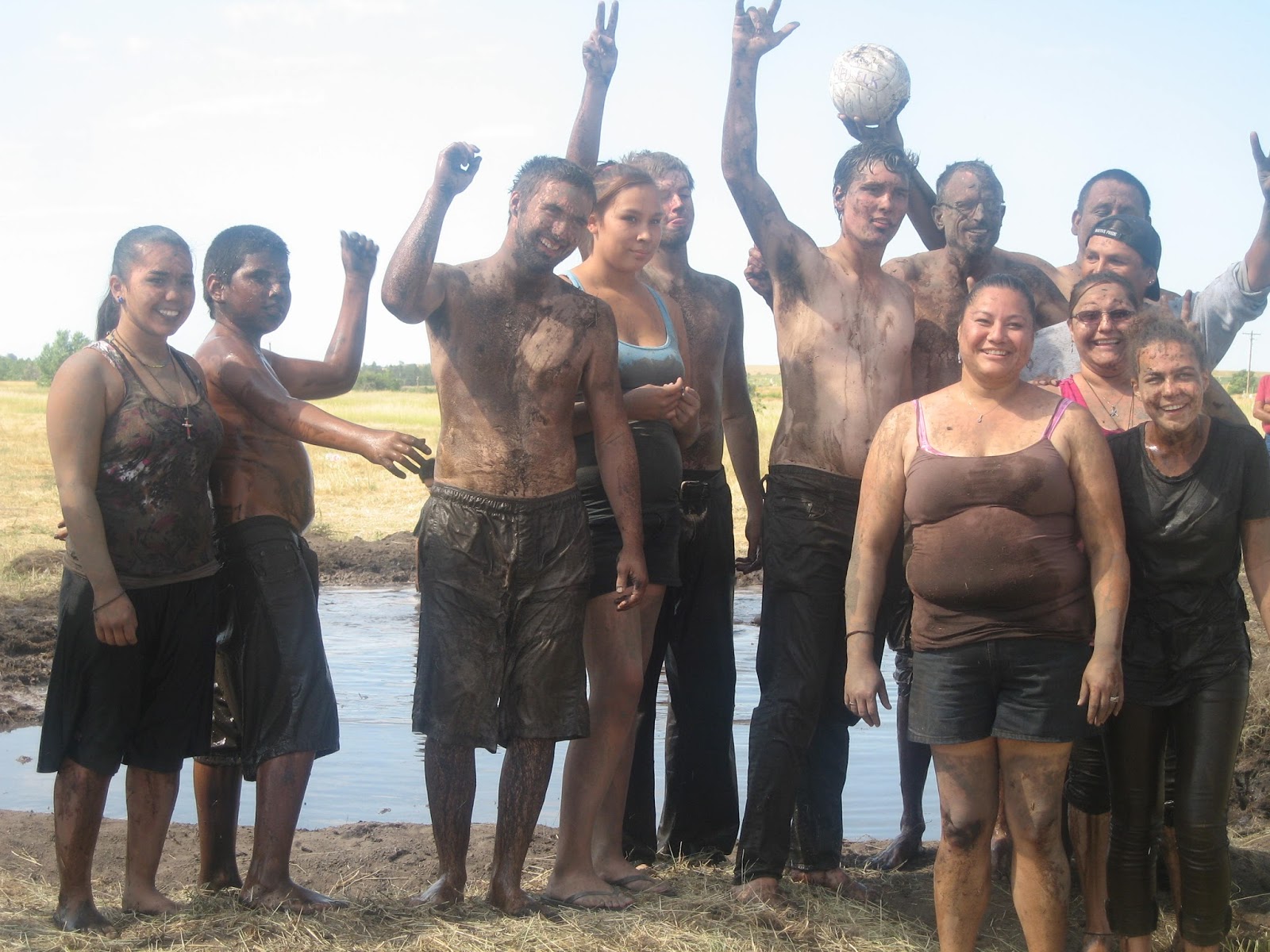
One of the openings was a mud volleyball game at the Eagle’s Nest District Pow Wow.  Our $50 entry fee
made way for a filthy four games of fun and laughs.  We ended up winning the $100 pot, and contributed that to the local youth program.  Something else happened that gave pause for reflection and consideration.  While playing, some of the local youth threw mud at us, at times with rocks mixed in.  One of our players got hit in the eye.  We asked the kids to stop.  They didn’t.  We asked some of the adults to intervene.  They did, but the kids returned and continued sporadically. To the credit of the Workcampers - and perhaps to the credit of the pacifist teachings that come from Quakerism - there was no consideration of reacting with violence or in-kind.

Over the next few days, we had some conversations about this experience.  We struggled to overcome our egos (“Why would they do this to me?  I’m a good person, and I’m here to help”), and as we did, we got to deeper conversations. For example:
·         We often find it understandable and excusable for an oppressed and abused community to exact revenge (a la much of what I hear about Palestinian violence against Israelis as “understandable”).  However, when we represent that power, and find ourselves vulnerable, it feels very different.  The fact is, we have benefited from oppression and exploitation.  Our experience this day was a taste of what many Lakota feel every day – especially when they venture off the Rez.  It was a real eye-opener about power and privilege.
·         In talking with Dwayne about this situation, he affirmed that we acted in the right way.  We did not have the leverage to do more – other than leaving the game, but we were having too much fun.  We could have yelled at the kids, but that would have further agitated the divide.  We were already the outsiders.  But Dwayne also said that if he were there, he would have come down hard on the kids and the adults.  As a member of the community, he could. 

We often talk about Quaker Workcamps as opportunities for experiential learning.  I learned more about power and privilege because of this.  And I am affirmed that change comes from within.  We were the outsiders, but because of how we were in this game, perhaps when we return we will be a bit less so.  

Monday, July 1, 2013

Mrs. Janey Boyd: A model of mercy in our midst

Over the past few years, I have had the opportunity to connect with Janey Boyd.  Janey is in her mid-80's, a long-time DC resident (over 60 years), and has been in food justice work going back to the Kennedy administration.  Our connection has been through the Mid-Atlantic Gleaning Network where she helps get crops from fields to poor families of all ages  We share a belief that when we work together, we can solve the world's problems better than when we myopically choose sides or focus on single issues.  She is the kind of person who breezily says children can't learn in schools if they don't get proper nutrition, which is why we can't let those good foods on the farms go to rot, but instead get them into the stomachs.  This sums up our work together.

Mrs. Boyd with Harford Friends School
Despite knowing her over these two years, it was only this past month that I got to personally meet her.  All previous communications had been by phone.  Last week, with a Workcamp group from Franklin, TN, we went twice to her house to drop off fresh collared greens and kale that we had gleaned from a local farm, and I stood in awe as Mrs. Boyd connected with the kids with her message of love, hope and justice.  Her commitment for speaking truth was on display as she told stories of confronting aldermen and judges on elder-care issues, and at the same time motioning for a car to slow down in her alley ("I'm not waving at you, I'm telling you to slow down", she said Friday afternoon as a car drove by).

This morning, I read this in my daily Bonhoefer:
The Merciful
"Blessed are the merciful, for they will receive mercy."
These persons without possessions, these strangers on earth, these powerless people, these sinners, these followers of Jesus, have in their life with him renounced their own dignity, for they are compassionate.  As if their own needs and their own poverty were not enough, they take upon themselves the needs and humiliation and sin of strangers.  They have an irresistible love for the down-trodden, the sick, the wretched, the degraded, the oppressed, for those who suffer unjustly, for the outcast, for all who are tortured with anxiety.  They go out and seek all who are enmeshed in the toils of sin and guilt.  No distress is too great, no sin too appalling for their compassion...They will be found consorting with publicans and sinners, careless of the shame they incur thereby.  In order that they may be compassionate they cast away the most priceless treasure of human life, their personal dignity and honor.  For the only honor and dignity they know is their Lord's mercy, to which they owe their very lives.
- from A Testament to Freedom 315-316

This sums up Janey Boyd to me.  From her planting of seedling tomatoes to give away, to her connecting people to service and food, to her speaking her truth to the most powerful, she inspires me.  She is a woman of limited financial means, but endless energy and love that she gladly shares with any and all. I am honored to know her and to share her with others.  May she inspire more to be as merciful as she is.   

Tuesday, June 25, 2013

Reflections from West Virginia: Energy, Army and Opportunity

Last week, Washington Quaker Workcamps led the annual Sidwell Friends School Workcamp to Caretta, WV to work with Big Creek People in Action, partnering once again with the great folks from Upshur Helping Hands from Buckhannon, WV.
 It was another great week of fun, fellowship, hard work, community-building, deep conversations, love, and learning - all the things that create opportunities for on-going bridge-building across economics, faiths, and geography as we do what we can to promote global community visions and action that belie notions of socio-poltical-economic "bubbles" that really do not exist.

As with all Workcamps, each person has a different experience, high point, or takeaway.  One of the biggest ones for me this year is this:
One evening, Chester Ball made his annual visit to perform, entertain and engage the group in music, games and dance.  This year, he brought with  
him three teens and one pre-teen.  The teens played guitar and sang with Chester - part of his way of preserving a music tradition from this troubled region while nurturing positive activities for youth.  At one point during the evening, I sat with the teens to thank them for coming and to learn more about them.  When asked about post-high school goals, the female among the teens stated she planned to go to cosmetology school.  The males all stated that they planned to either work "in coal" or join the Marines.  I asked whether they wanted to go to the Academy or enlisted; they all said they wanted to go enlisted so they could get to the front lines fully armed and ready to fight.  Coal or Army.  That was it as far as options.  College is prohibitive because of rising costs as well as the fact that they live in a community that does not nurture the pursuit of higher education.    

As I engaged with fellow program participants in sharing this conversation, it led to even more conversations. The wonderful thing about conversations as opposed to arguments and debates is that conversations seem to lead to new insights.  One such insight I had was the irony that, in the circles I tend to float in, there is a unified sense that coal and the military are bad.  The military often is engaged in fights to protect and acquire
Testing a coal tram
fossil fuels (notably, oil), and what we need to be doing is steering people to careers in sustainable and renewable energy.  The ironic part is that the military is starting to step up in a big way in developing alternative energies, with the goal of having 50% of its energy come from sustainable/renewable sources by 2025.  

It's a dilemma.  We want to be a part of creating opportunities as well as supporting people in following their leadings.  At the same time we know that better stewardship of human and natural resources is vital to a healthy world.  For these young men, their leadings right now are to coal and/or the military.  When it comes to renewable energy, we know that coal is not the way, but the military does open that door.  I don't see easy answers, but if I did, then it would not be a dilemma.  I do find that these Workcamp experiences create opportunities to become more open to creating a safe space and talking about the issues rather than choosing sides and fueling partisanship.  Last week affirmed that.  

Monday, June 10, 2013

Workcamps, 2013: Breaking Barriers, Nurturing Leaders

As we get ready to shift into high gear with the summer Workcamps and programs, I have also been reflecting on ways to integrate new ideas and opportunities so that we do not fall into a rut of relying on a template, but instead keep things new and fresh.

For starters, I am ever-more convinced that the responsibility that comes with planning and running service programs is to not just meet the expectations of participants (i.e. to feel good about making a difference, or understand a social injustice better), but to also challenge these expectations in a way that promotes thinking critically about what kind of world they envision and what else they can do in their lives to move closer to that vision.  It is in this kind of conversation that we talk about the importance of relationships - you don't create your vision of the world that includes others without including them in the conversation and the creation of that world - and about the role that privilege and responsibility have in social justice work.

In addition to these "continuing revelation" conversations, here at William Penn House we have an added dimension of progress this summer: we are focusing a concerted effort on nurturing the leaders of the next generation in leading these conversations.  Our summer intern, Nate Anderson-Stahl, joined us last summer for 2 weeks on Pine Ridge.  Prior to that, he had attended Baltimore Yearly Meeting summer camps and the teen adventure program.  Now he will be applying his knowledge and experience of Quakerism, Quaker process and Workcamps to developing and leading them as part of our team. In addition, we have three rising seniors from a DC-prep school who will be joining us for 2 weeks in late July.  The first week will be to experientially learn about Workcamps, the kinds of service we do in DC, the importance of relationships in doing service (I often think that, without a relationship, there usually is not service), how things are connected, and the importance of critically thinking and questioning things.  The second week, these students will then be leading the process for a Workcamp group coming to DC and, hopefully, taking the relations they establish with them to their school, bringing a new dynamic of service and opportunities with them.

It is always an honor to be able to work with the leaders of tomorrow.  My hope is that this summer will be the start of breaking down the compartmentalization we sometimes create around programs and issues, as we weave more connections into the fabric of community.  One vision: to create a flow where youth who have been introduced to Quaker ideals (in schools, Meetings and/or camps) and had an opportunity to practice them in a larger arena (Workcamps), become the farm system for Workcamp organizers, creators and leaders where they get to experience facilitating visioning and implementation built on relationships, and then take these experiences into the rest of their lives with greater consciousness of stewardship, compassion and persistent hope that overcomes the frustrations and disappointments that are sure to be there as well.  This is something I have been envisioning for the past few years; this year is looking like it is starting to take root.  As with all things, patience and perserverance seem to pay off, but now the real work begins.  
-Brad Ogilvie


Monday, April 29, 2013

From "I'm Shy" to "Let's Dance" in 60 Seconds

Last week, we hosted two separate groups for a day of Workcamps.  One group was made up of 12 students from China who had just graduated high school there and were part of a cultural exchange program before heading to college (some in the US, but most back in China).  This group arrived early and headed out to work on the beginnings of a project to turn a neglected bit of land into a healthy community space with a tiered rain garden, community garden and basketball court (this will be a project we will be a part of for the next few years).

The other group, from Harford Friends School in MD, consisted of the entire 8th grade class (all six of them), their Head of School, and one of the parents.  They proceeded to go from William Penn House to assist a remarkable woman, Janey Boyd, who has been addressing the problems of hunger in DC since the 1950's. Their work this day was to help unload food that had been gleaned from a local farm and package it for families to pick up at the school where the truck met the group, illustrating the fact that there is good nutritional and fresh food available if we can just get folks to help get it from farm to table.

When it came time to consider what to do for dinner, I thought of simplifying things by having the groups share dinner.  I was a bit unsure how this would play out.  There were differences in both age and culture, as well as language.  But these groups were sharing the house for the night, and Community is one of the testimonies that guides our work at William Penn House, so let's just have faith in it, I thought.
At first, it looked like the groups were going to share food, but sit separately.  I encouraged the Harford students to split in two groups at the tables we have.

"I'm shy" was the immediate response of one of the students, but they took the suggestion anyway.  Within minutes, what was a quiet room with the exception of some subdued Chinese language conversations became a boisterous room as people talked about everything from video games to dance.  The energy and spirit lifted as folks became aware of how much we are not separated by our nations, culture and language, but by how much we are united by our humanity.  I remember in particular, the "shy" student who is a dancer reveling in how she connected with one of the Chinese students who has a passion for dancing as well, and how she really wished she could see him dance.

I know this is just one meal, and who knows what impact it will have.  I do know that transcending one's fear, stepping out of one's comfort zone, and having a wonderful experience can be the building block for doing more of this.  Perhaps one day, the dancers will share that dance.

Tuesday, April 2, 2013

Moving from "Crisis" to "Sustainability": Reflections from New Orleans 2013 Workcamp

"Mercy that doesn't move intentionally in the direction of development will end up doing more harm than good - to both giver and recipient." - Robert Lupton, Toxic Charity

When Katrina hit New Orleans, there was an immediate disaster - flooded homes, unsanitary and inhuman
living conditions, death.  Once the waters started to recede, it became clear that the depths of the loss of life and property were greatly exacerbated by neglect of our environment and our fellow citizens.  This is the common narrative of our times: storms, earthquakes, tsunamis and disease draw our attention to the deeper injustices as the crisis preys on the more vulnerable among us.  Unfortunately, as we respond to the crisis, we tend to get entrenched in a crisis mode of thinking and acting, rather than doing the hard work of community building/rebuilding with a vision of sustainability.  The crisis response seems heroic and can be very gratifying, but if it is not in direct response to the crisis, it is often doing more harm than good.  So it is with New Orleans.

I just returned from taking Sidwell Friends School students to New Orleans during their annual spring break Workcamp.  The origins of this trip  trace directly to Katrina.  Most of the Workcamp activities in past years focused on rebuilding houses and cleaning up.  While this is important work, and it is important that we provide opportunities for people to engage in service in a way that they feel good, it is also important that distinctions be made between "crisis response" and sustainability, as well as between meaningful service and "feel-good" service.  So this year it was time to not just look more deeply but also engage more deeply at the issues and to challenge ourselves to be realistic about what we can do for one week each year. I wanted to challenge us to look at the fact that real community change has to come from within, so it is up to the people of New Orleans to make those changes just as it is up to the people of DC to change their community.  On the other hand, looking at things from the environmental angle and engaging in service there can help all of us address things where we are interconnected.

Our service projects included urban gardening at a charter school, helping exchange lightbulbs as part of Greenlight New Orleans' energy program, learning about the water threats of the Gulf and the Mississippi (which, through oil drilling, shipping, and snow melts connect to over half the country), and getting dirty helping restore some bayou spaces.  This offered a wide-range of activities that allowed for participants to see that there are many ways to serve.

Most importantly, however, as is so often the case with these week-long Workcamps, it is the fellowship that seems to really bring it all together.  Great questions were raised about what kind of difference we were making, why certain types of service seem more gratifying than others and how to do these services locally and why that matters.  In addition to service/justice-related conversations, there were also great conversations about race, segregation, equality - all the things that we
aspire for but find so elusive to practice in our daily lives.  These are the conversations that matter, and the establishment of deeper relations guarantees that these will be the foundation for even greater community change as we support each other in stepping out.


Of course, these trips have lots of laughs - many of which stem from
content not for public consumption given the lack of context.  But these laughs bring the positive energy to what can otherwise seem daunting work, establishing bonds of fellowship, friendship and care for each other that can carry us to being better stewards of each other and the world around us.