Showing posts with label equality. Show all posts

Sunday, August 21, 2016

The Consequences of Deciding Who Needs Our Service

I recently completed a course called "The Mind-Body-Energy Toolkit". The class was mostly geared towards people working in mental health as clinicians (as I do in addition to my work at William Penn House), but I find that what I learn in these classes also has applications in all of our community work and in Quaker Workcamps. After all, when it comes to addressing the large social justice issues, we have to remember that we are all humans first, and as human we have some basic psychological processes that transcend all the silos we like to create to divide us. Unfortunately, I have often noticed that when it comes to service programs and creating funding, policies and protocols, basic truths about psychology are often neglected. How else to explain why very smart people continue to address issues such as stigma by targeting people for service and engagement. It only reinforces the stigma.

In this class, the instructor, Dr. Robert Schwarz, a specialist in Comprehensive Energy Psychology, effectively demonstrated how moods and thoughts influence energy - our own as well as that of those around us.  In class demonstrations, "energy" was measured by muscle resistance. People had less energy both when they were asked to think thoughts, and when we were asked to think negative thoughts of volunteers, unbeknownst to them. We all know this: the more optimistic or good we feel about things, the more energy we have. But what are the implications of this when it comes to how we engage in well-meaning service work from a model that often relies on assumptions of what people need without knowing them?

It is both an honor and a responsibility we take seriously, and that responsibility includes trying to
bridge the gaps between what social sciences show us and how we engage in social justice work. The challenge is raising awareness about the importance of engaging with people at the personal level rather than at the level of assumptions. Often we hear reflections about how different people are, or how much we feel good about helping those in need. As Lilla Watson is often quoted, "If you have come here to help me, you are wasting your time. But if you have because your liberation is bound up with mine, then let us work together." It is this spirit - the spirit of unification - that we know sustainable change and peacemaking takes place. The "us/them" divide, even in well-meaning service efforts, still serves as division and requires a certain level of judgment about others and their needs that can negatively influence the energy flow of healing and possibility that we are trying to bring about.

So, as much as understanding history, and some of the disciplines of environment, climate change, culture, history and nutrition when we set out to do service, it is perhaps as important to consider the role of psychology, mirroring neurons and energy as a primer of service learning and experiential learning. It's not what we think, but how we connect, that matters. Planting the seeds of awareness about this are important. As Quakers are fond of saying, "There is that of God in All." Mirroring neurons flowing from positive thoughts and open hearts help to create the energy to truly let this be of peacemaking service to the world.

Friday, January 15, 2016

Fear of Tears

"I had to turn away. Otherwise, I was going to start crying."

These were the words of a recent WPQW participant who was in DC with her college for an alternative break week. We were taking time for reflection about what insights, experiences, or wisdom they had noticed from their time with us, so far. The activities included participating in Our Daily Bread (a fellowship community breakfast with people from all walks of life, including many who sleep on the streets and in shelters), garden winterization and soil prep for spring planting, and street outreach with people that are homeless.

Among the insights of other folks was the realization, garnered from their 1:1 time with people, that listening to people, simply engaging in conversation, being with people where they are, matters. In this was also the awareness of the fact that mental illness has high co-morbidity with the homeless population, but to really connect we have to have a relationship. Others had reflections that it all can seem overwhelming as we seek answers (I maintain that it is not answers that keep us moving, but the next good question), and that the real work for social justice has to continue in their daily lives, not just as an alternative vacation.

But it was the role of tears where things got real. One student spoke - somewhat apologetically - through her tears about how a homeless woman told her that she and her fellow-students reminded the woman of her own daughters. It brings it home - there are families, loved ones, and whole life stories that remain invisible. Then, there was the statement by the student about needing to turn away from all the stimulus. She said it was overwhelming. I suspect, and we talked about it, that what was overwhelming was not what was going on around her, but what was welling up inside of her, perhaps a mixture of anger, sadness, guilt, disgust, even love, and her all-too-common belief that we should not be emotional. And it is the fear of tears, the sadness, perhaps intellectualized as a sense of weakness, that we seem the most uncomfortable with, and it often leads us to want to flee.

And yet, we need to be with these emotions, fully present not just with our heads but with our hearts, embracing them, not fighting them, if we are truly to engage in the good work of trying to make the world a better place.  We can talk about statistics of poverty, mental illness, health indicators, etc., but as Emma Goldman said, "The demand for equal rights in every vocation of life is just and fair; but after all, the most vital right is to love and be loved." To be loving means being able to laugh and cry. When we turn away from our tears when they naturally occur, we turn away from our emotions, and we turn away from being present with others. But when we let it flow, we strengthen ourselves, become more present and more whole to carry on the good work.

Tuesday, November 24, 2015

Equality, Race and Grace

I remember a few years ago on a Quaker Workcamp, we were having a conversation about the various colleges that the students on the program were considering attending. One of the young folks mentioned that he would probably go to a prestigious university because his family had a long list of graduates from that school (siblings, parents, grandparents) , even though he might not otherwise have qualified for that university. The conversation turned to the paradox of wanting to work for equality but, at the same time, being a product of and beneficiary of privilege. "Do you think I should not go to that school if I get accepted?", asked the young man. After a moment of reflection, I said that, no, you should not turn down that acceptance but to, instead, commit to trying to balance the equation when in a position of taking action. For example, I mentioned that, when buying a car, perhaps buying a slightly lower costing car, and put that extra money towards a scholarship to support someone else or, if in a position of hiring someone, rather than hiring the candidate with the best education or best suit, consider the one who journeyed the longest to get to the interview.

So as I was recently attending a church service at National Community Church, I listened to Dr. David Anderson giving a powerful sermon about "Gracism" (as the spirit-led counterbalance to "Racism" that he defines as "to think, feel, or act negatively of others because of color, class or culture"). One of his seven points to practicing gracism is "I will consider you." His example was to recognize that a car dealer may offer a better deal to a man than a woman, and we act with grace by doing what we can to correct this by sharing with you my benefits. I think it is essentially what I was trying to articulate on that Workcamp. I also think it would be a great lesson for so many of the private schools we work with - rather than shame privilege, have the conversation about how we can effectively share that privilege with those who do not have it. As Dr. Anderson has listed it, this is identified as "Having Equal Concern".

It is sermons like this that I find amazingly inspirational and challenging. Even though I hear these kinds of sermons at places like NCC, they are what lead me to Quakerism. To practice Gracism is to see that of God in all and truly live that out. Of course, as a gay man, knowing that the founder of this church has been, to put it mildly, less than affirming about gay marriage (sending out the double-message that being gay is a sin, but we are called to be loving, as if my higher purpose is to be straight, as he did on the Kojo Nnamdi Show last year), and "sexual identity and orientation" is glaringly missing in the definition of racism, I cannot go all in here. I think the silence about sexual orientation can perhaps do much harm by continuing exclude truly all people. But having said that, I know that if places like NCC want to truly practice gracism, I'm in for that, knowing that I can still let my life speak and find true joy in the relationships I have formed there, and in that, find more ways to bring that grace to what we strive to bring in our William Penn Quaker Workcamps. Sometimes, being open with the messiness (or 'living in the tension', as if often expressed) really seems to be where life happens.

Tuesday, November 3, 2015

Mindfulness in the Garden

We recently spent about 90 minutes with ten 9th grade students from Sidwell Friends School at Wangari Gardens, cleaning out garden plots and organizing community spaces in preparation for winter. It's amazing what can get accomplished when you have multiple hands to help out.

Among the tasks was to pick kale that was still growing in abundance from one of our plots. Kale is one of the plants I have learned to appreciate since getting involved in gleaning and gardening here in DC. It's a low-maintenance plant that produces from spring through the hardest of frosts in the winter, and is also good for you.

As we wrapped up our time together, I asked the group, after a moment of silence, to reflect on an image or a memory from our time together that they can take with them, knowing that bringing intentionality to an image carries itself with us for a longer time. One of the kale pickers said that she will remember how relaxing it was to pick the kale. She was one of the students who had never picked kale, but quickly learned that you cannot mindlessly pick it (or, as I've seen noted other places, "mind full" and "mindful" are very different experiences). One has to connect with the plant, noting where the top of each stalk is, and gently taking each leaf and stem below it. It is not something that can be done while multi-tasking. It is being mindfully present with each stalk and each leaf for a brief moment.
Another student said she will take with her the image of the light reflecting around us as the sun was setting. "I don't usually get to see the sun set", she stated. It's not that the sun does not set every day; it's that we are so often busy doing other things to notice what is happening around us.

These are two simple examples and affirmations of how easy it is to experientially teach mindfulness. We had not talked about mindfulness, but these two students got it, and by taking a moment to intentionally connect with it, it starts to infiltrate their being. As good friend Janie Boyd has taught me, spending time in the garden is good for the soul. It's as simple as that.  I will get to work with many of these students once a month over the school year. I look forward to deepening this practice with them as we strive to do good in the world.

Saturday, June 27, 2015

Celebrating Diversity, Wondering about Equality

Earlier in the day, the Supreme Court had announced its decision paving the way for same gender marriage throughout the US. The energy of the happy-hour crowd was euphoric. Smile, hugs, "happy marriage day" messages. A definite day of significant progress. Among the crowd were men who clearly had lived through much of the long-struggle for gay rights mixed in with the young generation that will largely benefit from the struggle. I wondered how much the latter appreciated the work of the former or, as we see with the HIV/AIDS pandemic, how much of this will simply be taken for granted, just as my generation did not fully appreciate the struggles of the depression of my grandparents. Also among the crowd were some lonely figures, some of whom will no-doubt join the countless other people in the world - gay and straight - who can legally marry in wondering if and perhaps hoping for the "right one" to come along.  And, this being DC, no doubt many of the celebrants are among the rich and powerful - the already well-to-do.

As I left the noisy, celebratory scene and walked out onto the street, it was back to reality. Among this reality scene were many people who continue to live on the fringes of society - people who sleep on the streets, ask for donations, perhaps suffer from the neglect of a society that often seems to place greater value on acquisition of wants instead of helping meet each others' needs.  I don't say this with smugness. I, too partake in this to some extent. I think I do better every year, but I still have a long way to go.

This is why, to me, the ruling the day before basically keeping the Affordable Healthcare Act in tact, was more significant.  This was one of the few rulings in the past few years that addressed the biggest inequity that we continue to ignore - economic inequality (as did the Fair Housing ruling earlier in the week that was a reminder of how institutional our racist/classist policies still are). This was the program that Obama promised when he was running for President, and the one that he spent enormous political capital on when he knew he had it, and he has paid the price for since then in three House election cycles.  Now, the Supreme Court has solidified this, helping to ensure income inequality is less a factor in accessing healthcare.  Given other Supreme Court decisions removing voting rights and anti-discrimination protections that are routinely used against the poorest among us, this was huge.

So, while I absolutely celebrate and understand the significance of the marriage ruling, I cringe to think that the celebrations of this are deluding us from getting the real work done for justice. I cringe to think how many gays and lesbians will indulge in spending sprees on costly weddings and unneeded gifts, sending a message that "we have arrived", when the reality is we have a long way to go.

Monday, April 20, 2015

"It's so simple"...

As spring unfolds, at William Penn House we are in the midst of connecting with the community in a new way for us. Over the past few years, starting with gleaning and then community gardens, we have connected with the urban garden movement. As with any good movement, there needs to be a strong grassroots component that is actively engaged, not simply following the call from outsiders, but transforming things from within and the ground up.  Thanks to the leadership of some of our community partners and friends, and seeing the gaps, installing raised garden beds in yards and homes throughout DC is the focus of much of the work we are engaged in this summer, utilizing Quaker Workcamp groups, volunteers and staff.

After a winter and early spring of prep work (building a space for growing seedlings of primarily collard greens and kale, pre-cutting wood for boxes and beds), last week we started going out into the community. Saturday, April 18, as hundreds of thousands trashed the National Mall  while "honoring" Earth Day, a group of 20 people joined us less than 5 miles east to slowly scale-up this fledgling garden program. It was an invaluable experience as we were able to work out some of the kinks while getting the work and word out. As our community partner RonDell Pooler said, the vision is to create a food hub in what is now a food desert; this includes the expanding community gardens under RonDell's purview and now the garden beds going into people's yards.

"It's so simple" reflected one of the participants who joined us from a church in Altoona, PA. While the work to be done is not that simple in terms of economic justice and environmental stewardship, and this work alone won't get it done, it is this kind of work that is necessary to getting it done. This kind of work is really an expression of the Quaker testimony of Simplicity. It is about simple acts (building gardens) can help build bridges between issues (such as nutrition) while building bridges of relationships. As RonDell said, it is this kind of work that can turn food deserts to food hubs, while helping overcome barriers of separation and at the same time developing opportunities (such as green job training) for sustainability.

Outside a local Friends Meeting, there is a sign asking "How does your life help to remove the causes of War?" I personally think that the focus on "war" can create blindspots to all the causes of violence of which war is merely a part of the spectrum, but I also think that this is the kind of question seasoned pacifists should be able to readily have a list of regularly-engaged actions. For me, this garden project is on that list: it's a simple act that, while addressing hunger and environment, helps to build bridges of healing, compassion and sustainability in a severely fragmented community.  Will it end wars? Probably not. Will it help us on that track? The more we can engage folks, the more likely we can say "yes."

Wednesday, January 28, 2015

What can be learned "As Way Opens"

"I never knew that the US violated so many treaties with Indians"
"I learned that Thomas Jefferson brought over many of the invasive plants into Washington DC"
"I learned that we can get more done when we collaborate"
"I learned that gardens help to clean watersheds"
"I learned why Philip's Head screwdrivers are called that" (Thanks, google, for the assist on that one)
"I learned that when rainwater flows off my driveway down the street, it can add to pollution"
"I learned that there is a connection between hunger and violence"
"I learned that William Penn honored his agreements with the Indians, and his sons did not"
"I learned that you don't need to exert a lot of muscle to saw wood"

What do all these statements have in common? They were the comments of 4th grade students from Sidwell Friends School at the conclusion of spending 4 hours together as part of a William Penn Quaker Workcamp. 22 students and 2 teachers joined us on a wet, rainy/snowy, cold day to start what we look to be a growing collaboration that helps strengthen the fabric of the DC community while addressing issues of nutrition and environment and developing service leaders for the next generation.

The plan is to nurture service as an expression of Quakerism while giving the students an opportunity to see how all things are interconnected and how small steps are vital for the big things to happen. Specifically, our starting point was to build shelves that will be used for growing seedlings that will go out into community gardens in the spring, and to start cutting wood that will be used for container gardens in yards throughout DC. We started with a group conversation about some connections between gardens, nutrition and the environment, and how these also can be expressions of the Quaker testimonies. And then we got busy with the work for the next two hours, encouraging the students to give input to how to do things while also learning some basic but important skills critical to effective service (being able to measure, saw, connect). It all went as planned.

But it was what was not planned where some of the real learning happened, as evidenced by the comments above. Few of these were on our list of "learning objectives", but each probably has a deeper imprint and, therefore, longer staying power, because of how it came about: organically, through conversation and curiosity, as way opens, experientially. Many of the points came up as we were working together; others came up in conversations about the various posters and artwork hanging around the house.

This is what I find so wonderful about William Penn Quaker Workcamps: it is not the big things, the meeting with power and tackling the big issues. It is simply creating spaces for these "conversations that matter" to take place, always with a vision of coming together to make the world a better place. It is not what we teach, but that we create opportunities to engage, enquire, question and learn, that matter. It is exciting to see the seeds of this take place with 4th graders. It gives hope for the future, and excitement to see what takes root and grows.

Wednesday, January 21, 2015

"Outside the Gates": Why Diversity won't come from within

I am currently reading "Disquiet Time: Rants and Reflections on the Good Book", a collection of writings edited by Jennifer Grant and Cathleen Falsani. I know both these women through Wheaton College connections, and find their work inspiring as they reflect the growing convergence of deep faith and social liberalism.

One of the chapters, "Running from 'Healing' to Healing" by Dr. Calenthia Dowdy, is a reflection on Mark 11:17: "Is it not written, 'My house shall be called a house of prayer for all nations'? But you have made it a den of robbers." Dr. Dowdy writes about her experiences with churches and that she often found more affirmations for her talents and calling in transracial/cross-cultural ministry outside the church. She writes about how churches "loved having me in their congregation, but their objective was to change me - to heal me?- instead of recognizing that we could transform each other in community with one another." She includes a quote from Orlando Costas: "Salvation lies outside the gates of cultural, ideological, political, and socio-economical walls that surround our religious compound and shape the structures of Christendom. It is not a ticket to a privileged spot in God's universe, but rather a freedom for service." She concludes with "We are whole when we are outside the church gate, face-to-face and shoulder to shoulder with the grit and grime of a diverse humanity that, like us, is in need of Christ's healing."

As I move in Quaker circles, I often hear about desires in Friends Meetings and organizations to become more diverse. Dr. Dowdy's writing, for me, affirms that this work is not likely to happen when we-self-segregate in our congregations but out in the world. If we gloss over the word "Christ" in Dowdy's writings (at least those for whom the word does not resonate), and replace the word "Christendom" with "Quakerdom", what pearls of wisdom can Friends take from this that may help us understand why we lack diversity on our benches and pews?

Last fall, I wrote about an experience where I also felt like running - and in fact did run - from a Quaker gathering where diversity and racism was much a topic of discussion but not much of a reality among the gathered (see a blogpost about that here). It might behoove many Friends who are serious about becoming more a part of a fabric of diversity to move away from called meetings that talk about this and instead go out in the name of fellowship and service. At William Penn House, we welcome you to join us almost any day of the week with an opportunity to do this, or perhaps take a break from your Meeting for Worship and congregate with others. Sit with the discomfort of how you choose where you go, and how much race, color, politics and theology influence your decision-making. Mix it up a bit. Become a part of the healing. Isn't that a gift of Quakerism that can only take place when we venture out as Dowdy calls, "face-to-face and shoulder to shoulder with the grit and grime of a diverse humanity"? It's not going to come to us, but it is there for all to embrace.

Monday, March 31, 2014

"They don't care about us."

These were the words spoken to me by Mr. Harold Brown, a life-long resident of New Orleans.  We were standing on the lawn of his newly-built but not finished and already falling apart house, thanks in no small part to corrupt government practices from local to national levels, to corrupt contractors, and to sleezy family members.  Mr. Brown is 68 years old, losing his vision, and has no where else to go.  Katrina wiped out his livelihood - a fish market business and 10-unit apartment building and after a few years living in Houston in a flop-house (at $75/night) and paying $10 for meals (subsidized by FEMA money that finally ran out), he returned to his house only to find everything inadequate.

The whole story is a tragic nightmare. What is haunting me, however, are the words "they don't care about us."  It is far too easy to align myself with his statement, and to point the finger at politicians and sleeze-bag, greedy contractors and family members. I am sure that, simply because I was standing with Mr. Brown on this sunny, brisk Tuesday, he would not include me in this "they."  But is this really accurate. How much do I really care? Yes, my heart aches, and my blood boils. But is that all?

I don't have easy answers to any of this. I do know that I have to be careful about simply nodding my head and saying "yes they don't care" without taking a deep look at how much I really care as demonstrated by my actions.  I can demand that "they" put more funding into programs, but money was a major part of the corruption as it wound its way through the system with little reaching the ground. I can demand that the corporate exploiters of the region (oil, mostly) clean up their act, but I too like my lights and heat. I know that I can do more to raise awareness, to call on all of us to look around us to see where we might be fooling ourselves as we align with people in these kinds of circumstances.  Even as I attended a Quaker Meeting the Sunday after returning from NOLA, I could not help but notice that, out of 100 people in attendance, the lack of economic and racial diversity is jarring. Is this a true reflection of what it means to care?

In the Book of John, Chapter 9 in the Bible, there is the story of Jesus restoring sight to a blind man.  There is a back-and-forth with the Pharisees about whether it was the blind man or his parents who were the sinners that caused the blindness, or whether Jesus had devilish powers because of his ability to restore sight. Ultimately, what Jesus reminds us is this: it is not a sin to be blind.  The sin is to claim to see.  So, while I can see Mr. Brown's point that "they don't care", I have to be careful not to overlook my own part in this.  It is a blindspot that I might take comfort in, but it is one that will blind me to seeing the hard work, personal commitments and sacrifices we must make to bring justice to these kinds of situations.  It is humbling that it takes the words of a man losing his sight for me to try and open mine.

Wednesday, February 5, 2014

Skin in the Game

"'Blessed are those who are persecuted for righteousness' sake, for theirs is the kingdom of heaven' (Matt. 5:10)... With this beatitude Jesus thoroughly rejects the false timidity of those Christians who evade any kind of suffering for a just, good, and true cause because they supposedly could have a clear conscience only if they were to suffer for the explicit confession of faith in Christ.  Jesus cares for those who suffer for a just cause even if it is not exactly for the confession of his name."
Dietrich Bonhoeffer, Ethics

Yesterday, I wrote about how change at the micro-level (meaning, starting with me/us) is a vital component to bringing about macro-level change.  Then I read the above reading from my daily Bonhoeffer.  For modern day purposes, I am not sure I agree with the notion of being persecuted.  Persecution connotes harassment and oppression.  Certainly these can be a part of the consequence of standing up for a just cause, such as with the lunch counter sit-ins of the 1960's where people risked their lives in the name of equality, and suffered great harm, while responding with remarkable non-violence.  To me, this is a far-cry from what we often see today with protests so highly orchestrated that there is no risk or sacrifice, or calls for boycott that ask for nothing of the consumer. An exception might be preachers in Indiana who perform same-gender marriage if the state constitutionally bans gay marriage, as these preachers would face possible imprisonment.  
For me, however, the call is not to seek to be persecuted, but to put skin in the game - to make sacrifices, take risks, to be the change.  This means more than championing an issue, but to build relationships across divides. This means being willing to be vulnerable, to be uncertain, to act with doubt.  This means making the sacrifice while practicing kindness.  
I fail at doing this miserably and daily.  It is the humility of this that keeps me from feeling that I have the right to tell others what to do.  Instead, I hope to walk the journey with people.  I certainly don't want to seek out persecution as a validation of my sacrifice, but I am willing to be made uncomfortable, and to try and do things differently.  If we want the world to be a kinder, more compassionate and caring society where people are not so ego-driven, we have to start with ourselves.  For me, this starts with the willingness to make sacrifices, to be uncomfortable, to practice kindness, to do with less, and every day to try a little bit more.  It certainly doesn't end there, and just doing this is not enough, but the change won't happen without it.  

Tuesday, December 3, 2013

"Open and Affirming" is not the same as "Reconciliation and Forgiveness"

A week before Thanksgiving, at William Penn House, we hosted Danish Quaker K. Renato Lings who talked about his book "Love Lost in Translation" and his personal faith journey to reconciliation as a gay Christian.  It was a very enlightening presentation.  What I found most interesting was to hear Renato talk about the importance of finding comfort in his faith in order for him to really deal with his depression.  From a clinical standpoint, what I was hearing was that he had been traumatized growing up in a faith tradition that condemned him for being gay.  He subsequently spent many years avoiding his Christian faith, but was out to the world as a gay man.  Despite all the acceptance he felt (including among Quakers with whom he worked and worshiped), he still exhibited the lingering effects of the trauma (avoidance and other signs of depression).  It was not until he started to confront the "abuser" (The Bible as it had been used against him), and did extensive research into interpretations, meanings and historical factors, that he realized he could find a way to be both gay and Christian.  He no longer had to go through life being afraid to face the very thing that had caused him so much hurt.  (Side note: Andrew Marin has done some great work on the importance of forgiveness and reconciliation, including showing up at Pride parades with "I'm Sorry" signs.  See more here.)  
As the conversation unfolded, we discussed the importance of reconciliation and acceptance, but also the importance of recognizing that overcoming the traumatic experience that many gays and lesbians takes more than being "open and affirming."  To fully overcome the impact and control that traumatic experiences can have on people, it is important to work through the fear that leads to avoidance as this can habituate into a paralyzing way of life.
Many Quaker congregations consider themselves welcoming places for the glbt community, which is fantastic.  What we discussed at this evening event, however, was that to be welcoming without fully appreciating the depths of hurt that religious rejection can leave with people has the potential to cause inadvertent harm, and we do this by not better understanding the Bible.  Our own avoidance or lack of comfort with the Bible - the agent used for perpetrating the abuse - can leave us ill-equipped for being the reconciling place we would hope to be for those who have experienced the trauma.  This is where we might actually do more harm - by promising acceptance but missing the mark by not appreciating the depth of the harm.  Renato Lings' book might be a good place to start the journey to greater healing for so many.

Wednesday, August 28, 2013

Paying Attention to Economic Injustice

Like a good liberal, I woke up this morning listening to NPR.  There was a piece about Clarence B. Jones, one of the organizers of the 1963 March on Washington that is being commemorated this week.  He echoed one of the persistent themes that, while there has been much progress over the past 50 years, there is much to "the Dream" that is as yet unfulfilled.  The reporter states: "From his book 'Behind the Dream', Jones writes as long as there's a need for a legal category for hate crimes, police officers 'pulling over African Americans because they're driving cars considered out of their financial reach,' and people 'selling their houses because too many black families have moved in,' the dream remains diluted, tarnished and unfulfilled."

Now, I would never deny that these are certainly true and important, but I do see these as largely middle and upper-class issues that ignore the deeper economic injustices that are playing out.  As long as we dance around the fact that the overwhelmingly disproportionate numbers of people in prisons, unemployed, in underfunded schools, and with higher rates of poor health indicators are people of color (including Native Americans), and as long as poor people across the board have unequal access to opportunities as well as protections, the dream is unfulfilled.  And as long as people like Jones and entities like NPR neglect these facts, the dream will remain unfulfilled. 

I see the injustice in the wealthy corporate executive who is either a black man or a woman and receiving less than his/her white male counterpart, but it's at the other end of the economic spectrum that we need to be serious about if we are to break the cycle.  It's great to have models of success to break stereotypes, but if we don't address the education and nutrition issues.  It's great to ride my bike by the White House - as I was yesterday - and see all the black leaders getting out to attend a function.  But to also attend a regular breakfast as I did yesterday morning, consisting mostly of poor black people who seem to be left out of the Dream, reminds me of the real work to be done. 

Thursday, August 8, 2013

Pine Ridge, 2013: Reflections of power, privilege, peace and service

“Welcome Home.” 


This was how Dwayne, one of our hosts in Wanblee, greeted me.  This was my fourth trip to Wanblee and it is becoming a spiritual home of sorts.  It is becoming an important annual ritual that takes me out of my routine, and brings old and new acquaintances together in a deep and spiritual way.

This year, we had a great few weeks helping Earth Tipi work towards a model of sustainability on the Rez, and reconnecting with friends as we helped prepare for the Sundance.   We created a space to practice what we preach, and to work through the physical, emotional and interpersonal challenges in a safe, loving and trusting environment.  Through conversation, action, silence and reflection, we practiced grace, putting the ego aside. We went as way opened. 

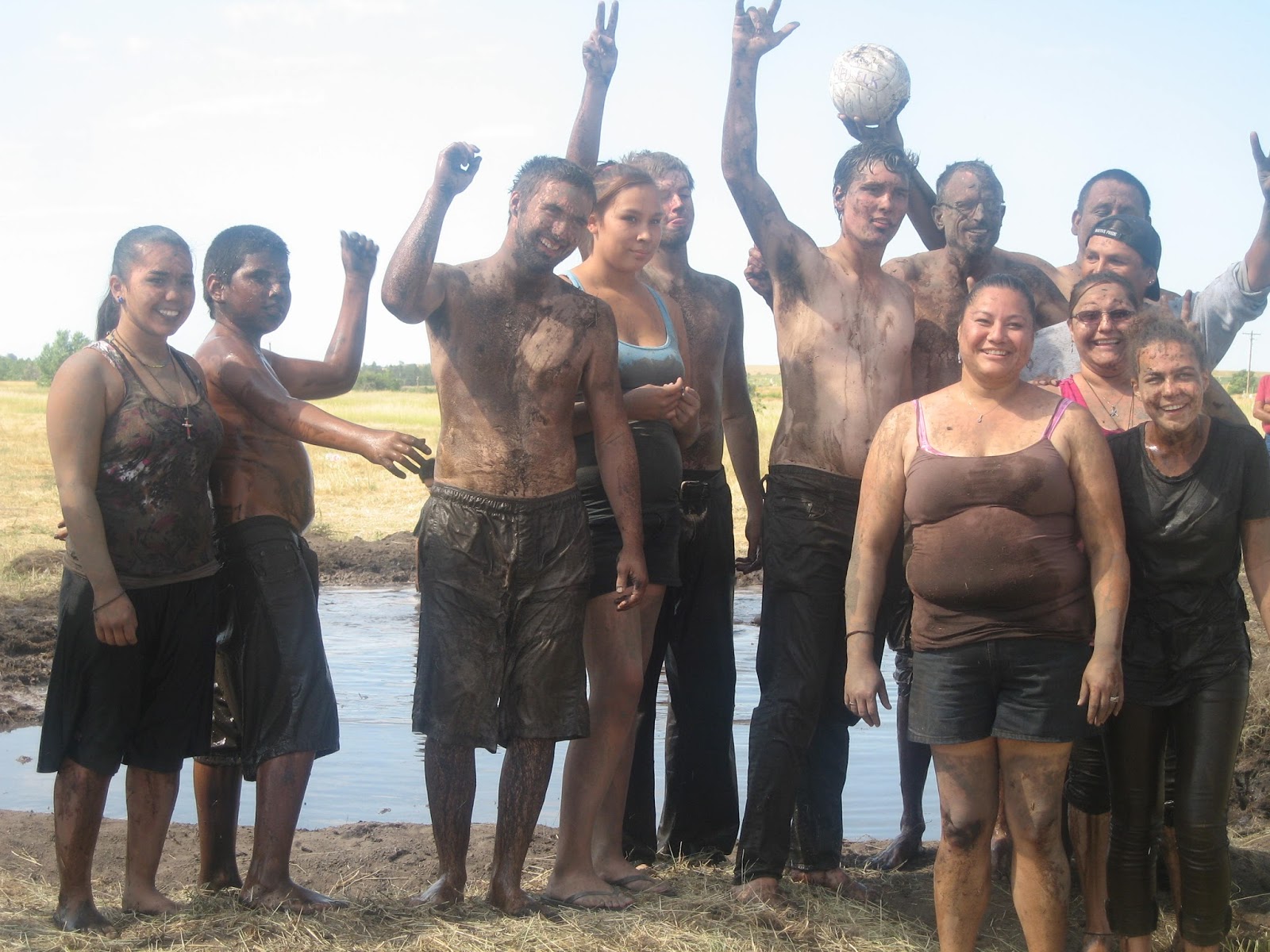
One of the openings was a mud volleyball game at the Eagle’s Nest District Pow Wow.  Our $50 entry fee
made way for a filthy four games of fun and laughs.  We ended up winning the $100 pot, and contributed that to the local youth program.  Something else happened that gave pause for reflection and consideration.  While playing, some of the local youth threw mud at us, at times with rocks mixed in.  One of our players got hit in the eye.  We asked the kids to stop.  They didn’t.  We asked some of the adults to intervene.  They did, but the kids returned and continued sporadically. To the credit of the Workcampers - and perhaps to the credit of the pacifist teachings that come from Quakerism - there was no consideration of reacting with violence or in-kind.

Over the next few days, we had some conversations about this experience.  We struggled to overcome our egos (“Why would they do this to me?  I’m a good person, and I’m here to help”), and as we did, we got to deeper conversations. For example:
·         We often find it understandable and excusable for an oppressed and abused community to exact revenge (a la much of what I hear about Palestinian violence against Israelis as “understandable”).  However, when we represent that power, and find ourselves vulnerable, it feels very different.  The fact is, we have benefited from oppression and exploitation.  Our experience this day was a taste of what many Lakota feel every day – especially when they venture off the Rez.  It was a real eye-opener about power and privilege.
·         In talking with Dwayne about this situation, he affirmed that we acted in the right way.  We did not have the leverage to do more – other than leaving the game, but we were having too much fun.  We could have yelled at the kids, but that would have further agitated the divide.  We were already the outsiders.  But Dwayne also said that if he were there, he would have come down hard on the kids and the adults.  As a member of the community, he could. 

We often talk about Quaker Workcamps as opportunities for experiential learning.  I learned more about power and privilege because of this.  And I am affirmed that change comes from within.  We were the outsiders, but because of how we were in this game, perhaps when we return we will be a bit less so.  

Tuesday, June 25, 2013

Reflections from West Virginia: Energy, Army and Opportunity

Last week, Washington Quaker Workcamps led the annual Sidwell Friends School Workcamp to Caretta, WV to work with Big Creek People in Action, partnering once again with the great folks from Upshur Helping Hands from Buckhannon, WV.
 It was another great week of fun, fellowship, hard work, community-building, deep conversations, love, and learning - all the things that create opportunities for on-going bridge-building across economics, faiths, and geography as we do what we can to promote global community visions and action that belie notions of socio-poltical-economic "bubbles" that really do not exist.

As with all Workcamps, each person has a different experience, high point, or takeaway.  One of the biggest ones for me this year is this:
One evening, Chester Ball made his annual visit to perform, entertain and engage the group in music, games and dance.  This year, he brought with  
him three teens and one pre-teen.  The teens played guitar and sang with Chester - part of his way of preserving a music tradition from this troubled region while nurturing positive activities for youth.  At one point during the evening, I sat with the teens to thank them for coming and to learn more about them.  When asked about post-high school goals, the female among the teens stated she planned to go to cosmetology school.  The males all stated that they planned to either work "in coal" or join the Marines.  I asked whether they wanted to go to the Academy or enlisted; they all said they wanted to go enlisted so they could get to the front lines fully armed and ready to fight.  Coal or Army.  That was it as far as options.  College is prohibitive because of rising costs as well as the fact that they live in a community that does not nurture the pursuit of higher education.    

As I engaged with fellow program participants in sharing this conversation, it led to even more conversations. The wonderful thing about conversations as opposed to arguments and debates is that conversations seem to lead to new insights.  One such insight I had was the irony that, in the circles I tend to float in, there is a unified sense that coal and the military are bad.  The military often is engaged in fights to protect and acquire
Testing a coal tram
fossil fuels (notably, oil), and what we need to be doing is steering people to careers in sustainable and renewable energy.  The ironic part is that the military is starting to step up in a big way in developing alternative energies, with the goal of having 50% of its energy come from sustainable/renewable sources by 2025.  

It's a dilemma.  We want to be a part of creating opportunities as well as supporting people in following their leadings.  At the same time we know that better stewardship of human and natural resources is vital to a healthy world.  For these young men, their leadings right now are to coal and/or the military.  When it comes to renewable energy, we know that coal is not the way, but the military does open that door.  I don't see easy answers, but if I did, then it would not be a dilemma.  I do find that these Workcamp experiences create opportunities to become more open to creating a safe space and talking about the issues rather than choosing sides and fueling partisanship.  Last week affirmed that.  

Monday, June 10, 2013

Workcamps, 2013: Breaking Barriers, Nurturing Leaders

As we get ready to shift into high gear with the summer Workcamps and programs, I have also been reflecting on ways to integrate new ideas and opportunities so that we do not fall into a rut of relying on a template, but instead keep things new and fresh.

For starters, I am ever-more convinced that the responsibility that comes with planning and running service programs is to not just meet the expectations of participants (i.e. to feel good about making a difference, or understand a social injustice better), but to also challenge these expectations in a way that promotes thinking critically about what kind of world they envision and what else they can do in their lives to move closer to that vision.  It is in this kind of conversation that we talk about the importance of relationships - you don't create your vision of the world that includes others without including them in the conversation and the creation of that world - and about the role that privilege and responsibility have in social justice work.

In addition to these "continuing revelation" conversations, here at William Penn House we have an added dimension of progress this summer: we are focusing a concerted effort on nurturing the leaders of the next generation in leading these conversations.  Our summer intern, Nate Anderson-Stahl, joined us last summer for 2 weeks on Pine Ridge.  Prior to that, he had attended Baltimore Yearly Meeting summer camps and the teen adventure program.  Now he will be applying his knowledge and experience of Quakerism, Quaker process and Workcamps to developing and leading them as part of our team. In addition, we have three rising seniors from a DC-prep school who will be joining us for 2 weeks in late July.  The first week will be to experientially learn about Workcamps, the kinds of service we do in DC, the importance of relationships in doing service (I often think that, without a relationship, there usually is not service), how things are connected, and the importance of critically thinking and questioning things.  The second week, these students will then be leading the process for a Workcamp group coming to DC and, hopefully, taking the relations they establish with them to their school, bringing a new dynamic of service and opportunities with them.

It is always an honor to be able to work with the leaders of tomorrow.  My hope is that this summer will be the start of breaking down the compartmentalization we sometimes create around programs and issues, as we weave more connections into the fabric of community.  One vision: to create a flow where youth who have been introduced to Quaker ideals (in schools, Meetings and/or camps) and had an opportunity to practice them in a larger arena (Workcamps), become the farm system for Workcamp organizers, creators and leaders where they get to experience facilitating visioning and implementation built on relationships, and then take these experiences into the rest of their lives with greater consciousness of stewardship, compassion and persistent hope that overcomes the frustrations and disappointments that are sure to be there as well.  This is something I have been envisioning for the past few years; this year is looking like it is starting to take root.  As with all things, patience and perserverance seem to pay off, but now the real work begins.  
-Brad Ogilvie


Tuesday, April 2, 2013

Moving from "Crisis" to "Sustainability": Reflections from New Orleans 2013 Workcamp

"Mercy that doesn't move intentionally in the direction of development will end up doing more harm than good - to both giver and recipient." - Robert Lupton, Toxic Charity

When Katrina hit New Orleans, there was an immediate disaster - flooded homes, unsanitary and inhuman
living conditions, death.  Once the waters started to recede, it became clear that the depths of the loss of life and property were greatly exacerbated by neglect of our environment and our fellow citizens.  This is the common narrative of our times: storms, earthquakes, tsunamis and disease draw our attention to the deeper injustices as the crisis preys on the more vulnerable among us.  Unfortunately, as we respond to the crisis, we tend to get entrenched in a crisis mode of thinking and acting, rather than doing the hard work of community building/rebuilding with a vision of sustainability.  The crisis response seems heroic and can be very gratifying, but if it is not in direct response to the crisis, it is often doing more harm than good.  So it is with New Orleans.

I just returned from taking Sidwell Friends School students to New Orleans during their annual spring break Workcamp.  The origins of this trip  trace directly to Katrina.  Most of the Workcamp activities in past years focused on rebuilding houses and cleaning up.  While this is important work, and it is important that we provide opportunities for people to engage in service in a way that they feel good, it is also important that distinctions be made between "crisis response" and sustainability, as well as between meaningful service and "feel-good" service.  So this year it was time to not just look more deeply but also engage more deeply at the issues and to challenge ourselves to be realistic about what we can do for one week each year. I wanted to challenge us to look at the fact that real community change has to come from within, so it is up to the people of New Orleans to make those changes just as it is up to the people of DC to change their community.  On the other hand, looking at things from the environmental angle and engaging in service there can help all of us address things where we are interconnected.

Our service projects included urban gardening at a charter school, helping exchange lightbulbs as part of Greenlight New Orleans' energy program, learning about the water threats of the Gulf and the Mississippi (which, through oil drilling, shipping, and snow melts connect to over half the country), and getting dirty helping restore some bayou spaces.  This offered a wide-range of activities that allowed for participants to see that there are many ways to serve.

Most importantly, however, as is so often the case with these week-long Workcamps, it is the fellowship that seems to really bring it all together.  Great questions were raised about what kind of difference we were making, why certain types of service seem more gratifying than others and how to do these services locally and why that matters.  In addition to service/justice-related conversations, there were also great conversations about race, segregation, equality - all the things that we
aspire for but find so elusive to practice in our daily lives.  These are the conversations that matter, and the establishment of deeper relations guarantees that these will be the foundation for even greater community change as we support each other in stepping out.


Of course, these trips have lots of laughs - many of which stem from
content not for public consumption given the lack of context.  But these laughs bring the positive energy to what can otherwise seem daunting work, establishing bonds of fellowship, friendship and care for each other that can carry us to being better stewards of each other and the world around us.


Wednesday, March 6, 2013

Focus on Material Resources Ignores the Untapped Resource of Compassion

We live in a world that is interconnected.  This is a readily-acknowledged sentiment. From the Christian belief that we are all a part of the body of Christ to the secular understanding that everything from poverty to disease to environment connected, we have many ways to engage in conversation about this largely agreeable fact.  But turning this conversation to unified action is very difficult.  Why?

Because live in a world where attempts to address issues, bring solutions and bring justice are compartmentalized.  Most non-profits focus on specific causes and needs, segregated by income, race, geography, or disease.  The fact that our world is interconnected with each part effecting the other seems to fall by the wayside.  Many of these well-meaning efforts are also deeply entrenched in a bureaucracy that is rigid, resistant to change and is more focused on institutional survival than mission-completion.

I was talking recently with folks about the kind of service and activism we engage in here at William Penn House.  It is always difficult to articulate exactly what we do here in familiar vernacular because we are not focused on one issue or another.  We truly believe that everything is interconnected.  We view our role as nurturing greater consciousness. A few years ago, we embraced the term "radical hospitality" to define our work.  It fits nicely with our belief that there is that of God/goodness in all, and as we build relations based on this deep faith in each other, good things and a more peaceful world emerge.  What this also does is affirm another aspect of a fairly universal belief: all people have  But in the world of social justice and social service with countless compelling issues, especially in a town that has hundreds if not thousands of cause organizations, it can feel isolating.

We also live in a world of finite resources.  The waters that flow around us now are the same waters that have flowed since the dawn of time, albeit now much more toxic and yet needing to nourish more people than ever.  Our capacity to absorb garbage is seriously limited.  The fossil fuels that take thousands of years to create are being depleted within decades.  We also work against ourselves with health issues - making healthcare extremely expensive while supporting unhealthy nutrition and health habits, and not using all the resources (such as self-testing for HIV) to encourage people to do for themselves what they can, instead fostering a dependency on others.  We basically keep going back to this notion that we have endless pockets of material reserves, that we can talk about the needs magically meeting the needs of others while continuing with our own over-consumption.

But there is a resource that is unlimited - our capacity to care for and love each other, and to do so with at least an effort of grace, rather than ego.   In attempting to live this way, I have also learned to appreciate a Jewish way of doing things that is build on concentric circles: we start in our immediate surroundings, tendign to the things closest to us (such as the environmental work in our backyard, being in fellowship at Capitol Hill Methodist Church's morning breakfast with many who are unhoused) and going out from there, never ending but not starting with a vision fixed on a far-away place that ignores those around us.

In doing this, we really see how it all is interconnected.  Tapping into these limitless resources of compassion that is good work, even if it does feel lonely at times in a society where material things continue to be the idols of worship.

Sunday, September 16, 2012

The Principle of Harmony: Grace in Action?

At a meeting recently, as we were going around the table giving personal updates, one of the people related that she recently got hooked on sports radio.  For years, she had ignored sports on principle.  Billions are spent in sports, and countless hours of human capital are spent on sports instead of things such as war, poverty and climate change.  Many sports are also violent (hockey, football and boxing), and at the college level, teenagers are exploited while academics often suffer.  In addition, there are the countless TV and radio hours of blather that has questionable social merit.  But her curiosity led to enjoying the chatter, and she was hooked.  What she reflected on was that it is this new-found knowledge of sports that is now the catalyst of her relationship with her father, who has alzheimers.  It gives them something they can talk about, despite a breakdown of communication capability.

It was her comment "I had to sacrifice my principles (of not giving any fiscal/human capital to sports) so that I could have a relationship with my dad" that really resonated with me.

For the past few months, as I have been clerking the Baltimore Yearly Meeting Peace and Social Concerns Committee and grappling with a minute connected to the Israeli/Palestinian conflict, I read a quote that Peace is made up of Justice and Harmony.  Many of us are good at standing on the principle of Justice.  Many of us on the left are enamored with the idea that, as Quakers say, we "speak truth to power."  We often do so without any consideration for what others think.  We at times do this with arrogance, as if we know what The Truth is, and perhaps by pointing the finger at those who we claim to be in power we ignore our own power.  We become righteous victims, which can alienate us further from people who might align with us but don't like the action we are demanding.  We apply this to so many aspects of our life - from where we shop, to the car we drive, to the TV/radio programs we listen to - to almost every aspect of our lives.  All of this is standing on the principle of justice.

But what if we were to stand on the principle of harmony?  What if we really did not only consider what our neighbors think about social justice issues, but let their opinions influence what we do.  When I have mentioned the notion that Peace is made up of Justice and Harmony, the retort is often that it is important to take principled stands, and somehow justice would be sacrificed at the expense of harmony.  But the more I think about it, harmony is not just a principled stand but the more difficult of the two (justice being the other).  I am reminded of the opening lines of the 2011 movie The Tree of Life comparing nature and grace: "Grace doesn't try to please itself; it accepts being slighted; it accepts insults and injuries.  Nature only wants to please itself, get others to please it, and likes to lord it over them.  No one who loves the way of grace ever comes to a bad end."  Grace is that moment when we are at with one another, calling on us to put ego aside, and is the bedrock of unity.  Grace, essentially, is like unconditional love,  As is written in 1 Corinthians 13:13, "three things will last forever - faith, hope and love - and the greatest of these is love."

This, to me, does not mean that other principles get sacrificed.  I do believe that we can stand firmly on the principle of harmony but also stand firm for what we believe.  It is a challenge for people whose faith - religious or secular - is embedded deeply in social action.  Conversely, to be completely and solely standing on the principle of harmony is hard for me to even fathom.  I have way too many opinions about what can and should be done.  I do think, however, that it is worthwhile to consider not brushing harmony off as an impediment to principled action, but to instead start to see that harmony is a very principled position grounded in grace and love, and that it perhaps has more power than many of our other well-intended efforts to bring a true, sustainable peace to the world.  


Saturday, August 6, 2011

Peace is a dance, not a stance

This was the talk/presentation I gave at BYM Annual Meeting for Business as clerk of the Peace and Social Concerns Committee:

“Peace” is a dance, not a stance. We can easily dance among ourselves, but when we also learn to dance joyfully with people we may not know, and with whom we may not agree, we are bringing greater peace. To joyfully seek that of God in all things is to see all people and things as dance partners.

We also recognize that the greatest marks left by Friends in the world – from influencing the ideals of our country, to the abolition movement, to voting rights for women – have often been the work, passions and leadings of individuals, not committees. What these individuals shared was a fire and a passion that could not be extinguished. Knowing that their objectives would not be achieved in their lifetime, they remained undeterred in working towards how they envisioned the world should be. Quakerism was often the source and inspiration of their work, and what emboldened them to take leaps of faith, to speak their truths, and as a result, the world is better.

As the 21st century unfolds, however, we face new challenges – within ourselves as well as in the world. Within this Yearly Meeting, we know that there are a great many good things happening in the name of peace. Support for and active involvement in the works of African Great Lakes Initiative, the Zarembkas and Ann Riggs in east Africa; Bolivian Quakers; the work of the Intervisitation Committee and involvement with FUM are but a few of the things worth mentioning. There are also the leadings of individuals within our Yearly Meeting, and some Monthly Meetings that are doing wonderful works in their community, too many to mention here. At the same time, we recognize that some PSC Committees struggle and may even be inactive. Just this week we heard, for example, that the Ad Hoc committee on gender and sexual diversity is laying itself down, and yet even in Friendly circles we hear people and things being called “gay” in a world where this kind of benign intent can do harm. So while a committee’s work may be done, there is still work to be done. While it is easy for us to look outside of ourselves and see fault, we must also seek to be ever-vigilant and increasingly conscious of our own blind spots. As Moliere said, “it is not what we do, but also what we do not do, for which we are accountable.”

For this committee, we find it both important and challenging to harness our efforts so that we are greater than the sum of our parts and the world continues to be positively influenced by our presence. We recognize that all things are connected. Torture, hunger, and the fuel and energy we have all consumed to be here this week are connected. We cannot shy away from this fact, but should instead be willing to embrace it. A challenge for all of us is to take the learning, wisdom and passions we share to not only support the issues, causes and programs we care about and deem worthy, but to apply them in our daily lives so that in the communities where we live, eat, sleep and work, we can know that the world is ever so incrementally better for having had this day. It is important to daily challenge ourselves to move in the direction of the world we seek. Supporting programs and building relations in remote places – whether they be in prisons, in South America, on a Reservation, or in Africa – is necessary, but if we do not also expand our circle of dance partners in our own backyard joyfully seeking that of God in all, we are missing something. Issues help bring unity among like-minded people, but are also used to divide and conquer. It is relationships – honest, genuine relationships that we live out every day – that bring unity to our global community.

As the Peace Testimony marks its 350th year, this committee will be looking for more opportunities to create more dancers and partners, seeking to nurture the leadings of some while creating opportunities for others to explore the world in new ways, with new lenses, learning new ways to engage or to simply re-contextualize the issues. Some examples of our work include:
• Prison Ministry. We have members and attenders on the committee who do prison mediation, AVP and teach non-violent communication in the prisons. There is also a pen-pal program. These are not only opportunities to connect to prisons, but also to deepen these practices in oneself. There are opportunities for people to be trained in mediation, as well as to simply be a pen-pal.
• Gleaning. Every year, in all of our communities, thousands of tons nutritious food is wasted simply because it is not transported. In an era when hunger and malnutrition is on the rise, this is unacceptable. We will be embarking on an effort to organize a few days this year to have Friends go to an identified farm, pick crops and get them to our local foodbanks. As an added bonus, because most gleaning programs are currently populated by Christian churches, this is an opportunity to build relationships among our neighbors whom we may not know and even hold judgment against without having known yet.
• Torture. We have a member who is actively involved in programs and activities that educate and inform people about the practice of torture and a call to end the practice. There will be a variety of opportunities throughout the year to engage and learn more.
• Workcamps. We will be looking to develop a Workcamp somewhere in the region over the next year that will be an opportunity for people to perhaps see things anew, or with new energy or sense of empowerment. These are also wonderful ways to bring community together across age, religion, culture and economic divides. Once one has learned to build and cross a bridge, it is not where the bridge has landed but that one knows how to build a bridge that matters.
• HIV/AIDS. As we continue to support the works in East Africa where AIDS is devastating, we must also recognize that the trends in the US are not good. However, a “game-changer” is in the works: self-testing for HIV. When the FDA approves this (perhaps as early as spring 2012) we will be approaching Friends Meetings to embrace this as an opportunity to “lead by example” by nurturing this option. There are those who say testing without education and support is dangerous. Possibly, but even if so, support and education doesn’t have to happen in an office; it can happen in safe places where people know they are loved and informed.
• National and International legislation. We will strive to have more effective pipelines with FCNL, AFSC and QUNO to provide guidance on issues, so we can get in a flow of discerning how to best use our voices while also becoming better educated and informed so we can reach into our own communities effectively.

To bring about the world we seek, many things are necessary, and none are sufficient. It is our strong hope that Friends can find their piece of the puzzle – their gift, their voice, their leading – and to invite this committee to be a part of nurturing it and being nurtured by it. Ultimately we are seeking to move towards the day when there are no destructive barriers of “us” and “them”. In this world, there is only “us” – all of us. Despite best intents, many of our movements of the past have become institutions of the present and do little to promote unity. It is the artist, the creative spirit, the mystic and the visionary who can envision the world as it should be as well as the person who recognizes the problems of the world as it is that are a part of this dance. We welcome people to attend our meetings with their ideas. We encourage folks to join us on September 10 for our annual Networking Day, as well as at William Penn House for our Sunday, 9/11 potluck when we will be talking about what we can learn from this past decade that we can take into our future with meaning and purpose, rather than lamentaion. We also ask that active PSC committees share with us their works. Our desire is to add value as well as support innovative and new works.

- Brad Ogilvie