Showing posts with label justice. Show all posts

Friday, January 15, 2016

Fear of Tears

"I had to turn away. Otherwise, I was going to start crying."

These were the words of a recent WPQW participant who was in DC with her college for an alternative break week. We were taking time for reflection about what insights, experiences, or wisdom they had noticed from their time with us, so far. The activities included participating in Our Daily Bread (a fellowship community breakfast with people from all walks of life, including many who sleep on the streets and in shelters), garden winterization and soil prep for spring planting, and street outreach with people that are homeless.

Among the insights of other folks was the realization, garnered from their 1:1 time with people, that listening to people, simply engaging in conversation, being with people where they are, matters. In this was also the awareness of the fact that mental illness has high co-morbidity with the homeless population, but to really connect we have to have a relationship. Others had reflections that it all can seem overwhelming as we seek answers (I maintain that it is not answers that keep us moving, but the next good question), and that the real work for social justice has to continue in their daily lives, not just as an alternative vacation.

But it was the role of tears where things got real. One student spoke - somewhat apologetically - through her tears about how a homeless woman told her that she and her fellow-students reminded the woman of her own daughters. It brings it home - there are families, loved ones, and whole life stories that remain invisible. Then, there was the statement by the student about needing to turn away from all the stimulus. She said it was overwhelming. I suspect, and we talked about it, that what was overwhelming was not what was going on around her, but what was welling up inside of her, perhaps a mixture of anger, sadness, guilt, disgust, even love, and her all-too-common belief that we should not be emotional. And it is the fear of tears, the sadness, perhaps intellectualized as a sense of weakness, that we seem the most uncomfortable with, and it often leads us to want to flee.

And yet, we need to be with these emotions, fully present not just with our heads but with our hearts, embracing them, not fighting them, if we are truly to engage in the good work of trying to make the world a better place.  We can talk about statistics of poverty, mental illness, health indicators, etc., but as Emma Goldman said, "The demand for equal rights in every vocation of life is just and fair; but after all, the most vital right is to love and be loved." To be loving means being able to laugh and cry. When we turn away from our tears when they naturally occur, we turn away from our emotions, and we turn away from being present with others. But when we let it flow, we strengthen ourselves, become more present and more whole to carry on the good work.

Saturday, May 2, 2015

Radical Hospitality and Voices for Justice

One of the amazing things about spending time at William Penn House is the incredible range of people that stay with us that we get to meet.  We get people from all continents, coming for everything business and touring to learning, advocacy and memorializing commemorating the 40th anniversary of the end of the Vietnam War. Every once in a while, we get folks who have a very special purpose: survival. So it was a quiet Friday, the 1st of May. I got a call from one of our friends in fellowship from the Southeast White House, Ernest Clover, about Reath Tang, a "brother", as Ernest called him, who was here in DC to try and engage any DC-based support in peace and reconciliation in South Sudan while also reuniting his family. The call to us was simpley because he needs lodging for about a week. We have space for a few days, so we welcomed Reath in Friday afternoon. 

Zach Yoder, one of our interns, spent a few minutes with Reath to learn more about the situation.  Reath Tang was a member of Parliament in South Sudan before the civil war started. He made a reputation for opposing the president Salva Kiir Mayardit when the he tried to push the parliament around. Reath strongly believes in the separation of powers, which has been steadily eroded by President Kirr and says that the current parliament is just a “rubber stamp” assembly.

Once the civil war started, the President’s militia targeted Reath. This was because of his reputation of opposition. Furthermore Reath is from the Nuer tribe and Kirr is from the Dinka tribe-the two largest tribes in South Sudan. Militia men came to Reath’s house looking for him but he was not there having been warned to leave the house. Instead they killed his brother and shot his sister in law in the head—a wound which she survived. 

Reath Tang arriving at WPH
Shortly before the fighting broke out, Reath had obtained a visa to visit the US for the National Prayer Breakfast. After the attempt on his life, he used this visa to flee to safety. If he had not gotten the visa in such a fortunate time he said, “I would be hiding in the bush of South Sudan right now.” His wife and 3 and 5 year old children were able to flee to a refugee camp in Uganda where they are now. For 8-9 months after the fighting broke out, he was not able to talk to them and didn’t know if they were alive or dead. Now his ultimate goal is to bring them to stay with him in the US.  Reath is still in the process of applying for asylum but has been able to obtain a work permit. He wants to establish himself in DC and become an advocate for South Sudan. He wants 3 main things to be brought about for his country: 
  1. He wants Ugandan forces currently fighting in the country on the side of the President to leave. The Ugandan government is currently participating in the civil war while also acting as one of the mediators for the peace process. Reath says that none of the countries that neighbor South Sudan can serve impartially in the negotiations. They all have vested interests in Sudan and it’s wealth of natural resources, including oil. 
  2. Reath wants the content of a African Union investigation into Human Rights abuses to be made public. He says that until people are held accountable for what they have done, there can be no reconciliation. 
  3. Reath wants the US to condemn President Kirr's government as illegitimate. The South Sudanese parliament recently extended Kirr’s term for another 3 years to avoid an election. This single act is clearly illegitimate and should concern the US who invested so much in South Sudanese independence. The US has not acted before when Kirr killed 20,000 people in a single week and continued to kill 30,000 more over time, but Reath recognizes that violations of basic democratic procedure is something that the US might be convinced it should pay attention to.
When stories of globalized terror and genocide show up at your front door in person, they take on new meaning. For us at William Penn House, hosting someone like Reath is both an honor and an opportunity to try and share his story, so here it is. If you feel led to help Reath get his story out there, please pass this on. If you feel led to help, we also welcome any contributions to cover his lodging fees ($200). At a minimum, holding Reath in the light as he works for reconciliation and justice is much appreciated.

Tuesday, August 19, 2014

Quaker Workcamps: After 4 days, change really does happen.

I started participating in Quaker Workcamps about four years ago. I noticed a pattern after having experienced multi-day Workcamps: sometime around the 4th day, something shifted. It has been hard to clearly articulate it, other than to say that the group came together, shifting from being individuals to becoming a community. This was true regardless of location. It wasn't just that we became a community, but the relationships that developed during Workcamps have lasted. Strong bonds have been formed. Previous posts on this site have reflected on this (such as here and here).

Last week, I was taking a class titled "The Whole Brain Child." The instructor, Dr. Tina Bryson, commented on the first day that she is a big fan of week-long summer camps because they give youth an opportunity to open up new neural pathways in the brain, bringing balance and integration to the various parts of the brain, and to form new attachments. She commented that the research shows that all of these things happen within a relatively short period of time - a few days. For the class purposes, we were looking at the implications of this when working in clinical settings with youth and adults for whom neural integration and attachment are not healthy and balanced. For me, there was the added "ah hah!" that this is what I have seen happen on Workcamps.

All of this helps me better understand what it is that happens around that fourth day. As we become more comfortable and familiar with each other and our new surroundings, our brain moves up from the heightened "on alert" state (the amygdala) that is engaged when we are in new situations. Then the real magic happens. Through a series of activities, down time, play time, mindfulness and reflection, various parts of the left and right brain are stimulated as we have week-long conversations about service, social justice, and community. Brain integration takes place. Neural pathways are opened, and new attachments are formed.  The exciting thing is that Dr. Bryson's work and the work of others cited in the class show that these can have lasting positive impact on the mental and physical health of people.

The implications for this are fantastic. To start, there is the issue of how, when we segregate ourselves to be among "like-minded" people, we are likely to be hardening neural pathways that don't allow us to easily see the truths of others or fully engage in life in healthy ways.  For Friends, I see this as a challenge we need to address. If we are to truly believe that there is that of God in All, but we tend to be fairly partisan in our social actions while spending time among like-minded people, our brain does not stay open and integrated, and the emotional amygdala gets activated when we hear discord, leading to a shut-down of higher level thinking. So what we need to do is to more actively engage in experiences that allow us to work through this.

This is where Quaker Workcamps come in - especially the multi-day Workcamps as we run them at William Penn House. We consciously take time to be with people that are on the surface different from us, but do so from a place of equality rather than service (where roles are defined between server and the served). We overcome anxieties by going places we are told are unsafe, and experientially see that things are not as we have been told. This is where the integration starts, and continues as we play, work, reflect, converse, eat and sleep. And then there is the time factor. We take time for these processes to take root and new, lasting relationships to be formed. We do all of this as we look at issues of social, economic and environmental justice.  The next step, as we have started more this year, is to have participants of these programs take on leadership roles - furthering the process of healthy integration and attachment.

None of this is the full explanation of what happens. It does not exclude the possibility that higher powers are at play. It simply brings empirical evidence to validate what we have seen anecdotally and intuitively. But that is huge in our world of skepticism and proven outcomes.  It validates the role that Quaker Workcamps can play in our spiritual formation, outreach, community building and peace/justice work. Most importantly, as we support creativity, critical thinking, collaboration and community, new ideas and actions for a more just peaceful world can emerge. They might not be exactly what we envisioned, but just like when the brain has all aspects engaged utilizing what they do best, the more we can be engaged with others despite our differences, the better off we all will be.

Thursday, August 8, 2013

Pine Ridge, 2013: Reflections of power, privilege, peace and service

“Welcome Home.” 


This was how Dwayne, one of our hosts in Wanblee, greeted me.  This was my fourth trip to Wanblee and it is becoming a spiritual home of sorts.  It is becoming an important annual ritual that takes me out of my routine, and brings old and new acquaintances together in a deep and spiritual way.

This year, we had a great few weeks helping Earth Tipi work towards a model of sustainability on the Rez, and reconnecting with friends as we helped prepare for the Sundance.   We created a space to practice what we preach, and to work through the physical, emotional and interpersonal challenges in a safe, loving and trusting environment.  Through conversation, action, silence and reflection, we practiced grace, putting the ego aside. We went as way opened. 

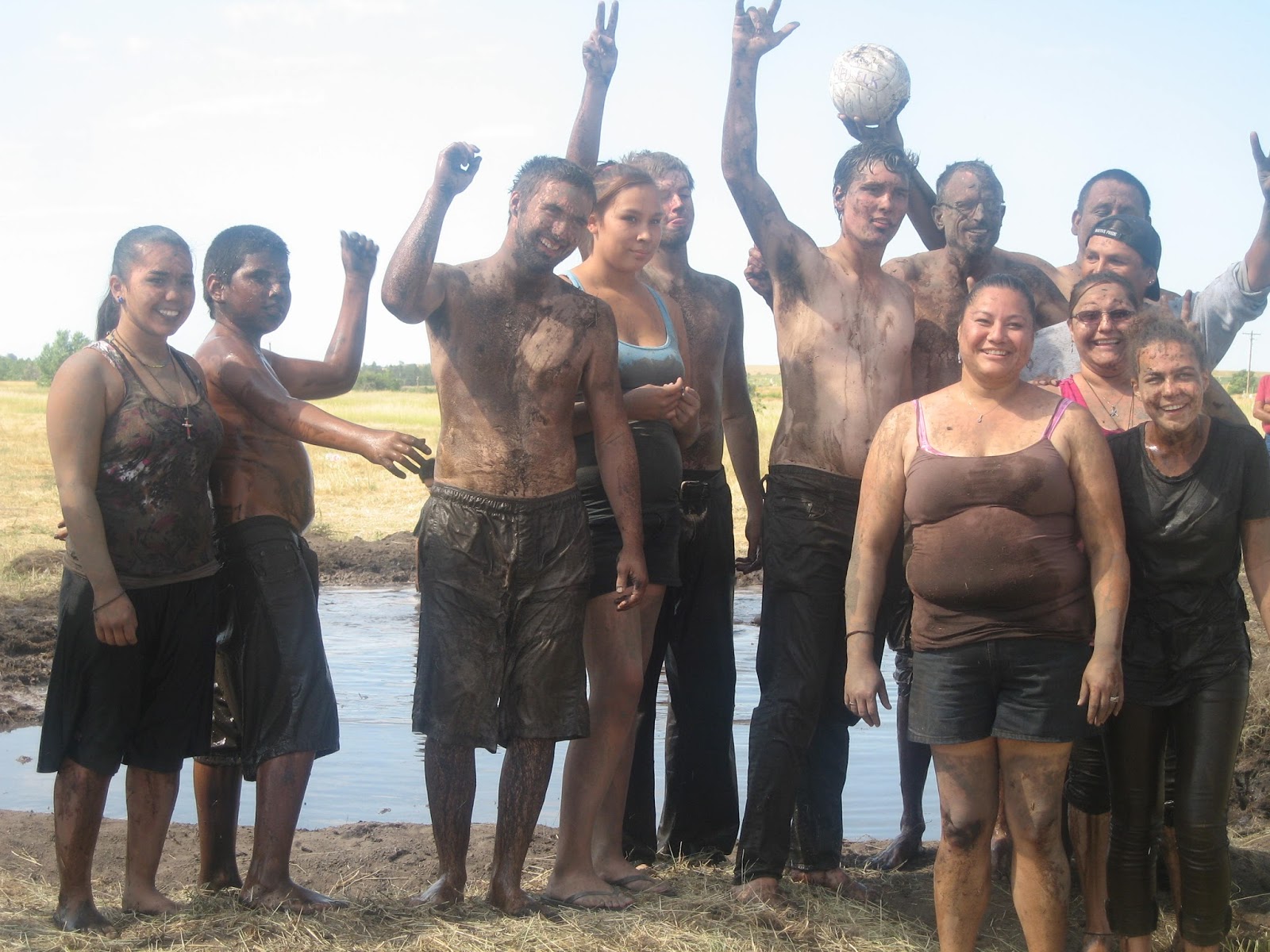
One of the openings was a mud volleyball game at the Eagle’s Nest District Pow Wow.  Our $50 entry fee
made way for a filthy four games of fun and laughs.  We ended up winning the $100 pot, and contributed that to the local youth program.  Something else happened that gave pause for reflection and consideration.  While playing, some of the local youth threw mud at us, at times with rocks mixed in.  One of our players got hit in the eye.  We asked the kids to stop.  They didn’t.  We asked some of the adults to intervene.  They did, but the kids returned and continued sporadically. To the credit of the Workcampers - and perhaps to the credit of the pacifist teachings that come from Quakerism - there was no consideration of reacting with violence or in-kind.

Over the next few days, we had some conversations about this experience.  We struggled to overcome our egos (“Why would they do this to me?  I’m a good person, and I’m here to help”), and as we did, we got to deeper conversations. For example:
·         We often find it understandable and excusable for an oppressed and abused community to exact revenge (a la much of what I hear about Palestinian violence against Israelis as “understandable”).  However, when we represent that power, and find ourselves vulnerable, it feels very different.  The fact is, we have benefited from oppression and exploitation.  Our experience this day was a taste of what many Lakota feel every day – especially when they venture off the Rez.  It was a real eye-opener about power and privilege.
·         In talking with Dwayne about this situation, he affirmed that we acted in the right way.  We did not have the leverage to do more – other than leaving the game, but we were having too much fun.  We could have yelled at the kids, but that would have further agitated the divide.  We were already the outsiders.  But Dwayne also said that if he were there, he would have come down hard on the kids and the adults.  As a member of the community, he could. 

We often talk about Quaker Workcamps as opportunities for experiential learning.  I learned more about power and privilege because of this.  And I am affirmed that change comes from within.  We were the outsiders, but because of how we were in this game, perhaps when we return we will be a bit less so.  

Tuesday, April 2, 2013

Moving from "Crisis" to "Sustainability": Reflections from New Orleans 2013 Workcamp

"Mercy that doesn't move intentionally in the direction of development will end up doing more harm than good - to both giver and recipient." - Robert Lupton, Toxic Charity

When Katrina hit New Orleans, there was an immediate disaster - flooded homes, unsanitary and inhuman
living conditions, death.  Once the waters started to recede, it became clear that the depths of the loss of life and property were greatly exacerbated by neglect of our environment and our fellow citizens.  This is the common narrative of our times: storms, earthquakes, tsunamis and disease draw our attention to the deeper injustices as the crisis preys on the more vulnerable among us.  Unfortunately, as we respond to the crisis, we tend to get entrenched in a crisis mode of thinking and acting, rather than doing the hard work of community building/rebuilding with a vision of sustainability.  The crisis response seems heroic and can be very gratifying, but if it is not in direct response to the crisis, it is often doing more harm than good.  So it is with New Orleans.

I just returned from taking Sidwell Friends School students to New Orleans during their annual spring break Workcamp.  The origins of this trip  trace directly to Katrina.  Most of the Workcamp activities in past years focused on rebuilding houses and cleaning up.  While this is important work, and it is important that we provide opportunities for people to engage in service in a way that they feel good, it is also important that distinctions be made between "crisis response" and sustainability, as well as between meaningful service and "feel-good" service.  So this year it was time to not just look more deeply but also engage more deeply at the issues and to challenge ourselves to be realistic about what we can do for one week each year. I wanted to challenge us to look at the fact that real community change has to come from within, so it is up to the people of New Orleans to make those changes just as it is up to the people of DC to change their community.  On the other hand, looking at things from the environmental angle and engaging in service there can help all of us address things where we are interconnected.

Our service projects included urban gardening at a charter school, helping exchange lightbulbs as part of Greenlight New Orleans' energy program, learning about the water threats of the Gulf and the Mississippi (which, through oil drilling, shipping, and snow melts connect to over half the country), and getting dirty helping restore some bayou spaces.  This offered a wide-range of activities that allowed for participants to see that there are many ways to serve.

Most importantly, however, as is so often the case with these week-long Workcamps, it is the fellowship that seems to really bring it all together.  Great questions were raised about what kind of difference we were making, why certain types of service seem more gratifying than others and how to do these services locally and why that matters.  In addition to service/justice-related conversations, there were also great conversations about race, segregation, equality - all the things that we
aspire for but find so elusive to practice in our daily lives.  These are the conversations that matter, and the establishment of deeper relations guarantees that these will be the foundation for even greater community change as we support each other in stepping out.


Of course, these trips have lots of laughs - many of which stem from
content not for public consumption given the lack of context.  But these laughs bring the positive energy to what can otherwise seem daunting work, establishing bonds of fellowship, friendship and care for each other that can carry us to being better stewards of each other and the world around us.


Wednesday, March 6, 2013

Focus on Material Resources Ignores the Untapped Resource of Compassion

We live in a world that is interconnected.  This is a readily-acknowledged sentiment. From the Christian belief that we are all a part of the body of Christ to the secular understanding that everything from poverty to disease to environment connected, we have many ways to engage in conversation about this largely agreeable fact.  But turning this conversation to unified action is very difficult.  Why?

Because live in a world where attempts to address issues, bring solutions and bring justice are compartmentalized.  Most non-profits focus on specific causes and needs, segregated by income, race, geography, or disease.  The fact that our world is interconnected with each part effecting the other seems to fall by the wayside.  Many of these well-meaning efforts are also deeply entrenched in a bureaucracy that is rigid, resistant to change and is more focused on institutional survival than mission-completion.

I was talking recently with folks about the kind of service and activism we engage in here at William Penn House.  It is always difficult to articulate exactly what we do here in familiar vernacular because we are not focused on one issue or another.  We truly believe that everything is interconnected.  We view our role as nurturing greater consciousness. A few years ago, we embraced the term "radical hospitality" to define our work.  It fits nicely with our belief that there is that of God/goodness in all, and as we build relations based on this deep faith in each other, good things and a more peaceful world emerge.  What this also does is affirm another aspect of a fairly universal belief: all people have  But in the world of social justice and social service with countless compelling issues, especially in a town that has hundreds if not thousands of cause organizations, it can feel isolating.

We also live in a world of finite resources.  The waters that flow around us now are the same waters that have flowed since the dawn of time, albeit now much more toxic and yet needing to nourish more people than ever.  Our capacity to absorb garbage is seriously limited.  The fossil fuels that take thousands of years to create are being depleted within decades.  We also work against ourselves with health issues - making healthcare extremely expensive while supporting unhealthy nutrition and health habits, and not using all the resources (such as self-testing for HIV) to encourage people to do for themselves what they can, instead fostering a dependency on others.  We basically keep going back to this notion that we have endless pockets of material reserves, that we can talk about the needs magically meeting the needs of others while continuing with our own over-consumption.

But there is a resource that is unlimited - our capacity to care for and love each other, and to do so with at least an effort of grace, rather than ego.   In attempting to live this way, I have also learned to appreciate a Jewish way of doing things that is build on concentric circles: we start in our immediate surroundings, tendign to the things closest to us (such as the environmental work in our backyard, being in fellowship at Capitol Hill Methodist Church's morning breakfast with many who are unhoused) and going out from there, never ending but not starting with a vision fixed on a far-away place that ignores those around us.

In doing this, we really see how it all is interconnected.  Tapping into these limitless resources of compassion that is good work, even if it does feel lonely at times in a society where material things continue to be the idols of worship.

Wednesday, January 23, 2013

What Workcamps mean to me


Thoughts on relationships and the Workcamp experience
by Mark Sundermeyer

In its truest form, a work camp is something that goes beyond providing a service. Far too often service is viewed as doing something to help someone, when the reality of the benefit is mutual and harmonious. When we look beyond the simple task of service, when we create meaningful and lasting relationships with those that we work with, those relationships color our view of the world and our place within it. 

  1. Relationships
Building relationships with the people that we are working for and with is the heart of the Workcamp experience, without it, Workcamps are simply physical acts of service. Through several trips to Caretta, West Virginia, I developed relationships with some of the people we were working with, relationships with people that I would never have imagined I would come into contact with, much less become friends with. These relationships transcended any preconceived notions that I may have had about the people of Caretta and caused me to look inward and examine how I fit in with this group of people. Surprisingly, I had very little trouble feeling at one with the community. It became clear to me that there was very little difference, if any between the people of Caretta and myself. This realization is paramount to the Workcamp experience and one that is directly in tune with Quaker philosophy. Building relationships with those that we work with allows us to see that of God in everyone, including ourselves.
  1. Bearing Witness
Another key aspect of the Workcamp is the simple experience of immersing oneself in another person’s life and struggles. This may be the most underrated part of the Workcamp, and does not require a physical outcome, but is surely a powerful component. In my trips to New Orleans in the aftermath of Hurricane Katrina, I began to notice that simply viewing someone’s struggle could be affirming to even the most devastated victim. I am reminded of a sign I saw in the lower 9th ward that read,
“This is what has happened to us,
We have lost loved ones and our homes,
See this devastation and know that this is our struggle.”
People’s struggles go unnoticed in the blur of news media that engulfs us everyday. Simply acknowledging the depths and seriousness of people’s struggles is something that ties directly into our relationships with the people that we work with. If we cannot understand what other people have been through, then the work we do is nothing more than a favor. When we bear witness, we can begin to see parallels to our own lives. It is not a belittling parallel, but rather a unifying experience that solidifies our relationships. To bear witness is not limited to struggles; bearing witness is a holistic practice that includes seeing the joy in people’s lives as well. When we can truly understand each other, our sorrows, our joys, then we can begin to create meaningful relationships. This is the power of the Workcamp.  
Through the experience of creating relationships and bearing witness in service, the Workcamp gains meaning on an internal level. When service is no longer viewed as something that is done to someone else, but as a mutual exchange of experience, both parties leave the Workcamp changed and with a better understanding of their selves and one another. This change may not be predictable but it surely is a strong one. For me, this change was a gradual awareness; I began to see in my life in a different light over the course of many Workcamps as I built relationships with people and places. To the best of my ability, I began to see people as they truly were, not defined by a single struggle, but as a whole person. When Workcamps focus on building meaningful relationships and bearing witness, i.e. working in a place for more than a day, and not just painting or building, then the outcome of the Workcamp will be such that people will naturally be drawn to service, a truer service, one that would be immediately relevant and powerful in their lives.

Thursday, November 1, 2012

Visible and Invisible Walls of Oppression

  • 25% higher high school dropout rates
  • Huge standardized test performance discrepancies, often reflecting a cultural bias
  • Discrepancies in unemployment and pay rates
  • Few opportunities to escape oppression but with a gun, either in crime or military service
  • Pervasive militarism
  • Unjust and unequal uses of the legal and penal system to perpetuate cultural and real violence
These are some of the common narratives that have been told here in Israeli/Palestine.  Before I proceed further, let me clearly state that this posting is not to excuse any bad and abusive atrocities by the Israeli Military or settlers against Palestinians. But as I hear these tails of injustice, I can't help but think we have these same narratives in the US, and by not seeing these, we are going to be challenged to get to the root causes of division that lead us all the way through the spectrum of violence.

When I have mentioned this to some people in the delegation, they say "well at least we have laws to prevent this in the states."  This provides absolutely no comfort to me.  It feels like we are saying "sorry our society is so unjust, abusive, violent and prejudiced, but we will give a pass on accountability because we mean well."  To take comfort in laws while ignoring the outcomes misses the real hard work - the same work that we seem to be expecting to be done in Israel, as if we are better practitioners.  Our walls in the states are just as entrenched, just more invisible.  Here's my take on how our walls of segregation and prejudice play out in the states, despite our laws:
  • Laws are one thing.  Enforcement and access to laws is another.  Basically one's ability to have the law work for them has a direct connection to how much money they have to pay a good lawyer.  The economic injustice prevails.
  • We may not have blatant walls and checkpoints, but we have rivers, tunnels, bridges and trains.  These often serve as real and symbolic barriers to segregation and access, and used in a myriad of ways.  In DC, there is the "east of the river" concept.  Train stops, as another example, are sometimes lacking (in the case of Georgetown) to keep some people out, while in other places in DC make getting to a low-paying job an ordeal.  
  • Inner-city violence and rural drug addiction have a direct connection to poor funding for schools, high unemployment and racism/elitism (consider how we classify people in the Appalachias as "hicks").
  • Our prison system is another tool of legalized segregation and injustice, where blacks account for 44% of the incarcerated population.  Those corrupt corporate elite who ruin countless lives in the name of greed walk freely (and in luxury), while those who suffer from their greed are stuck in cycles of violence, abuse, unemployment, addiction and debt all over the country. 
  • The cultural violence is also reflected in higher suicides and murders in many places or among certain groups.  The government/military doesn't have to do it because we do it to ourselves while the rich and powerful thrive.
  • Military indoctrination?  Considering that military service is one of the last remaining ways youth can escape the cycles of poverty in their communities all over the world, we have that.  Furthermore, we don't call people dedicated to breaking the cycles of violence in the name of peace "heroes"; we save that for the troops, and do it persistently in everything from sports announcements to priority boarding on airplanes.  Americorps folks don't get that. 
  • While we don't have home occupations and settlements, we do have predatory loans, right of public domain, and suburban expansionism into rural communities that often displace people.  One Palestinian farmer here, for example, turned down a "name your price" offer for his farm.  He could have been rich.  He chose to stay and fight in a very peaceful and honorable way.  It's inspiring, and I wish more in the states would be so principled, but he also could have been rich.  To me, this is less an example of a victim as a noble person.  
This is not a "tit-for-tat" issue to me.  It's an attempt to normalize the all-too-common narrative that takes place in Israel/Palestine, Washington DC, West Virginia, New Orleans, Pine Ridge, you name it.  Internationally, I see the same in rural Kenya.  The oppressor has a foot on the neck of the oppressed.  In places like the US, it is done so brilliantly that we hardly notice it.  This is not meant to say "so just accept it", but to say "let's unite."  To say "at least we have better laws" does not promote that unity.  Let's not look at the laws; let's look at the outcomes and come together with greater passion and wisdom that we are all in this fight together.   I believe the change will come when we stop competing for who has the greatest victim narrative.  When those of us in places of privilege deem that the suffering of a group across the oceans is worse than that of those around us, it raises questions and concerns about what we are saying about the value of all people.  However, when truly start relating as equals with a commitment to move forward together, that's when I think we will see our way to greater global justice.

Sunday, September 16, 2012

The Principle of Harmony: Grace in Action?

At a meeting recently, as we were going around the table giving personal updates, one of the people related that she recently got hooked on sports radio.  For years, she had ignored sports on principle.  Billions are spent in sports, and countless hours of human capital are spent on sports instead of things such as war, poverty and climate change.  Many sports are also violent (hockey, football and boxing), and at the college level, teenagers are exploited while academics often suffer.  In addition, there are the countless TV and radio hours of blather that has questionable social merit.  But her curiosity led to enjoying the chatter, and she was hooked.  What she reflected on was that it is this new-found knowledge of sports that is now the catalyst of her relationship with her father, who has alzheimers.  It gives them something they can talk about, despite a breakdown of communication capability.

It was her comment "I had to sacrifice my principles (of not giving any fiscal/human capital to sports) so that I could have a relationship with my dad" that really resonated with me.

For the past few months, as I have been clerking the Baltimore Yearly Meeting Peace and Social Concerns Committee and grappling with a minute connected to the Israeli/Palestinian conflict, I read a quote that Peace is made up of Justice and Harmony.  Many of us are good at standing on the principle of Justice.  Many of us on the left are enamored with the idea that, as Quakers say, we "speak truth to power."  We often do so without any consideration for what others think.  We at times do this with arrogance, as if we know what The Truth is, and perhaps by pointing the finger at those who we claim to be in power we ignore our own power.  We become righteous victims, which can alienate us further from people who might align with us but don't like the action we are demanding.  We apply this to so many aspects of our life - from where we shop, to the car we drive, to the TV/radio programs we listen to - to almost every aspect of our lives.  All of this is standing on the principle of justice.

But what if we were to stand on the principle of harmony?  What if we really did not only consider what our neighbors think about social justice issues, but let their opinions influence what we do.  When I have mentioned the notion that Peace is made up of Justice and Harmony, the retort is often that it is important to take principled stands, and somehow justice would be sacrificed at the expense of harmony.  But the more I think about it, harmony is not just a principled stand but the more difficult of the two (justice being the other).  I am reminded of the opening lines of the 2011 movie The Tree of Life comparing nature and grace: "Grace doesn't try to please itself; it accepts being slighted; it accepts insults and injuries.  Nature only wants to please itself, get others to please it, and likes to lord it over them.  No one who loves the way of grace ever comes to a bad end."  Grace is that moment when we are at with one another, calling on us to put ego aside, and is the bedrock of unity.  Grace, essentially, is like unconditional love,  As is written in 1 Corinthians 13:13, "three things will last forever - faith, hope and love - and the greatest of these is love."

This, to me, does not mean that other principles get sacrificed.  I do believe that we can stand firmly on the principle of harmony but also stand firm for what we believe.  It is a challenge for people whose faith - religious or secular - is embedded deeply in social action.  Conversely, to be completely and solely standing on the principle of harmony is hard for me to even fathom.  I have way too many opinions about what can and should be done.  I do think, however, that it is worthwhile to consider not brushing harmony off as an impediment to principled action, but to instead start to see that harmony is a very principled position grounded in grace and love, and that it perhaps has more power than many of our other well-intended efforts to bring a true, sustainable peace to the world.