Showing posts with label Blind spots. Show all posts

Sunday, October 19, 2014

Reflections on Friends and Diversity

This past week, I was at a gathering of Friends. One of the energized topics was "diversity." Truth be told, I cringe when I hear this topic come up. I have usually heard it talked about while sitting with an overwhelmingly white, middle-class, well-meaning group in some kind of a conference or symposium setting. Too often, the emphasis seems to be on external characteristics (skin color), while ignoring long-standing power and economic factors that make this a more complex issue. This was no different. As seems to be the pattern, there was some hand-wringing, self-effacing acknowledgment of work to be done, and recognition that it is a tough topic to talk about, let alone act on.

Then, this morning, I attended service at an Evangelical church. I went as I was in the neighborhood, and felt led there rather than Quaker Meeting as I had just spent a few days with Friends and wanted a change of pace. To be clear, there is much of the message of this church about salvation, baptism and true believers "need to do all of this" that I struggle with, let alone the fact that the most vocal, well-funded and powerful people working to deny my rights as a gay man share this ideology. But I also know some of this church community through my work and fellowship in DC, find them very welcoming and inspiring, and I have a deep respect for other parts of their message, their work, their witness and their faith.

As I sat in the church waiting for the service to start, I noticed people of many cultures - black, white, Asian, Hispanic - coming in as individuals and couples. Up front, there was a group of people communicating through sign language. People came from a real cross-section of cultures and economies. If there was one noticeable lacking of diversity, it was age. Most people were in their 20's and 30's - a stark difference from most Quaker gatherings.  The main message of the morning was about having faith transcend fear so that we go out into the world truly living our faith. "Peace" was an integral part of that message.

So I have to ask myself: "What is going on here." Quakers have a long history of being on the forefront of the rights movements from abolition to civil rights, women's rights, and gay rights. That is certainly our past, but it clearly is not our present. Just look at HIV/AIDS. There was a time that Friends were actively involved, but as the devastation moved from the ostensibly white gay male into the African-American community, Friends efforts subsided. What happened to the passion for justice for all?

We can not simply rest on the past and continue to consider ourselves "progressives." When it comes to race, we might take comfort that we are progressives because we do not have prejudice in our hearts, but our actions do not match our words. I suspect some may think we are progressives because we are not the blatant racists, and we see no one ahead of us. This is probably because true progressives are so far ahead they are getting read to lap us, but we choose to think they are still behind us.

The question is: can our faith steel us to transcend our fear, step through our walls of segregation and get out into the community? Our stances on political issues can no longer be the barometer of our "progressiveness." We need to get out there, letting our belief that there is that of God in All guide us to new places, new relationships and new friendships. Talking about diversity in closed-community meetings is not going to get it done, and it's not living our faith.

Thursday, September 18, 2014

"To Love and Hate Life at the Same Time"

I attended a Meeting for Worship recently at a Quaker school. The first message was given by a youth facing a serious, life-threatening medical condition. His message was powerful, but laced with humor as well. The more serious part of the message was what to do with the question of what it is like to live with a life-threatening condition. In his wisdom, he stated that it is not easy to understand this experience unless one has faced death him/herself - "to love and hate life at the same time."

For the rest of the Meeting and the rest of the day, that term "to love and hate life at the same time" flowed through me almost like fresh air. Since being told more than 20 years ago that I had perhaps 5 years to live and have greatly exceeded that expectation, my own journey has included explorations of mortality, life, soul, death and perhaps most importantly, fear of death. I have read and written much about these from academic, spiritual and experiential vantage points. I have seen lengthy theories and essays on the topic. But never have I heard it put so succinctly: "to love and hate life at the same time."

I think many of us walk around with lots of love and lots of fear which can come across as being in the vicinity of hate. People who preach against gay rights, for example, are often labeled as "haters" even though they could very well be fueled by love for their Bible, their faith and their fear that if they don't do what they can to bring rightness to the world, they too will suffer the consequences. Then we, in turn, perhaps channel some of our own hatred to them for other reasons. The point is that we spend a lot of time compartmentalizing the ways we objectify "love" and "hate" to somehow create a buffer zone of safety from dealing with the complexity of both of these emotions. Facing death, as this young man so clearly articulated, does not allow for us to compartmentalize; we are forced to confront how much we love life and how much we hate knowing that it will all come to an end someday, no matter what our circumstances are.

One of the Quaker testimonies is "Simplicity." For issues as complex as life and death, I don't know that there could be a more simple message to sum it up than to understand that our human condition is one where we have to learn to love and hate life at the same time. Trying to keep them separate only creates internal and external conditions. When we see that we can actually do both, perhaps we will all be better no matter what comes.

Friday, August 8, 2014

Mindfulness, Simplicity, Fear and Quaker Workcamps

I just finished reading the book "Mindfulness" by Harvard professor Ellen Langer.  The premise is that mindfulness is much more than a meditative state of consciousness; it is an awareness of choices, and that things have different meanings in different contexts.  One of her main themes is that we often live mindlessly, having assumptions about people, places and things because of the way we have been raised.  We can see this in the divisive nature of our culture and the assumptions we make about people with differing opinions.  We see it in the way we are led by polls and community conversations that give limited options, leading us to think these are the only options.  Her research supports that when people are actively engaged and have many options, they are more likely to stay engaged, to be optimistic, to be healthier and to even live longer.
Much of her writing is in sync with what we strive to accomplish with Washington Quaker Workcamps.  We talk often about options and opportunities, instead of problems.  We talk often about the importance of the journey, not the destination.  A guideline is that there are not mistakes, only opportunities to learn.  By walking to places, we encourage practicing mindfulness about our surroundings.  Through reflection and action, we change the context within which we see ourselves in the world.  All of this is intended to create safe spaces for participants - mostly youth - to see the world as one of opportunities to be embraced and for them to see their own gifts in embracing them.

Two common challenges we run into when planning and running Workcamps that are also reflected in Langer's work are fear and control. They usually go hand-in-hand, and the result is that they often lead to more mindlessness rather than mindfulness.  The desire to create and follow a set schedule blocks our ability to engage in what is going on in the moment.  The fear of upsetting parents can lead to limited options of service - revolving around perceived needs or around false senses of security such as only doing service that guarantees nothing bad can happen.  Not only do these limit the experiences and learning opportunities of the participants, I think they are also doing a disservice by not allowing the youth to actively look at options and make (or at least influence) decisions by engaging in the process of weighing factors such as personal hunger and personal risk.  It does not adequately prepare them to deal with these things as they head off to post-high school lives where the supervision is far less.

In 1 Peter 3: 13-22, the message is about not letting fear stop us from doing what is right, but to also have good reasoning for doing what is right.  At Washington Quaker Workcamps, we do not shy away from conversations about the role that fear and control play in guiding daily action, and how these can lead us to be negligent in our responsibilities.  A fear that a teen may hurt him/herself by climbing a ladder or using a power tool does not adequately prepare that youth for when he/she is no longer at home.  Likewise, concerns that a parent might be upset because his/her youth has to wait 2 hours for dinner while preparing food for homeless people is not a reason to avoid the important experiences and lessons about justice and privilege that are at the root of so many service programs, and a fear of being in close proximity to homeless people who may have mental illness should lead to conversations about how we make assumptions about people and things we have not experienced rather than not going to a fellowship breakfast of mostly homeless folks.

The Quaker Testimony of "Simplicity" is one of the ways to break down some of this fear and control.  "Simplicity", in this context, is in the Benedictine tradition of striving to let go of assumptions of what we have been told about other people or places so we can be open to seeing what is with our own eyes.  When we tell people that certain neighborhoods in our own town are unsafe (even though we may send them to places just as unsafe in other cities or countries), we perpetuate closed assumptions rather than open wonder. When we engage with something or place that is new to us, our eyes are open. The right thing to do is to engage, create, collaborate, and inspire curiosity, not to perpetuate fear through assumptions. It is not only right for the benefit of Quaker Workcamp participants, but it is right for bringing greater justice and peace to the world.

Monday, March 31, 2014

"They don't care about us."

These were the words spoken to me by Mr. Harold Brown, a life-long resident of New Orleans.  We were standing on the lawn of his newly-built but not finished and already falling apart house, thanks in no small part to corrupt government practices from local to national levels, to corrupt contractors, and to sleezy family members.  Mr. Brown is 68 years old, losing his vision, and has no where else to go.  Katrina wiped out his livelihood - a fish market business and 10-unit apartment building and after a few years living in Houston in a flop-house (at $75/night) and paying $10 for meals (subsidized by FEMA money that finally ran out), he returned to his house only to find everything inadequate.

The whole story is a tragic nightmare. What is haunting me, however, are the words "they don't care about us."  It is far too easy to align myself with his statement, and to point the finger at politicians and sleeze-bag, greedy contractors and family members. I am sure that, simply because I was standing with Mr. Brown on this sunny, brisk Tuesday, he would not include me in this "they."  But is this really accurate. How much do I really care? Yes, my heart aches, and my blood boils. But is that all?

I don't have easy answers to any of this. I do know that I have to be careful about simply nodding my head and saying "yes they don't care" without taking a deep look at how much I really care as demonstrated by my actions.  I can demand that "they" put more funding into programs, but money was a major part of the corruption as it wound its way through the system with little reaching the ground. I can demand that the corporate exploiters of the region (oil, mostly) clean up their act, but I too like my lights and heat. I know that I can do more to raise awareness, to call on all of us to look around us to see where we might be fooling ourselves as we align with people in these kinds of circumstances.  Even as I attended a Quaker Meeting the Sunday after returning from NOLA, I could not help but notice that, out of 100 people in attendance, the lack of economic and racial diversity is jarring. Is this a true reflection of what it means to care?

In the Book of John, Chapter 9 in the Bible, there is the story of Jesus restoring sight to a blind man.  There is a back-and-forth with the Pharisees about whether it was the blind man or his parents who were the sinners that caused the blindness, or whether Jesus had devilish powers because of his ability to restore sight. Ultimately, what Jesus reminds us is this: it is not a sin to be blind.  The sin is to claim to see.  So, while I can see Mr. Brown's point that "they don't care", I have to be careful not to overlook my own part in this.  It is a blindspot that I might take comfort in, but it is one that will blind me to seeing the hard work, personal commitments and sacrifices we must make to bring justice to these kinds of situations.  It is humbling that it takes the words of a man losing his sight for me to try and open mine.

Friday, March 7, 2014

Fasting or Monetary Incentives: The Extremes of Charity and Justice


This year, as a lenten practice, I am reading a daily reflection about a different saint each day.  This morning, it was about Sharbel Makhluf, a 19th century Lebanese monk who spent the last half of his life as a hermit. He is known for both his fasting and his care for others. He would leave his hermitage routinely to go care for villagers. The prayer suggested for today is "God of our fasting, show us how our hunger unites with those in need of bread, how letting go of life's comforts can aid those lacking necessities for life."  

Then I turned to Dan Pallotta's daily hit from his book "Uncharitable."  Dan is the founder of Pallotta Teamworks, was a pioneer in fundraising via AIDSRides/Cancer Walks, and was an inspiring visionary. I still remember clearly the first time I heard him, in July 1996 on the first day of the Twin Cities-Chicago AIDSRide, challenging everyone that we could end the AIDS pandemic within a decade. I think he was right in the vision, but unfortunately and ironically, there was too much money invested in and to be made from AIDS to allow for the creative innovations to make it happen. 

Today's "hit": "An ambitious reporter puts a sentimental photo of a child with leukemia in the newspaper and asks, 'How can you be so cruel as to want to earn a profit from his situation?' I put up the photos of a million others like him and ask, How can you be so shortsighted as to deny me and a thousand others the monetary incentive it would take to devote our life’s work to helping these children? You have just robbed them of our talents. What if your moral compass is wrong?"  

These two represent the polar ends of the spectrum of the cultural and institutional realities of the social justice/charity/advocacy world. At William Penn House (where we work for beans), we get groups that want us to set up service programs for them but sometimes they have trouble seeing why they should pay us a fee as they are doing charity. I would love to double the Workcamp fee so that WPH could have a cushion, a bit of security and I would be able to perhaps save a bit for the future. And I see many colleagues in the field in much the same boat.  It sometimes feels like because we work in this field, we are expected to live like St. Makhluf.  

On the other hand, I see why people are concerned about the money made in charity work. I see and know people making well over 6 figures (some more around half a million).  They are happy; the donors - often the deep pockets of the Clinton/Gates/Bono realm - are happy. The workers fly in high circles. They are very good at raising money, creating good images, marketing, etc, but are the donors really getting the best bang for the buck? Do people enter these jobs fueled by their passions for the cause, or by the lure of the paycheck? How many dollars are spent in meetings to no end? Even being a part of the DC HIV Prevention Planning Group, a non-paid position, I suspect that we meet to meet, but actually do very little. I'm working on that one. 

It really boils down to the tension between ego and grace. For me, personally, I don't think I could ever live the life of Makhluf, Francis, or countless others. Even in my daily life, I stand in awe at the life of grace of some of the people I know. In one case, this life of having and needing little (and this is with someone who gave up much to do his ministry) is essential.  And yet, I firmly believe that the more one has attachments to things that can be bought with wealth, the more the ego gets fed, and this inevitably is a problem.  Just look at how Dan's quote ends.  He basically is saying that if I don't get paid what I want, it's your fault for robbing people of my gifts. The immorality is yours.  

It's fair enough to do what we can so that people can make a living, and I think it's fair enough to negotiate what an equitable wage is, and what is too much, and through this tension we can get the biggest bang for the buck. To me it boils down to this: fair and decent wages are good - perhaps essential, but getting rich off the backs of the poor and the sick is not. 

Wednesday, February 5, 2014

Skin in the Game

"'Blessed are those who are persecuted for righteousness' sake, for theirs is the kingdom of heaven' (Matt. 5:10)... With this beatitude Jesus thoroughly rejects the false timidity of those Christians who evade any kind of suffering for a just, good, and true cause because they supposedly could have a clear conscience only if they were to suffer for the explicit confession of faith in Christ.  Jesus cares for those who suffer for a just cause even if it is not exactly for the confession of his name."
Dietrich Bonhoeffer, Ethics

Yesterday, I wrote about how change at the micro-level (meaning, starting with me/us) is a vital component to bringing about macro-level change.  Then I read the above reading from my daily Bonhoeffer.  For modern day purposes, I am not sure I agree with the notion of being persecuted.  Persecution connotes harassment and oppression.  Certainly these can be a part of the consequence of standing up for a just cause, such as with the lunch counter sit-ins of the 1960's where people risked their lives in the name of equality, and suffered great harm, while responding with remarkable non-violence.  To me, this is a far-cry from what we often see today with protests so highly orchestrated that there is no risk or sacrifice, or calls for boycott that ask for nothing of the consumer. An exception might be preachers in Indiana who perform same-gender marriage if the state constitutionally bans gay marriage, as these preachers would face possible imprisonment.  
For me, however, the call is not to seek to be persecuted, but to put skin in the game - to make sacrifices, take risks, to be the change.  This means more than championing an issue, but to build relationships across divides. This means being willing to be vulnerable, to be uncertain, to act with doubt.  This means making the sacrifice while practicing kindness.  
I fail at doing this miserably and daily.  It is the humility of this that keeps me from feeling that I have the right to tell others what to do.  Instead, I hope to walk the journey with people.  I certainly don't want to seek out persecution as a validation of my sacrifice, but I am willing to be made uncomfortable, and to try and do things differently.  If we want the world to be a kinder, more compassionate and caring society where people are not so ego-driven, we have to start with ourselves.  For me, this starts with the willingness to make sacrifices, to be uncomfortable, to practice kindness, to do with less, and every day to try a little bit more.  It certainly doesn't end there, and just doing this is not enough, but the change won't happen without it.  

Tuesday, February 4, 2014

Macro-Change Starts at the Micro-Level

Over the weekend, I was talking with a good friend about politics, justice and equality issues.  We come at things from very different angles politically and policy-wise, but we know that we want the same things in the world - less conflict, less injustice, more opportunity, more equality.  As we were talking, Mike (not his real name) kept citing data showing that many of the social programs (mostly in education - Head Start, college funding programs) are simply not producing positive outcomes.  We shared sentiments that there is too much bureaucracy and there is too much self-interest from professional organizations, lobbyists and politicians, and once programs are established, the cultural dependency often overlooks outcomes while keeping the funding going.  Mike kept referring to the fact that government-funded programs need to support programs that are proven to bring about change on the macro-level, and the simple fact is that many of our entrenched programs - many of which seemed like great ideas - are not producing the outcomes to justify their continued funding and policy control.

So much of this certainly resonates with my experiences.  I've seen first-hand a deeply-entrenched bureaucracy dictating policy and operating a rigid paradigm in AIDS services.  What I realized, as we were talking and finding that we were not in sync, is that we were talking at different elevations.  Mike stated that new ideas can get funded to ramp up if they are proven to work on a small scale.  While I know this is true, to be able to even get these preliminary outcomes requires a level of funding and administration that small organizations don't have.  Effectively, to implement totally new ideas requires a funding that few innovators have.

“Yesterday I was clever, so I wanted to change the world. Today I am wise, so I am changing myself.” - Rumi


More importantly, though, was recognizing that, while we absolutely need macro-level change - in education, in energy, in environment, in jobs and income - this change does not start at the macro-level.  It starts at the micro-level - with individuals, small groups.  You. Me.  It is at the macro-level that we can measure the success of the effort, but it is the individual action that the change really takes root.  Taking two issues of the day as examples:
  • Energy: As the Keystone Pipeline seems to be nearing approval the voices start to rise up against it, out of concern for the environment as well as the land rights of the Lakota.  But just as I saw after the BP blowout in the Gulf a few years ago, the focus is on the high-level of national and international policy.  To date, I have yet to see a call for less consumption to go along with this, and our consumption is just as complicit in the problem as is greed of the stockholders.  I remember the days when we were encouraged to lower our thermostats, and to "drive 55" not for safety but for fuel efficiency.  These days, the call for sacrifice in combination with better policy seems lacking. 
  • HIV/AIDS: Bank of America and U2 join forces during the Super Bowl evening to give $1 for every free download of U2's latest song (although, if you look at the fine-print, there was a $2 million - a drop in the bucket for BofA and certainly provides great publicity and revenue for both BofA and U2).  The people downloading a free song were feeling good that they were making a difference - by getting something for free.  All in the name of ending AIDS.  Except for one thing.  Not one message to encourage people to know their status, to act or think different. What a lost opportunity.  It is rare that you would have such a wide audience and could really change the message or at least challenge the status quo - raise the conversation, make people think.  Kudos to Coca Cola for doing just that with their ad.  
In both these cases, it may be true that we need more funding and/or better policy that considers the potential environmental impact.  But no matter what the policy - the macro-level work - it is ultimately going to take each one of us to DO differently as individuals on a mass scale - that will bring the change to that macro-level.
-Brad Ogilvie

Tuesday, December 3, 2013

"Open and Affirming" is not the same as "Reconciliation and Forgiveness"

A week before Thanksgiving, at William Penn House, we hosted Danish Quaker K. Renato Lings who talked about his book "Love Lost in Translation" and his personal faith journey to reconciliation as a gay Christian.  It was a very enlightening presentation.  What I found most interesting was to hear Renato talk about the importance of finding comfort in his faith in order for him to really deal with his depression.  From a clinical standpoint, what I was hearing was that he had been traumatized growing up in a faith tradition that condemned him for being gay.  He subsequently spent many years avoiding his Christian faith, but was out to the world as a gay man.  Despite all the acceptance he felt (including among Quakers with whom he worked and worshiped), he still exhibited the lingering effects of the trauma (avoidance and other signs of depression).  It was not until he started to confront the "abuser" (The Bible as it had been used against him), and did extensive research into interpretations, meanings and historical factors, that he realized he could find a way to be both gay and Christian.  He no longer had to go through life being afraid to face the very thing that had caused him so much hurt.  (Side note: Andrew Marin has done some great work on the importance of forgiveness and reconciliation, including showing up at Pride parades with "I'm Sorry" signs.  See more here.)  
As the conversation unfolded, we discussed the importance of reconciliation and acceptance, but also the importance of recognizing that overcoming the traumatic experience that many gays and lesbians takes more than being "open and affirming."  To fully overcome the impact and control that traumatic experiences can have on people, it is important to work through the fear that leads to avoidance as this can habituate into a paralyzing way of life.
Many Quaker congregations consider themselves welcoming places for the glbt community, which is fantastic.  What we discussed at this evening event, however, was that to be welcoming without fully appreciating the depths of hurt that religious rejection can leave with people has the potential to cause inadvertent harm, and we do this by not better understanding the Bible.  Our own avoidance or lack of comfort with the Bible - the agent used for perpetrating the abuse - can leave us ill-equipped for being the reconciling place we would hope to be for those who have experienced the trauma.  This is where we might actually do more harm - by promising acceptance but missing the mark by not appreciating the depth of the harm.  Renato Lings' book might be a good place to start the journey to greater healing for so many.

Friday, October 18, 2013

"Never in Doubt; Seldom Right"

Living and working in Washington, DC, it is not possible to hide from politics.  This is a political post. 

Unless you've been living under a rock, you know that the government shut down for almost three weeks, and re-opened yesterday.  What has been fascinating and troubling to me is how some key players (Sen. Cruz most notably, but pretty much the Tea Party-elected representatives) have so much influence in all of this.  Their claim to act as they have is that they ran on and were elected a platform of shutting down Obamacare.

What is disturbing about this mindset is the lack of appreciation that we live in a pluralist society and, in this kind of society, "my" or "our way" is not always the way things can and should go.  It's offensive when people claim to speak for "real Americans" as Cruz, Bachmann and Palin so often do.

But, this is not just the purview of the Tea Party.  The far left has often acted just as smug, righteous and divisive.  When I lived in DuPage County, IL - a fairly conservative county - in 2006, Tammy Duckworth was first running for congress. She narrowly lost to Peter Roskam in the election for the seat vacated by retiring Henry Hyde.  Duckworth had not been the favorite of many of the DuPage Democrats because she was a military veteran and not "liberal enough."  This tepid support may have negatively influenced her chances.  Similarly, the Green Party of 2000 basically paved the way for Bush.  And in 2012, there was the incredibly wasteful "Recall Walker" effort in Wisconsin.  It seems to me that, as we become increasingly polarized as a society, we are also entering into a period of shut-downs (or taking things to the edge) and recall efforts (as seen in Wisconsin and Colorado).  This is also perhaps influenced by our increasing need for immediate gratification (as much of the left demonstrated with the rapid disappointment that Obama did not immediately shut down Guantanamo, end "don't ask/don't tell", etc.).  Certainly, Quakers are also susceptible to this, with our "War is not the Answer" and other righteous statements. 

A few years ago, I read a book titled "In Praise of Doubt: How to have convictions without becoming a fanatic."  My big takeaway from that book is that, in a pluralistic society, it is important to have deep convictions, but to hold them with just enough doubt that it doesn't serve to divide us further.  This means that, while I may always be the voice for gay rights, environmental responsibility, non-violent actions, I do so with the awareness that mine is one of many voices in the choir that needs to learn to sing together. Remembering the line from the Prayer of St. Francis - that I seek to understand, rather than to be understood - helps ground me here as well. 

For sure it is easy to point the finger Cruz and his cronies for the recent fiasco.  But just as easily, we could be pointing fingers at Nader and the Green Party, and all people who feel so certain of their stances that they live a "with me or against me" sense to them.  We need to do better.  I can say that this is one of the things we try to nurture in our programs at William Penn House - the practice of listening and noticing, not reacting and judging.  We have plenty of opportunities to do the latter; what we need is more of the former to raise civility in the world. 

Wednesday, August 28, 2013

Paying Attention to Economic Injustice

Like a good liberal, I woke up this morning listening to NPR.  There was a piece about Clarence B. Jones, one of the organizers of the 1963 March on Washington that is being commemorated this week.  He echoed one of the persistent themes that, while there has been much progress over the past 50 years, there is much to "the Dream" that is as yet unfulfilled.  The reporter states: "From his book 'Behind the Dream', Jones writes as long as there's a need for a legal category for hate crimes, police officers 'pulling over African Americans because they're driving cars considered out of their financial reach,' and people 'selling their houses because too many black families have moved in,' the dream remains diluted, tarnished and unfulfilled."

Now, I would never deny that these are certainly true and important, but I do see these as largely middle and upper-class issues that ignore the deeper economic injustices that are playing out.  As long as we dance around the fact that the overwhelmingly disproportionate numbers of people in prisons, unemployed, in underfunded schools, and with higher rates of poor health indicators are people of color (including Native Americans), and as long as poor people across the board have unequal access to opportunities as well as protections, the dream is unfulfilled.  And as long as people like Jones and entities like NPR neglect these facts, the dream will remain unfulfilled. 

I see the injustice in the wealthy corporate executive who is either a black man or a woman and receiving less than his/her white male counterpart, but it's at the other end of the economic spectrum that we need to be serious about if we are to break the cycle.  It's great to have models of success to break stereotypes, but if we don't address the education and nutrition issues.  It's great to ride my bike by the White House - as I was yesterday - and see all the black leaders getting out to attend a function.  But to also attend a regular breakfast as I did yesterday morning, consisting mostly of poor black people who seem to be left out of the Dream, reminds me of the real work to be done. 

Thursday, August 8, 2013

Pine Ridge, 2013: Reflections of power, privilege, peace and service

“Welcome Home.” 


This was how Dwayne, one of our hosts in Wanblee, greeted me.  This was my fourth trip to Wanblee and it is becoming a spiritual home of sorts.  It is becoming an important annual ritual that takes me out of my routine, and brings old and new acquaintances together in a deep and spiritual way.

This year, we had a great few weeks helping Earth Tipi work towards a model of sustainability on the Rez, and reconnecting with friends as we helped prepare for the Sundance.   We created a space to practice what we preach, and to work through the physical, emotional and interpersonal challenges in a safe, loving and trusting environment.  Through conversation, action, silence and reflection, we practiced grace, putting the ego aside. We went as way opened. 

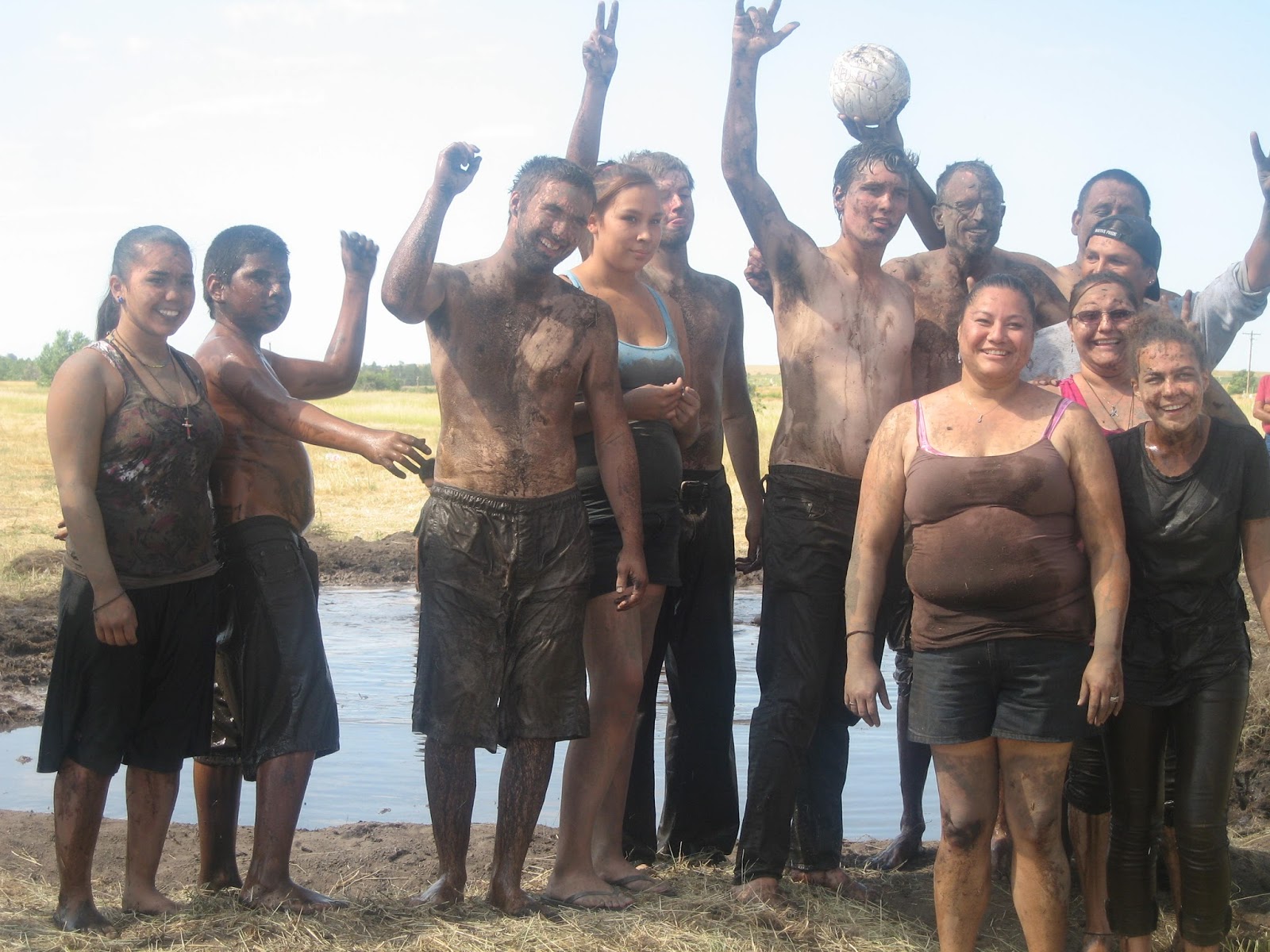
One of the openings was a mud volleyball game at the Eagle’s Nest District Pow Wow.  Our $50 entry fee
made way for a filthy four games of fun and laughs.  We ended up winning the $100 pot, and contributed that to the local youth program.  Something else happened that gave pause for reflection and consideration.  While playing, some of the local youth threw mud at us, at times with rocks mixed in.  One of our players got hit in the eye.  We asked the kids to stop.  They didn’t.  We asked some of the adults to intervene.  They did, but the kids returned and continued sporadically. To the credit of the Workcampers - and perhaps to the credit of the pacifist teachings that come from Quakerism - there was no consideration of reacting with violence or in-kind.

Over the next few days, we had some conversations about this experience.  We struggled to overcome our egos (“Why would they do this to me?  I’m a good person, and I’m here to help”), and as we did, we got to deeper conversations. For example:
·         We often find it understandable and excusable for an oppressed and abused community to exact revenge (a la much of what I hear about Palestinian violence against Israelis as “understandable”).  However, when we represent that power, and find ourselves vulnerable, it feels very different.  The fact is, we have benefited from oppression and exploitation.  Our experience this day was a taste of what many Lakota feel every day – especially when they venture off the Rez.  It was a real eye-opener about power and privilege.
·         In talking with Dwayne about this situation, he affirmed that we acted in the right way.  We did not have the leverage to do more – other than leaving the game, but we were having too much fun.  We could have yelled at the kids, but that would have further agitated the divide.  We were already the outsiders.  But Dwayne also said that if he were there, he would have come down hard on the kids and the adults.  As a member of the community, he could. 

We often talk about Quaker Workcamps as opportunities for experiential learning.  I learned more about power and privilege because of this.  And I am affirmed that change comes from within.  We were the outsiders, but because of how we were in this game, perhaps when we return we will be a bit less so.  

Tuesday, June 25, 2013

Reflections from West Virginia: Energy, Army and Opportunity

Last week, Washington Quaker Workcamps led the annual Sidwell Friends School Workcamp to Caretta, WV to work with Big Creek People in Action, partnering once again with the great folks from Upshur Helping Hands from Buckhannon, WV.
 It was another great week of fun, fellowship, hard work, community-building, deep conversations, love, and learning - all the things that create opportunities for on-going bridge-building across economics, faiths, and geography as we do what we can to promote global community visions and action that belie notions of socio-poltical-economic "bubbles" that really do not exist.

As with all Workcamps, each person has a different experience, high point, or takeaway.  One of the biggest ones for me this year is this:
One evening, Chester Ball made his annual visit to perform, entertain and engage the group in music, games and dance.  This year, he brought with  
him three teens and one pre-teen.  The teens played guitar and sang with Chester - part of his way of preserving a music tradition from this troubled region while nurturing positive activities for youth.  At one point during the evening, I sat with the teens to thank them for coming and to learn more about them.  When asked about post-high school goals, the female among the teens stated she planned to go to cosmetology school.  The males all stated that they planned to either work "in coal" or join the Marines.  I asked whether they wanted to go to the Academy or enlisted; they all said they wanted to go enlisted so they could get to the front lines fully armed and ready to fight.  Coal or Army.  That was it as far as options.  College is prohibitive because of rising costs as well as the fact that they live in a community that does not nurture the pursuit of higher education.    

As I engaged with fellow program participants in sharing this conversation, it led to even more conversations. The wonderful thing about conversations as opposed to arguments and debates is that conversations seem to lead to new insights.  One such insight I had was the irony that, in the circles I tend to float in, there is a unified sense that coal and the military are bad.  The military often is engaged in fights to protect and acquire
Testing a coal tram
fossil fuels (notably, oil), and what we need to be doing is steering people to careers in sustainable and renewable energy.  The ironic part is that the military is starting to step up in a big way in developing alternative energies, with the goal of having 50% of its energy come from sustainable/renewable sources by 2025.  

It's a dilemma.  We want to be a part of creating opportunities as well as supporting people in following their leadings.  At the same time we know that better stewardship of human and natural resources is vital to a healthy world.  For these young men, their leadings right now are to coal and/or the military.  When it comes to renewable energy, we know that coal is not the way, but the military does open that door.  I don't see easy answers, but if I did, then it would not be a dilemma.  I do find that these Workcamp experiences create opportunities to become more open to creating a safe space and talking about the issues rather than choosing sides and fueling partisanship.  Last week affirmed that.  

Tuesday, November 24, 2009

Listening and Dialog

What is the difference between listening to listen and listening as part of dialog? I had not given much thought to this, other than intuitively knowing there's a difference, until recently. At William Penn House a few weeks ago, we hosted two Navy Midshipmen. In announcing this event, it was stated that "these students will be here to talk about their dreams for the world, selection of service as a vehicle for pursuing this dream, and what it means to be of service. We look forward to this being an evening for pacifists and people committed to a world without war to listen with appreciative ears and to find common ground."

By referring to their commitment as "service", a listserve became energetically engaged in questioning why we were doing this event, that what these young men do is not "service" but "murder", and that we should give equal time to real service (neglecting to notice that just about all we do at William Penn House is service). It was interesting to see "pacifists" going after like-minded people, and to observe that, while these Navy Midshipmen were able to answer questions clearly about why they have made the commitments they have made and the struggles and dilemmas of these choices, the pacifists struggled with articulating their "hard" questions and making connections between what they/we are against and what we are for. I could go on about many things, but perhaps most simplistically, I have been pondering what it is to listen as an exercise vs. listening as part of a dialog.

Here are some thoughts:
Neurologically, listening/observing is what some call an "alpha" brain activity, where the rear hemisphere of the brain is engaged, but what is going on is just letting things enter. Imagine walking through the woods as part of a meditative exercise in noticing what is going on, vs. thinking about work, what is around the corner, or some other mental activity that takes one out of the moment. This is the alpha activity, whereas "beta" activity is that latter part - thinking of something next. To just be present, to listen, is really a discipline in being in the moment. It does not mean to not think, but to instead let information fully enter for discernment, rather than discern what is allowed in. The blocks to this are emotions - anger, fear, etc. - and too much thinking that looks for where the speaker is "wrong" (or a fear that I am wrong).

In dialog, I suspect that we are always listening with one foot in the moment, and the other in "what am I going to say next?", which interferes with being fully present to the other. This can be especially challenging when we have firmly held beliefs (in this case, about the military). Unfortunately, when we demonize things like the military, we tend to develop blindspots about many things, including that we might be complicit in the need for the military to protect us.

Are there things we can do to handle this better? In my experience, Appreciative Inquiry has been a good tool. Quite simply, to learn to listen fully, with appreciative ears, has been helpful. It does not mean that I simply accept all that is being said, but for the moment my job is to listen and to appreciate. I can later go back, more fully informed, and look at things more deeply, exploring where my own values lie on issues. I think it adds to integrity. It certainly beats "pacifists" creating conflict among like-minded people.