Showing posts with label peacemaking. Show all posts

Friday, August 5, 2016

Words Are Never Enough: Reflections from Pine Ridge

The wind started shaking my tent at 1:58AM. We had to drop people off at the airport 100 miles away by 4:30AM. It was as if the wind knew, and was acting as Mother Earth’s alarm clock, helping us to take care of what needed to be done.

These are the kinds of things that seem to happen every time we are on Pine Ridge. Energy, spirit and relationships are strong, and it is easier to be present in the moment. Wind announces that it is coming so that you can stop what you are doing and revel in its cooling presence. White cows emerge just as they are inquired about; dogs warn us to prepare for storms in the most remarkable ways – knocking on doors; cars get stuck in mud just in time for us to get out and see remarkable views. The
ever-present nature, the natural beauty of the Rez and the Badlands, weather elements, plants and animals (including horses joining us for dinner) all help us deepen our connection to all that is around us in ways that are not always felt in our daily routines. They are what invite a downpour of rain to become a communal shower, and deeply appreciating a nap in the shade. They are what get people to wake up at 5AM just to watch the sunrise or fall into frequent moments of silence and worship.

Mike Sierra's farm
And there are the remarkable and inspiring people. Shannon Freed, her husband Adam Weasel and his father Gerald Weasel, through their company Earth Tipi, are working to be a demonstration of sustainability in Manderson while also developing a place for people to come together to explore, be a part of, and help build a sense of community. Mike Sierra and his wife and the small farm way off the beaten path in Oglala that is a model of healthy, organic vegetables grown local – something we saw more signs of this year than we have seen in past years. Reva High Horse and her niece and husband Cindy and Dwayne High Horse, carrying on the tradition of the Sundance in a way that, over the course of a few short days, builds deep and lasting relationships – one big family that extends to include all of us who came together, often as strangers or acquaintances, as we explore our own faith, values and traditions while learning those of the Lakota through fellowship, work and stories. Our tasks may not always make sense to us, but we learn to respect their importance to others. Respect is a necessary component of peace and justice work. Through it all, there are also the struggles of addiction, unemployment, and idleness. As one of our members said during our last worship-sharing, this is real life, not the materialistic, frenetic lives we tend to live when we leave the Rez. 

Inside tipi after Meeting for Worship
“Are these the Quakers?” asked one of the leaders of the High Horse Sundance, pointing to the tents that housed 20 of us from a mix of Friends entities that included a private school (Sidwell), a college (Wilmington) and a Monthly Meeting (Downingtown, PA). Mike Gray is the constant Quaker presence, as he has been for over 20 years. Through William Penn Quaker Workcamps, we try to do our part to help maintain that Quaker presence – not just in numbers but in our faith and practice. We are a witness, and our own worship becomes something for others to witness and to participate in, just as we participate in sweats and song. As we heard from a Lakota man who works as a park ranger at Badlands National Park’s Lakota-managed division, we all worship one God, just in different ways. The hospitality expressed at the High Horse Sundance is a testimony to that.

We have now all returned home, with the exception of Mike who will be heading south in a week or
so. We have moved back to beds from nights on the ground, sometimes in tents, sometimes under the stars, or in a few cases, in a tipi. We have washed off most of the dirt that we had become a bit accustomed to (although will likely still find remnants of dirt, grass and bugs in our clothes for a while), and the facial hair we may not otherwise sport is shaved. It is ironic that being so used to not cleaning ourselves can lead to feeling so cleansed. We were wisely counseled by Rosebud elder Charlene to listen to and pursue our dreams and our purpose. Perhaps not being so concerned with earthly things like what to wear and how to look opens way for doing this. Our dreams will be perhaps driven more by our hearts that are now fuller, our love and our tears. We are hopefully more whole, more grounded, more intentional and more respectful as we re-engage our minds to our purpose. We are also challenged to step up our support for the Lakota and other native Americans – whether it is calling on Congress to stop cutting Indian healthcare funds or fully funding Indian colleges (both of which are treaty commitments that continue to be violated), or calling on President Obama to pardon Leonard Peltier before he leaves office in a few months, or directly supporting the work of Earth Tipi or Mike Sierra.

William Penn set out to create the Peaceable Kingdom. We have a long way to go, but we saw glimpses of what is possible the last few weeks. We hope that more F/friends will join us so we can maintain – and perhaps grow – the presence of the Quakers on the ground next summer and in spirit and advocacy throughout the years. 

From July 20 to August 4, William Penn Quaker Workcamps was on Pine Ridge. Many thanks to Mike Gray, Shannon Fried, Adam Weasel, Mike Sierra, Reva High Horse, and Jeff Domenick and Sue McKenna from Downingtown Friends Meeting. And to all who joined us, what a ride! You were all fantastic. Let’s keep it going. More pictures can be seen on William Penn Quaker Workcamps' facebook page (https://www.facebook.com/williampennquakerworkcamps/photos/?tab=album&album_id=293764887644760)
-Brad Ogilvie


Monday, April 27, 2015

Words of War

Two consecutive Sundays. Two different Monthly Meetings. Two different states. One remarkably similar message reflecting on the popular Quaker query making the rounds: “How does your life help to remove the causes of war?” followed by a reference to “War is not the Answer.” 

Increasingly, I wonder how useful these ruminations serve Quakerism, especially as they seem to become an increasing part of congregational vernacular. And when these messages are also proudly displayed to the public, I wonder whether they are an admonition to others that they should be like us, and then how much does that help us live our faith.  The “causes of war” are so vast and complex, but war is really, in my mind, simply a part of the spectrum of violence that includes greed, power, fear, hunger, faith, love, education, institutionalization, nationalism, rigidity, and religion, just to name a few. A better query might be something like “What can I do today to break the cycles of violence?” 

The focus on “war” in these messages raises two thoughts for me. First, in Quaker circles, the action that often follows is a call to cut military spending. It is an over-simplification that ignores some of the realities of our society. If you visit many of the neglected parts of our country – rural areas as well as urban – you will hear many people say they want to join the military. This is not because they love war, but because the military is one of the few legal options many people have to get out of otherwise dire circumstances where employment and education are scarce and violence and drugs are rampant. As manufacturing jobs continue to disappear, there is little else currently on the horizon that is a viable option. In addition, we should recognize that the military also engages in many peace-making and emergency rescue operations. Given the small numbers of Quakers, we might want to engage in building an infrastructure to replace some of these rather than spending a lot of time, energy, faith and money on the notion that we can get the politicians running the massive bureaucracy to do the right thing. It’s a bottom-up approach, but when numbers are small, sometimes bridge-building and doing the small things can have the greatest impact.

Then there is the word “war” itself. It is a word that evokes negative imagery and energy, but in doing so allows us to gloss over all the ways that we participate in the cultural, environmental and economic injustices that perpetuate the cycles of violence. “War” is something that is easy to say others do. Focusing on war has a way of externalizing and, subsequently, absolving us from our culpability.  


Often I hear Quakers being described (at times self-described) as “against war” or, more interesting to me, “not believing in war.” As a pacifist, I have come to appreciate that we have to not only think but act deeper. I do believe in violence. I see it every day, and I abhor it. The power of Quakerism is not in our stance against war but in the oft-cited belief that “there is that of God in All”. When we can use this to steel ourselves to compassionately break down the barriers of classification that serve to divide us from our neighbors and fellow global community members, we are getting more to the root causes of violence – the real work of pacifism. Instead of the harsh messages full of words like “not”, “don’t”, and “war” that affirm little but evoke violent images, having positive words that invite positive energy and imagery would be a nice change. Words do matter.  

Thursday, August 8, 2013

Pine Ridge, 2013: Reflections of power, privilege, peace and service

“Welcome Home.” 


This was how Dwayne, one of our hosts in Wanblee, greeted me.  This was my fourth trip to Wanblee and it is becoming a spiritual home of sorts.  It is becoming an important annual ritual that takes me out of my routine, and brings old and new acquaintances together in a deep and spiritual way.

This year, we had a great few weeks helping Earth Tipi work towards a model of sustainability on the Rez, and reconnecting with friends as we helped prepare for the Sundance.   We created a space to practice what we preach, and to work through the physical, emotional and interpersonal challenges in a safe, loving and trusting environment.  Through conversation, action, silence and reflection, we practiced grace, putting the ego aside. We went as way opened. 

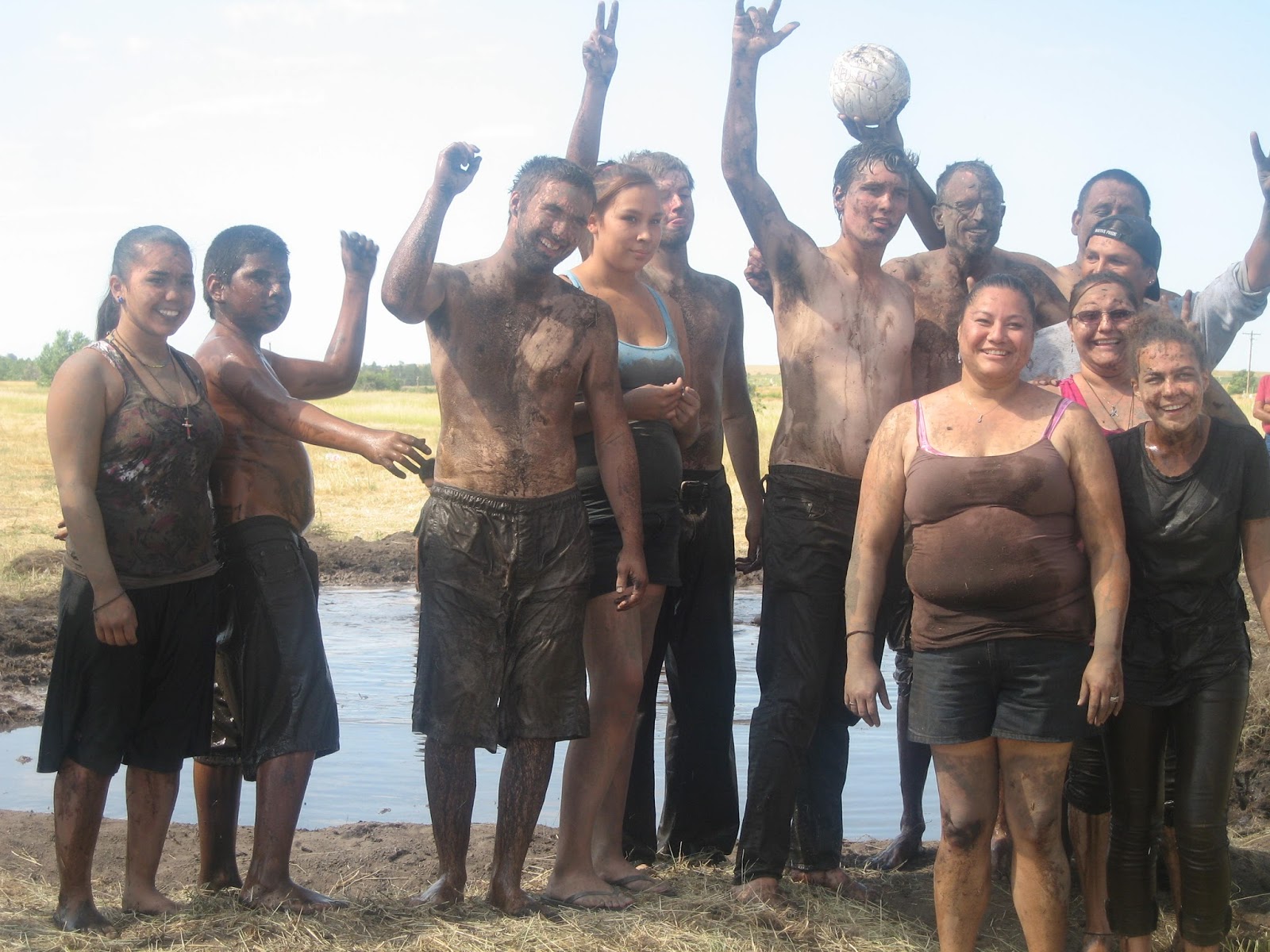
One of the openings was a mud volleyball game at the Eagle’s Nest District Pow Wow.  Our $50 entry fee
made way for a filthy four games of fun and laughs.  We ended up winning the $100 pot, and contributed that to the local youth program.  Something else happened that gave pause for reflection and consideration.  While playing, some of the local youth threw mud at us, at times with rocks mixed in.  One of our players got hit in the eye.  We asked the kids to stop.  They didn’t.  We asked some of the adults to intervene.  They did, but the kids returned and continued sporadically. To the credit of the Workcampers - and perhaps to the credit of the pacifist teachings that come from Quakerism - there was no consideration of reacting with violence or in-kind.

Over the next few days, we had some conversations about this experience.  We struggled to overcome our egos (“Why would they do this to me?  I’m a good person, and I’m here to help”), and as we did, we got to deeper conversations. For example:
·         We often find it understandable and excusable for an oppressed and abused community to exact revenge (a la much of what I hear about Palestinian violence against Israelis as “understandable”).  However, when we represent that power, and find ourselves vulnerable, it feels very different.  The fact is, we have benefited from oppression and exploitation.  Our experience this day was a taste of what many Lakota feel every day – especially when they venture off the Rez.  It was a real eye-opener about power and privilege.
·         In talking with Dwayne about this situation, he affirmed that we acted in the right way.  We did not have the leverage to do more – other than leaving the game, but we were having too much fun.  We could have yelled at the kids, but that would have further agitated the divide.  We were already the outsiders.  But Dwayne also said that if he were there, he would have come down hard on the kids and the adults.  As a member of the community, he could. 

We often talk about Quaker Workcamps as opportunities for experiential learning.  I learned more about power and privilege because of this.  And I am affirmed that change comes from within.  We were the outsiders, but because of how we were in this game, perhaps when we return we will be a bit less so.  

Monday, April 29, 2013

From "I'm Shy" to "Let's Dance" in 60 Seconds

Last week, we hosted two separate groups for a day of Workcamps.  One group was made up of 12 students from China who had just graduated high school there and were part of a cultural exchange program before heading to college (some in the US, but most back in China).  This group arrived early and headed out to work on the beginnings of a project to turn a neglected bit of land into a healthy community space with a tiered rain garden, community garden and basketball court (this will be a project we will be a part of for the next few years).

The other group, from Harford Friends School in MD, consisted of the entire 8th grade class (all six of them), their Head of School, and one of the parents.  They proceeded to go from William Penn House to assist a remarkable woman, Janey Boyd, who has been addressing the problems of hunger in DC since the 1950's. Their work this day was to help unload food that had been gleaned from a local farm and package it for families to pick up at the school where the truck met the group, illustrating the fact that there is good nutritional and fresh food available if we can just get folks to help get it from farm to table.

When it came time to consider what to do for dinner, I thought of simplifying things by having the groups share dinner.  I was a bit unsure how this would play out.  There were differences in both age and culture, as well as language.  But these groups were sharing the house for the night, and Community is one of the testimonies that guides our work at William Penn House, so let's just have faith in it, I thought.
At first, it looked like the groups were going to share food, but sit separately.  I encouraged the Harford students to split in two groups at the tables we have.

"I'm shy" was the immediate response of one of the students, but they took the suggestion anyway.  Within minutes, what was a quiet room with the exception of some subdued Chinese language conversations became a boisterous room as people talked about everything from video games to dance.  The energy and spirit lifted as folks became aware of how much we are not separated by our nations, culture and language, but by how much we are united by our humanity.  I remember in particular, the "shy" student who is a dancer reveling in how she connected with one of the Chinese students who has a passion for dancing as well, and how she really wished she could see him dance.

I know this is just one meal, and who knows what impact it will have.  I do know that transcending one's fear, stepping out of one's comfort zone, and having a wonderful experience can be the building block for doing more of this.  Perhaps one day, the dancers will share that dance.

Wednesday, March 6, 2013

Focus on Material Resources Ignores the Untapped Resource of Compassion

We live in a world that is interconnected.  This is a readily-acknowledged sentiment. From the Christian belief that we are all a part of the body of Christ to the secular understanding that everything from poverty to disease to environment connected, we have many ways to engage in conversation about this largely agreeable fact.  But turning this conversation to unified action is very difficult.  Why?

Because live in a world where attempts to address issues, bring solutions and bring justice are compartmentalized.  Most non-profits focus on specific causes and needs, segregated by income, race, geography, or disease.  The fact that our world is interconnected with each part effecting the other seems to fall by the wayside.  Many of these well-meaning efforts are also deeply entrenched in a bureaucracy that is rigid, resistant to change and is more focused on institutional survival than mission-completion.

I was talking recently with folks about the kind of service and activism we engage in here at William Penn House.  It is always difficult to articulate exactly what we do here in familiar vernacular because we are not focused on one issue or another.  We truly believe that everything is interconnected.  We view our role as nurturing greater consciousness. A few years ago, we embraced the term "radical hospitality" to define our work.  It fits nicely with our belief that there is that of God/goodness in all, and as we build relations based on this deep faith in each other, good things and a more peaceful world emerge.  What this also does is affirm another aspect of a fairly universal belief: all people have  But in the world of social justice and social service with countless compelling issues, especially in a town that has hundreds if not thousands of cause organizations, it can feel isolating.

We also live in a world of finite resources.  The waters that flow around us now are the same waters that have flowed since the dawn of time, albeit now much more toxic and yet needing to nourish more people than ever.  Our capacity to absorb garbage is seriously limited.  The fossil fuels that take thousands of years to create are being depleted within decades.  We also work against ourselves with health issues - making healthcare extremely expensive while supporting unhealthy nutrition and health habits, and not using all the resources (such as self-testing for HIV) to encourage people to do for themselves what they can, instead fostering a dependency on others.  We basically keep going back to this notion that we have endless pockets of material reserves, that we can talk about the needs magically meeting the needs of others while continuing with our own over-consumption.

But there is a resource that is unlimited - our capacity to care for and love each other, and to do so with at least an effort of grace, rather than ego.   In attempting to live this way, I have also learned to appreciate a Jewish way of doing things that is build on concentric circles: we start in our immediate surroundings, tendign to the things closest to us (such as the environmental work in our backyard, being in fellowship at Capitol Hill Methodist Church's morning breakfast with many who are unhoused) and going out from there, never ending but not starting with a vision fixed on a far-away place that ignores those around us.

In doing this, we really see how it all is interconnected.  Tapping into these limitless resources of compassion that is good work, even if it does feel lonely at times in a society where material things continue to be the idols of worship.

Wednesday, December 5, 2012

Israel and Palestinian Peace: What are the goals?

Since returning from the delegation trip to Israel and Palestine in early November, I have given 3 subsequent presentations about what I saw and learned, and included these learnings in a series of other presentations last week on global human rights issues.  Each time I presented and was asked questions, I learned even more about the challenges of advancing human rights in a world of institutional activism that often dehumanizes people by painting groups with broad brushes, blurring vital differences.

As I had learned from speakers in the Mideast, the goals of the peace movements are not clear.  One spokesperson (from the Israeli Coalition Against Home Demolitions) stated that his goal is to keep the hopes of the Palestinians alive "until they figure out what they want."  Then there is the  Boycott, Divestment, Sanctions (BDS) movement that has 3 stated goals, one of which is "Respecting, protecting and promoting the Rights of Palestinian refugees to return to their homes and properties as stipulated in UN Resolution 194", which was written in 1948. (The Kairos Palestine Document echoes the same sentiment.)  But there is disagreement among the BDS leaders about what this means.  One co-founder stated unequivocally that this means he has the right to get his grandparents property back and kick all the people who have lived their for as much as 3 generations.  Another leader stated that this is not a realistic goal in the 21st century but should be the spirit in which negotiations are made.  I personally suspect that "right of return" is no more likely than Rapid City, SD being given back to the Lakotas, but I also have not heard much conversation about how this would play out.  For some it seems to be the goal, and for others it's an absolute deal-breaker.

Then, yesterday, there was this posting by a Quaker from Annapolis who is living in the Mideast.  He wrote about the "Principles of Peace", part of the Geneva Accord that is supposed to be the model for peace between Israelis and Palestinians.  The first of these principles is "End of Conflict; End of All Claims."  This is the kicker among peace advocates for this region: there is a global, widespread call for peace and justice, including from Israelis and Palestinians.  But does this vision of peace include "End of All Claims" or "Right of Return"?  If it's the latter, does this include not only Palestinians displaced in 1948, but Jews from Hebron who were relocated to Jerusalem by the Brits in 1929 with a promise of right of return?

A conservative friend of mine said to me recently he is fascinated by how the desire for peace in the Mideast is dividing liberals.  I am increasingly believing it is because we can get caught up in movements that, on the surface, simply want peace but actually have very different views of what that looks like.  "End of All Claims" or absolute "Right of Return" are gulfs apart.  By signing on to the BDS movement, we are being asked to endorse "Right of Return" whether we know it or not. It's unfortunate.  I think we could rapidly find greater harmony in pushing for bringing an end to the settlements, home demolitions and occupations, and for equality for Palestinians in Israel (the other 2 goals of the BDS movement), but we have to be diligent and aware of what is being attached to this. Many good bills in our own congress are shot down because of suspect attachments.  "Right of Return" plays the same role in peace efforts for the Mideast.

Tuesday, October 30, 2012

War, Peace and Flipping Coins


On Monday evening (Oct. 29), our IFPB delegation split up into small groups and spent the night with host families in the ancient walled city of Acco on the Mediterranean.  My travel roommate, Deklan, and I were staying with the family of Yosef a few blocks from the water.  We were joined by Laura and Art who were staying with Yosef’s brother, Ahmed, closer to the water.  The dinner conversation was lively, as we bantered back and forth about historical facts and comparative narratives of injustice and violence – present as well as historical – all around the world. 

After dinner, Deklan, Yosef and I went for a walk.  Deklan asked Yosef how he thinks things will unfold between the Palestinians and Israelis.  “War” was his calm, somewhat sad, answer.  For him it is clear that the only way to avoid war is to return to the 1967 borders but is not going to happen.  He was clear that he does not want war, but he just doesn’t see an alternative.   I reflected my own faith that where there are signs of hope, we can help lessen the violence.  Deklan’s stance was that the Israelis simply need to stop with the lows and policies that keep the Palestinians as second class (or worse) citizens.  It’s as easy as “flipping a coin”, he said. 

“War, Peace or a coin toss”, mused Yosef.  I am increasingly thinking that it is going to be some combination of all of these.  There is already violence – blatant as well as systemic – and to reverse these will take effort and certainly some luck. If, as Yosef said, there will be no peace until there is a return to the 1967 borders, there is no way there without the upheaval of at least 500,000 settlers, many of whom are not likely to go peacefully and will be backed by many Israelis.  At the same time, many Palestinians are not enamored with their own leadership, so even if the Palestinians were to gain autonomy, I would expect a battle for power from within as well.  And then, of course, there is the insidious systemic nature of violence, as evidenced y the US-supported military destruction followed by US-funded rebuilding.  It’s a great economic machine.  It’s a mess.

As I start to reflect on my time here, I don't see groups of people.  I see the faces of individual humans, many of whom are caught up in the daily challenge of human survival.  I am awed by the beauty and the passions in these individual struggles, while shuddering at our capacity to dehumanize each other to the point of annihilation in some cases.  There is Yosef, with his exasperation of  constant arrests and harassment for speaking out but also his friendly hospitality.  There is his wife, and her somewhat defensive and unnecessary statement that Palestinians just want to support life.  There is 23-year old Mahmoud’s spirit of hope for the future while including me in a Palestinian bachelor party with festive music and dancing.  There are the sincere desires and demonstrations of a commitment to find a peaceful way forward from the members of kibbutz communities.  There are Roi and Rwan, a Jew and a Palestinian (his grandparents came to Israel in the 1930's because of anti-semitism in one case and zionism in the other; her grandparents village was wiped out in 1948) working together to bring cross-cultural learning to Jewish and Arab schools as part of their work at the Arab-Jewish Community Center in Tel Aviv.  There are organizations creating new ways forward through theater and community outreach.  And then there are people who hate, fear, resent or wish to harm the neighbor they don’t know.   

I have hope that, if we stay connected and keep acting in ways that support the common humanity of each other through the upheavals, we can come back together as a stronger global community.  Just as I believe will happen in the US as we struggle with all our various prejudices and practices of injustice past and present, my hope is that our descendants can sit around the dinner table, sharing meals from all our faiths and cultures,  celebrate each other rather than try to lord over each other, and look to the past wondering "what the heck were they thinking?"  Yes, it’s ideal, but we can start practicing now so when the opportunity comes, we are ready.  As Whitney Young said “it’s better to prepare for the opportunity that may not come, then to have an opportunity emerge, and not be prepared.” 

Friday, October 26, 2012

Faith, Justice and Grace in Israel

The thankful heart sees the best part of every situation. It sees problems and weaknesses as opportunities, struggles as refining tools, and sinners as saints in progress (Francis Frangipane)


This is now my third day here in Jerusalem with Interfaith Peace Builders.  It has been an eye-opening experience to see and learn more about this amazing region of the world.  It has also not been an easy trip for me.  As so often seems to be the case, while I share the passions and concerns that the current state of things here is perpetuating immense harm on many Palestinians, I don't necessarily share in the sentiments expressed or the specifics of the calls to action.  There are stories of farmers being disconnected from their farms, and idle farms are then deemed vacated and taken by the government.  Because of limited movement, Palestinians cannot enter into parts of Jerusalem to argue their cases for land and home.  Institutionalized harrassment is pervasive.  On the other hand, I know that there must be more to the story. Good friends of mine talk about the importance of Israel in their lives, the bombings suffered by attacks.  I see people of deep faith - Muslims, Jews, and Christians - just going about their daily lives, some trying to co-exist, others just living.  The more I learn, here and see, the less certain I am about anything - sometimes by what is said, other times by what is not said.    I do know this: people are suffering from violence.  If things remain on the present course, there will be much more suffering. I know there is anger, hatred, hurt and mistrust of scary proportions.  From terms like "the Arabs want to eradicate Israel" to "my 10 year old nephew wants to kill all the Israeli soldiers", this goes deep.  I guess much of this is understandable, but a speaker we heard today spoke my mind when she said "All violence is unacceptable.  No buts".

So what is mine to do?  I don't know.  Will BDS (boycott/divestment/sanctions) promote peace and justice? Given that, as one person working against home-demolition stated, the Palestinians need to figure out what they want, I can't even venture an educated guess.  I hear too many opinions.  In my role as Clerk of a Quaker committee (where reaching consensus can be a black hole of time to little positive effect) and what I hear from folks, it's a tricky thing.   What I am seeing more clearly that mine is to stay committed to my belief (that has been backed up by experience) that there is God in all things, and mine is to joyfully keep seeking.  To be a bridge-builder.  I have a long way to go, but it seems to be what my leading.  I hope to return with some possible actions people can take that don't need consensus.  I hope to bring back a deeper appreciation of why Israel is so important to both secular and religious Jews.  Perhaps I can help to develop a Workcamp trip here to tour the holy sights, reflect on their meaning and role in lives and conflict, spend time on a kibbutz and at a Palestinian farm. Perhaps even help build a personal relationship or two across the divide, building on where some already exist.  Basically be in fellowship.  Nothing dramatic, but all with a clear vision of justice and harmony. 

I find it a challenge to give voice to this whilst among people who are clearly well-informed passionate activists, some of whom say "the facts are in, and the time for action is now", reflecting a sense of urgency that current trends are dooming much of the Palestinian community.  I don't disagree, although I am not sure that referring to doers of misdeeds as the "f#cking Israelis" helps.  I can't help but go back to where I place my bets: try to practice grace, dedicating myself to hearing what people have to say rather than demanding them to hear what I have to say.  Continually try to put my ego aside, soften the heart and not try to lord what I think needs done over other people, but still hardening my own resolve for a more just world.  I suspect many people think this is wishy-washy, but hopefully people who know me know that I am not shy about speaking my truth.  I wouldn't think a wishy-washy person can disagree as much as I do, but I try to do so in a way to really here another's truth, not deny theirs, seeking to understand rather than be understood.

The issues here are a mess.  There are signs of hope, such as the Palestinian farmer who responds to countless efforts to intimidate and take his farm with love and hospitality, or the woman at the kibbutz leading the Other Voice for Peace, but the hope is in their spirit, not their situation.  The least, and perhaps best, I can do is simply be that constant appreciative voice for hope, trusting that love may not prevent bad things, but can help make whatever happens do less harm.  It's a lot of work, much of it lonely, but seems to be my lot. 

Sunday, September 16, 2012

The Principle of Harmony: Grace in Action?

At a meeting recently, as we were going around the table giving personal updates, one of the people related that she recently got hooked on sports radio.  For years, she had ignored sports on principle.  Billions are spent in sports, and countless hours of human capital are spent on sports instead of things such as war, poverty and climate change.  Many sports are also violent (hockey, football and boxing), and at the college level, teenagers are exploited while academics often suffer.  In addition, there are the countless TV and radio hours of blather that has questionable social merit.  But her curiosity led to enjoying the chatter, and she was hooked.  What she reflected on was that it is this new-found knowledge of sports that is now the catalyst of her relationship with her father, who has alzheimers.  It gives them something they can talk about, despite a breakdown of communication capability.

It was her comment "I had to sacrifice my principles (of not giving any fiscal/human capital to sports) so that I could have a relationship with my dad" that really resonated with me.

For the past few months, as I have been clerking the Baltimore Yearly Meeting Peace and Social Concerns Committee and grappling with a minute connected to the Israeli/Palestinian conflict, I read a quote that Peace is made up of Justice and Harmony.  Many of us are good at standing on the principle of Justice.  Many of us on the left are enamored with the idea that, as Quakers say, we "speak truth to power."  We often do so without any consideration for what others think.  We at times do this with arrogance, as if we know what The Truth is, and perhaps by pointing the finger at those who we claim to be in power we ignore our own power.  We become righteous victims, which can alienate us further from people who might align with us but don't like the action we are demanding.  We apply this to so many aspects of our life - from where we shop, to the car we drive, to the TV/radio programs we listen to - to almost every aspect of our lives.  All of this is standing on the principle of justice.

But what if we were to stand on the principle of harmony?  What if we really did not only consider what our neighbors think about social justice issues, but let their opinions influence what we do.  When I have mentioned the notion that Peace is made up of Justice and Harmony, the retort is often that it is important to take principled stands, and somehow justice would be sacrificed at the expense of harmony.  But the more I think about it, harmony is not just a principled stand but the more difficult of the two (justice being the other).  I am reminded of the opening lines of the 2011 movie The Tree of Life comparing nature and grace: "Grace doesn't try to please itself; it accepts being slighted; it accepts insults and injuries.  Nature only wants to please itself, get others to please it, and likes to lord it over them.  No one who loves the way of grace ever comes to a bad end."  Grace is that moment when we are at with one another, calling on us to put ego aside, and is the bedrock of unity.  Grace, essentially, is like unconditional love,  As is written in 1 Corinthians 13:13, "three things will last forever - faith, hope and love - and the greatest of these is love."

This, to me, does not mean that other principles get sacrificed.  I do believe that we can stand firmly on the principle of harmony but also stand firm for what we believe.  It is a challenge for people whose faith - religious or secular - is embedded deeply in social action.  Conversely, to be completely and solely standing on the principle of harmony is hard for me to even fathom.  I have way too many opinions about what can and should be done.  I do think, however, that it is worthwhile to consider not brushing harmony off as an impediment to principled action, but to instead start to see that harmony is a very principled position grounded in grace and love, and that it perhaps has more power than many of our other well-intended efforts to bring a true, sustainable peace to the world.  


Monday, June 25, 2012

Kindness and Appreciation

I just returned from a week-long Workcamp in McDowell County, West Virginia with students from Sidwell Friends School and Upshur Helping Hands from Buckhannon, WV.  These trips are always energizing, exhausting, hopeful and discouraging.  The kids are great and give a sense of hope for the future.  We do great work, but there are always the questions of "In what ways are we breaking the cycle?" and "How do we translate the experiences of service in other communities to making a difference in our own backyard?"  In this part of WV (coal country) there are few jobs available with little on the horizon; there is limited access to the basics - food, healthcare, education - so the opportunities to get out are limited.  Drug addiction is a huge problem - perhaps an even bigger problem than anything else. But there is also a beauty and a sense of belonging to the place that keeps people there and draws others there such as ourselves.  In addition, because it is coal country and we rely on coal to keep energy affordable, we are connected.  This area bears the consequences of our thirst for energy.  So in the mix of all this, we do have opportunities to explore individual and societal patterns and perhaps explore how we can learn things in a place like McDowell County that can be of benefit to that county as well as in our own backyard. What I find is that that it is rarely in the actual service that these opportunities emerge, but in the conversations as we spend time together.

This past week, the theme of Kindness and Appreciation emerged.  Here's how it came about:
We were helping a woman by nailing down her porch stairs.  After we finished and returned to our own project next door (building a porch roof), one of the kids who helped asked if we were thanked for our work.  I stated that yes, we were, but also questioned "should that matter?"  Rather than do something so that we are thanked, is it not ok to be thankful for the opportunity to be of service?  It was an "off-the-cuff" response, but seemed to resonate with both the student and with me.  For many, making sure to thank people is a golden rule - so much so that at times, the thanks seem more driven by obligation than appreciation.  I do believe that it is best when there is time taken to express appreciation, but when it is not forthcoming, does that mean we don't help the person?  Does that mean they don't appreciate our efforts?  To truly be of service, it is without expectation.  In fact, the most spiritually important service we can provide might be the kind of service that is not appreciated or even noticed.
The thing is, because we are human, it is not so easy to put our egos aside.  This can leave an empty feeling if we keep the need for appreciation externally-focused.  What we can do is practice a deep sense of appreciation for the opportunity to be of service and, in our act of service, we are serving not just another person but also a higher purpose - God, community, environment - take your pick.  If nothing else, the world is a better place.  By bringing appreciation to these interactions, we bring greater appreciation to the world.

This is where kindness fits in.  The more we can practice little acts of kindness - anything from holding a door open for someone, stopping to pet a dog, picking up a piece of litter - I have found that the heart softens and the ego-need lessens.
It really is simply said: if we want more appreciation in the world, we can practice greater appreciation.  If we want more kindness in the world, we have to practice more kindness.
These multi-day Workcamps - whether they are in DC, West Virginia, South Dakota, New Orleans, or Kenya - are opportunities to practice this through service, building community, worship sharing/reflection and simply becoming more conscious.  It is when we can use these "away" experiences to enhance our proficiency as well as energize our spirit in our daily lives, that I believe we are truly on the way to global transformation towards greater peace.

Monday, April 16, 2012

Personal and Social Gospel of Quakerism

To what extent is Quakerism – as expressed by unprogrammed liberal Friends – a mushy religion defined more by silent worship and stances on social issues than on deep theology? Based on where Friends show up and the bumper stickers on our cars, it is clear where we stand on war, military spending, gay rights, mountain-top removal, hydro-fracking and environmental issues. We have a standard-issue car – either a Toyota Prius or Honda Civic hybrid. These tend to all be expressions of our social gospel, but underneath all of this, is there a disciplined theology that guides our principles?

I often sense (perhaps project?) among Quaker circles a feeling that if we were to drop our rigidity on socio-enviro-political issues we would not be sure what we stand for, or if we dare to suggest that we question the applicability of Quaker process to our decision-making that we are violating something sacred. We have a clear social gospel that is averse to injustice, is earth-centered and very much about the common good, but what about our personal gospel – sacred truth – that provides the ballast for the social gospel? It’s not that there is anything wrong with the social gospel, but when that is all we have, it tends to need the “other” - someone on the other side of the issue - to give it validity, and it can lead to an emotional reactivity as we choose sides and point fingers.

The challenge seems to be that when the idea of a “personal gospel” is raised, there is an understandable reaction, as if piousness, purity, sin and damnation are to follow, none of which fit easily with both our social gospel and the sometimes mushy “all people are welcome” message. I often found myself recoiling at the thought. Does this mean unprogrammed Friends cannot advocate a personal gospel?

As I have found, Friends readily embrace some form of “there is that of God in All” as a common and core truth. Can this be embraced and nurtured as a personal gospel – one that, above all else, is our core truth in a way that does not threaten or negate the social gospel, but instead informs the social gospel? Many people come to Quakerism after painful experiences with rigid and/or orthodox gospel messages of judgment, sin, hell and damnation, finding comfort in the warmth of a loving and welcoming community that also generally sits on what they find the “right side” of social issues. Our embracing of the common truth, however, tends to be fairly soft.

One does not have to spend too much time with unprogrammed Friends to seen that many – perhaps 50% or more – of the folks that live in our community are really not welcome because of their politics or stances on social issues.

Is it possible to reverse this, and to say that all are welcome DESPITE their stance on social and political issues, and that these are secondary to our commitment to welcoming all? Certainly we have the words in our materials. For example, the Baltimore Yearly Meeting Vision Statement has these two points (page 121 of 2011 Yearbook):
• “We aspire to listen deeply and inclusively to each other”
• “We seek to…witness in the world to our shared experience of the infinite love of God”

To the first point, aspiring to listen deeply and inclusively: are not our Meetings and gathering places where we practice deep listening – not to each other, but just as a practice of deep listening? We can get caught up sometimes thinking we need to be listening for something or to each other, but deep listening is more of a holistic practice.

To the second point, when we seek (and we do so joyfully – the trickier part) to share our experience of the infinite love, this is a calling to try and be an example of that infinite love, knowing that we as humans can never perfect it but we can always get a bit better at it. Being joyful about seeking keeps a sense of wonder and enthusiasm alive while keeping the judgment and negative aspects at bay, allowing us to be more open to seeing that God/goodness in others. It is this deeper connection that allows for the truths of our social gospel to be held in civil rather than divisive discourse, ultimately advancing both the personal and social gospel through faith.

This is not some mushy theology, but is in fact one that calls for some of the deepest faith. If we truly believe there is that of God in all, and ours is to joyfully seek it while sharing that infinite love, we have to constantly be practicing it, trying to improve on it, every single day. We have to know that we will never perfect the practice of it. I certainly fail countless more times than I succeed. But in deepening our faith in it, we can always get better. It means that our Meetings and gatherings are places to more consciously practice it so that when we venture out in the world no matter where we are we are better practiced. It also means finding new places to practice – going to places where there not people of “like mind”, and not try to convince them the error of their ways, but to instead practice deep listening while joyfully seeking and loving.

As this election year unfolds, unprogrammed Friends have an opportunity and perhaps a responsibility to embrace this challenge. If ever there was a time to practice advancing both our personal and social gospel, this is it. I also believe that if we only focus on the social gospel while demonizing those who disagree with it (including conservatives, military, etc.), we are doing so at the expense of our personal and communal gospel and both will lose.

(Acknowledgment: Some of the inspiration for this discernment of personal and social gospel is due to 2 books I recently read; "Finding Our Way Again: The Return of the Ancient Practices" by Brian McLaren and "Saint and the Sultan" - about St. Francis of Assisi meeting with the Sultan of Egypt during the height of the 5th crusade - by Paul Moses.)

Wednesday, September 28, 2011

Israel, Palestinians, and Quakers

As clerk of the BYM Peace and Social Concerns Committee, I have recently found that to give this work due diligence, it is becoming increasingly important that I have a better knowledge base on the complex issue of the Palestinian/Israeli conflict. Most recently, the call for Palestinian statehood – which had long seemed a no-brainer to me – has heated up. Within the Yearly Meeting, there are those who are passionate that we should be vocal in supporting Palestinian statehood and boycotting all things Israel. Widening the circle I have seen and heard from some folks that not supporting statehood makes no sense and Obama is once again not showing fortitude. Among some of this group I have been taken aback by what I would call a somewhat toxic response laced with nasty comments bordering on hatred. And, in mid-September, three Quaker organizations (AFSC, FCNL, and QUNO) released a statement endorsing the Palestinian request at the UN for statehood - an act that the Obama administration asked them not to do, but to instead try to negotiate a peace first. In the Quaker statement, it is noted that the Palestinian request at the UN is a peaceful act, and should be endorsed. What seems to be missing is a deeper understanding of some of the history, such as that Mr. Abbas, despite recent actions, seems to struggle with making decisions (see this editorial for more) and this could be problematic in establishing a peaceful statehood.

And yet, as I sat and watched things unfold, I saw this issue evolve (or devolve?) into another partisan issue, where the political left generally endorsed statehood and the right did not, and Obama’s acts were perceived as politically motivated to appease the right. Personally, I am suspect of any issue that becomes partisan in this country, and wonder what the middle-ground is that people do not want us to see. So, I started to reach out. First, I contacted a friend of mine from high school who is Jewish, very liberal, and very connected with Israel. After high school, she did a year-long kibbutz, and this year her twin children are doing two separate kibbutzes in Israel. I forwarded to her some materials that I was receiving from Friends for her input. She connected me with a Jewish scholar who works at the Institute for Christian and Jewish Studies in Baltimore. From both of them, I have started to gain a deeper understanding of these issues. For example, among Jewish Americans, there is little support for Israeli occupation of territories, but there is also a strong concern about the security of Israel. And yet, in the various materials I have shared with them, they felt that the security of Israel was not a consideration. If Palestinians are granted statehood, does that mean that they could assume that Jerusalem is included as part of this deal? If that’s the case, we probably could expect to see a sharp rise in violence in that city. So I was starting to see that, in fact, Obama is right to say that peace needs to lead to statehood, and not the other way. Statehood first, I now think, will most likely lead to more violence, not less.

Then this morning there was this op-ed piece in the Washington Post questioning why Human Rights groups are ignoring Palestinian war of words (written by one of the founding members of Human Rights Watch). Essentially, for me, this best clarifies the issue, which is that, while I think Palestinians should have statehood, if it is established through the UN and not through a peace settlement with Israel, the anti-Israeli element of the Palestinian government and society could very-quickly take up arms. As the writer points out, the speaker of the Palestinian parliament called for the killing of the Jewish people “down to the last one of them” in 2007. I am reminded of the comments I heard from a speaker at the National Cathedral – a man from Darfur who was from the side that was being persecuted and executed (another issue I am shamefully thin on understanding). He said that with all the “Save Darfur” signs he was seeing, he was clear that the last thing we wanted to do was arm those who were being persecuted because the vengeance would be more brutal. Can we take comfort that this will not happen to Israel?

This is a very complex issue, and one that is going to take an immense amount of bridge-building. As I have delved into this, I am more convinced that this Friend (me) will not be actively involved in the public policy statements and minutes that take the side of the Palestinians in such a blanket way. There are factions within the Palestinian community that absolutely want to do violence to Israel. Peace, for some, is not the goal; eradication of Israel is. At the same time, within our own communities, when we ignore this reality, we are also not being kind to neighbors who do not support Israeli policy but are passionate that Israel must be protected. So, while I think we need to stand down from the partisan policy statements, I do think we should step up our role as bridge-builders – the ultimate peace makers. It is when we can widen our own circle of understanding that we can perhaps see new ways forward.

Saturday, August 6, 2011

Peace is a dance, not a stance

This was the talk/presentation I gave at BYM Annual Meeting for Business as clerk of the Peace and Social Concerns Committee:

“Peace” is a dance, not a stance. We can easily dance among ourselves, but when we also learn to dance joyfully with people we may not know, and with whom we may not agree, we are bringing greater peace. To joyfully seek that of God in all things is to see all people and things as dance partners.

We also recognize that the greatest marks left by Friends in the world – from influencing the ideals of our country, to the abolition movement, to voting rights for women – have often been the work, passions and leadings of individuals, not committees. What these individuals shared was a fire and a passion that could not be extinguished. Knowing that their objectives would not be achieved in their lifetime, they remained undeterred in working towards how they envisioned the world should be. Quakerism was often the source and inspiration of their work, and what emboldened them to take leaps of faith, to speak their truths, and as a result, the world is better.

As the 21st century unfolds, however, we face new challenges – within ourselves as well as in the world. Within this Yearly Meeting, we know that there are a great many good things happening in the name of peace. Support for and active involvement in the works of African Great Lakes Initiative, the Zarembkas and Ann Riggs in east Africa; Bolivian Quakers; the work of the Intervisitation Committee and involvement with FUM are but a few of the things worth mentioning. There are also the leadings of individuals within our Yearly Meeting, and some Monthly Meetings that are doing wonderful works in their community, too many to mention here. At the same time, we recognize that some PSC Committees struggle and may even be inactive. Just this week we heard, for example, that the Ad Hoc committee on gender and sexual diversity is laying itself down, and yet even in Friendly circles we hear people and things being called “gay” in a world where this kind of benign intent can do harm. So while a committee’s work may be done, there is still work to be done. While it is easy for us to look outside of ourselves and see fault, we must also seek to be ever-vigilant and increasingly conscious of our own blind spots. As Moliere said, “it is not what we do, but also what we do not do, for which we are accountable.”

For this committee, we find it both important and challenging to harness our efforts so that we are greater than the sum of our parts and the world continues to be positively influenced by our presence. We recognize that all things are connected. Torture, hunger, and the fuel and energy we have all consumed to be here this week are connected. We cannot shy away from this fact, but should instead be willing to embrace it. A challenge for all of us is to take the learning, wisdom and passions we share to not only support the issues, causes and programs we care about and deem worthy, but to apply them in our daily lives so that in the communities where we live, eat, sleep and work, we can know that the world is ever so incrementally better for having had this day. It is important to daily challenge ourselves to move in the direction of the world we seek. Supporting programs and building relations in remote places – whether they be in prisons, in South America, on a Reservation, or in Africa – is necessary, but if we do not also expand our circle of dance partners in our own backyard joyfully seeking that of God in all, we are missing something. Issues help bring unity among like-minded people, but are also used to divide and conquer. It is relationships – honest, genuine relationships that we live out every day – that bring unity to our global community.

As the Peace Testimony marks its 350th year, this committee will be looking for more opportunities to create more dancers and partners, seeking to nurture the leadings of some while creating opportunities for others to explore the world in new ways, with new lenses, learning new ways to engage or to simply re-contextualize the issues. Some examples of our work include:
• Prison Ministry. We have members and attenders on the committee who do prison mediation, AVP and teach non-violent communication in the prisons. There is also a pen-pal program. These are not only opportunities to connect to prisons, but also to deepen these practices in oneself. There are opportunities for people to be trained in mediation, as well as to simply be a pen-pal.
• Gleaning. Every year, in all of our communities, thousands of tons nutritious food is wasted simply because it is not transported. In an era when hunger and malnutrition is on the rise, this is unacceptable. We will be embarking on an effort to organize a few days this year to have Friends go to an identified farm, pick crops and get them to our local foodbanks. As an added bonus, because most gleaning programs are currently populated by Christian churches, this is an opportunity to build relationships among our neighbors whom we may not know and even hold judgment against without having known yet.
• Torture. We have a member who is actively involved in programs and activities that educate and inform people about the practice of torture and a call to end the practice. There will be a variety of opportunities throughout the year to engage and learn more.
• Workcamps. We will be looking to develop a Workcamp somewhere in the region over the next year that will be an opportunity for people to perhaps see things anew, or with new energy or sense of empowerment. These are also wonderful ways to bring community together across age, religion, culture and economic divides. Once one has learned to build and cross a bridge, it is not where the bridge has landed but that one knows how to build a bridge that matters.
• HIV/AIDS. As we continue to support the works in East Africa where AIDS is devastating, we must also recognize that the trends in the US are not good. However, a “game-changer” is in the works: self-testing for HIV. When the FDA approves this (perhaps as early as spring 2012) we will be approaching Friends Meetings to embrace this as an opportunity to “lead by example” by nurturing this option. There are those who say testing without education and support is dangerous. Possibly, but even if so, support and education doesn’t have to happen in an office; it can happen in safe places where people know they are loved and informed.
• National and International legislation. We will strive to have more effective pipelines with FCNL, AFSC and QUNO to provide guidance on issues, so we can get in a flow of discerning how to best use our voices while also becoming better educated and informed so we can reach into our own communities effectively.

To bring about the world we seek, many things are necessary, and none are sufficient. It is our strong hope that Friends can find their piece of the puzzle – their gift, their voice, their leading – and to invite this committee to be a part of nurturing it and being nurtured by it. Ultimately we are seeking to move towards the day when there are no destructive barriers of “us” and “them”. In this world, there is only “us” – all of us. Despite best intents, many of our movements of the past have become institutions of the present and do little to promote unity. It is the artist, the creative spirit, the mystic and the visionary who can envision the world as it should be as well as the person who recognizes the problems of the world as it is that are a part of this dance. We welcome people to attend our meetings with their ideas. We encourage folks to join us on September 10 for our annual Networking Day, as well as at William Penn House for our Sunday, 9/11 potluck when we will be talking about what we can learn from this past decade that we can take into our future with meaning and purpose, rather than lamentaion. We also ask that active PSC committees share with us their works. Our desire is to add value as well as support innovative and new works.

- Brad Ogilvie

Wednesday, August 3, 2011

Of Sundances and Yearly Meetings

Last week I was on Pine Ridge, SD as part of a Workcamp. Our work focused on preparing grounds on a point overlooking the Badlands for a Sundance Ceremony. Sundance Ceremonies are the most sacred of ceremonies – four days of praying, fasting, singing, dancing, sweating and piercing by Sundancers (all of whom have native/indigenous ancestry) surrounded by an extended adopted family that spiritually supports the dancers while also supporting each other through community. For those of us who were there as part of the Workcamp - 7 teens and 3 adults - it was an incredible honor to be entrusted with helping to prepare for this sacred ceremony. We helped rebuild the dance arbor, build new sweat lodges, clean the grounds, and dug a pit for an outhouse that had fallen over.
We were invited to participate in sweat lodges, another sacred tradition. One of the adults with us also participated in a traditional buffalo killing/butchering. It was a week that deeply touched and challenged us to stay open to doing what we were asked to do and had opportunities to do. Soaking rains and hot temperatures could fray the nerves, but we stayed with it. We also got to know some of the dancers who are spending this current week in even more trying conditions, making incredible sacrifices in the belief that this is what helps to keep the cycles of the year. (It should be noted that both Sundance ceremonies and sweat lodges are sacred ceremonies; news that they are harmful are often connected to people who have adapted them to events for profit and, with so many things, money and profit often corrupt the goodness and original purpose of things – sometimes at great harm).

I left the group on Sunday (kicking and screaming, I must say) to join Baltimore Yearly Meeting’s Annual Sessions. I had been asked to lead a retreat for Friends, and had developed a theme of “Simplicity, Truth and truths.” For me, the motivation for this was my belief that has been validated by experiences that when we truly engage in the world in the spirit of deep appreciative listening and staying open despite discomfort, some incredible things can happen. For me, this is what it means to be a Friend - to joyfully seek that of God in all. To do this to any large degree takes discipline and commitment – the ability to hold true to one’s convictions, not be intimidated by others, and at the same time truly honor others as sacred beings (“seeking that of God”). During the retreat, I know I stepped on some toes and sacred cows as I questioned how well we Friends are at doing this, and going so far as challenging us that we are stuck holding on to social and political ideologies more than our core truth. As an example, I noted that Friends cannot easily say what Quakers believe, but in Quaker circles people often and easily state what “others” believe (including Catholics, Evangelical Christians, Tea Partiers and Republicans). In my pushing some of these issues, there was at times a tension that rose in the room as people were uncomfortable with being challenged, avoiding conflict and pain.

This has had me thinking about annual rites and traditions, and their purpose. The Sundance Ceremony – one full of sacrifice, pain, spirit – is done selflessly and completely on faith. The people who participate give greatly of themselves, and are challenged every day to make it happen. Even among the Workcampers, we were sleeping in the elements, using the outhouses, working outside in hot conditions, and being challenged both physically and emotionally, intentionally as well as inadvertently, as we were called to look out for each other and take leaps of faith that our works matter. We became a community and became a part of a larger community. Deep and meaningful conversations took place at the most unexpected times about humanity (ours as well as others), about compassion and judgment in our lives and the world, and how we can support each other simply by letting the experience of deepening relationships unfold. These were conversations that could not be planned for, but are deeply meaningful and transformative. To me, it is Quakerism in action – letting our lives speak. The irony is that all the teens attend a Friends school, but could say little about what going to a Quaker school means other than that the Testimonies are on the wall. However, as our week together progressed, through our work and talk, I think there was a deepening of the sense of Quakerism through our words and actions.

But among Friends, I sometimes observe that our gatherings ask little of us. All our meals are prepared; we mostly stay in rooms (but for a smattering of tents) and can easily get out of the elements. No doubt there is great information, networking and sharing that happens at these gatherings, but I wonder if we are not missing out on opportunities for even deeper spiritual growth and outward connections by avoiding challenging ourselves on our faith, our beliefs, and how we interact with one another. The message of my Workshop was that kindness – the authentic kindness that I experienced when I did the AIDSRides in the late 1990’s when thousands of us took to the road for long, painful bike rides while intentionally supporting and cheering each other rather than focusing on our own pain, the authentic kindness that truly welcomes the stranger - can really transform and revolutionize relationships, and it is the simplicity of intellect and emotion that opens us to truly and joyfully seeking that of God in all. I question whether we as Friends are very good at this these days as we have developed great attachments to issues over the past few decades. In challenging us, maybe we can support each other in being better at it. But if we are afraid to challenge each other at our gatherings on what we believe and in the ways we do and do not live in accordance of those beliefs, can we really be any good at (and do we even have a leg to stand on) in challenging others on these very same things?

The Sundance ceremony taught me about how faith, prayer, challenge and sacrifice prepares and propels the participants (and the world) for another cycle around the sun. Can we likewise learn to be uncomfortable at our annual gatherings as Friends? The fellowship and sharing of information is important, but if we are to also challenge ourselves to a deeper radical connection to our core truths – the kind that revolutionizes and transforms, we have to be willing to be made uncomfortable. I’m not suggesting we adapt any traditions or practices, but am suggesting that we be more willing to feel a bit more heat around our faiths and practices so that we can more deeply embrace the things that really matter. The heat and fatigue in South Dakota wore away our facades as we got to know more deeply the spirit in and around us; can our Annual Gatherings help to do this as well? If we remain solely in our physical and emotional comfort zones, I suspect this may be harder than it needs to be.

-Brad Ogilvie