Showing posts with label Peace. Show all posts

Tuesday, September 29, 2015

Prayers for, prayers with, and just praying

"Is it ok if we ask the people we are serving to pray for them?" asked the man on the other end of the line. I had been contacted to set up some service opportunities for people coming to DC on church missions on behalf of his Christian service organization. I paused. In that pause, he asked "do Quakers not do this?" I answered that my silence was not so much about the "prayer", but the "for". It was something I had not ever articulated, but had been struggling with. To pray for people based on assumptions of need because of a perceived condition, even though we did not know them (yet), did not sit easily with me. What I said was that I think it would be great to ask people to join them in prayer, but with an openness that we are praying together, and be open that the person may not want to do this.

The other day, as Pope Francis made his rounds in DC, two things struck me: As he met with John Boehner, he asked Boehner to pray for him. Boehner was floored by the gesture. Usually, in Boehner's view, a person asked the Pope for prayers. (It was with some interest that Boehner resigned the next day). Moments later, the Pope was out on the Capitol porch, asking all people for their prayers, but "if there are among you those who do not believe or cannot pray to send good wishes my way." What a statement of humility.

Over the past year, I have been an infrequent attender of The Theater Church (National Community Church), a non-denominational "rock-n-roll" church. I struggle with some of their theological message, especially when sentiments of "my God will beat your God" or "therefore, you must proclaim Jesus as your savior" show up, usually in the songs. But many of the folks I have met from this church inspire me with their actions. When I was recovering from surgery in 2014, I got calls from some of them and knew they were praying for me. But when I am with any of them, I revel in the opportunity to pray with them - it gives me hope and energy.  And as I listen to the words, I am mindful that, when I was laid low, they did not pray for me, but they prayed that I be comforted through the journey.

Quakers use the term "hold in the Light" often in a way that means the same thing, at least to me, as "say prayers for...".  When someone is clearly ailing to the point that their life circumstances are altered, such as through illness, I get it, although as someone who has been on the receiving end of these prayers, I have been uncomfortable with it. I sometimes think it would be better to pray for strength to make the world a better place, rather than for my recovery. But, more to the point, when we gather in the name of service and/or fellowship, I love the idea of taking time to pray/hold in the light/be thankful with folks. I think it comes from a place of equality - that we are all in this together, rather than suggesting that one has greater "prayer authority" over another.  Furthermore, when we might pray for the betterment of the conditions in which someone lives that are the results of generations of suppression, exploitation and genocide, might we not want to actually pray for forgiveness for living off the fruits of such actions?

These are not easy things, but I suspect that prayers/holding in the light is not meant to be easy. Increasingly, I think praying "for" is too easy, but to be in prayer - and fellowship - with people is really what it's all about.  These things should not be just about providing comfort to the discomforted, but to discomfort the comfortable. May our prayers, holding in the light, or good wishes then be about having the strength to carry on in the face of the hard work to be done.

Tuesday, September 15, 2015

When it comes to Service Learning, Don't Forget the Basics

You have to learn to walk before you can run. We all know that, but when it comes to the world of service, especially as it increasingly becomes a fixture in many schools and churches, we don't apply this basic principle very well. As I take time to reflect on the past year's activities and turn attention to what's next, I am mindful of this tenet as well as how often it is overlooked in service work.

People who want to make a difference in the world often want to have a deep, meaningful relationship with people "in need".  The reality is that expecting to do this for a short period of time is not only difficult but also problematic and raises ethical concerns. It can replicate patterns of abandonment that many people already experience. And when people doing service say "I know I am getting more out of this than the people I am serving", this is not a good thing - unless the follow-up statement is "I'm going to spend the rest of my life trying to correct this imbalance."

One of the ways to address this, from the outset, is to make sure that before people are sent out to do service work, they have some basic skills. These skills include listening to others as well as to their own anxieties, being patient, learning to connect with people as people, not as a group with presumed needs based on material conditions that only materialism can correct. These relationship skills are further enhanced when we learn to appreciate the inherent wisdom that all people have from their life experiences, and when we can connect at this level  - with our hearts - truly amazing this can happen. The real wonder of this work is when we realize our gift is not to fix a problem, but to simply be in fellowship, let a relationship form, and realize we serve something greater than ourselves - a more just world - when we do this well. But sometimes, when we do this work well, what can arise is the need to fix something. The question is, are service participants equipped with the skills to do this, or has room been made to learn this?

What skills am I referring to:
  • hammering a nail into a piece of wood
  • using a saw to cut wood
  • be able to paint a wall neatly and clean a brush
  • use a lawn mower
  • cook a meal
These are pretty basic, but often lacking. And yet, when we are engaging with people on fixed
incomes, they can be the most essential skills we can have. Without these, often I have found that well-meaning people want to be of service but need to learn these basics. In addition, while being engaged in using these in the service, real conversations can unfold where we really come together. This does not mean that all service has to be this kind of service but, for me, not having these is akin to wanting to hear a person but not willing to listen. Furthermore, when we go out in the name of service without these skills, we can end up doing more harm than good, especially if it is a short-lived service program ("short-lived" can actually be a lengthy period of time - weeks, even months). If we think our gift is merely our presence, but we are not going to be around for long, we perpetuate cycles of abandonment while stroking our own egos. It is absolutely the wrong way to go. And if we are engaging in activities that require these skills and we don't have them, we can do messy jobs, waste materials, or even cause physical hurt.

When we know that our service is to help make a room brighter (painting), or a lawn better (mowing), we have much more realistic expectations of ourselves and our capacities. This past summer, we had two students from a DC private school who learned some of these basics (as well as how to get around on the Metro, opening up a "whole new world", as one student put it). They also affirmed for us at William Penn House that we need to be teaching these more as we require students to do service.  My hope is that, this coming year, we can work closer with groups to develop these both before they come to us or, before we go out to serve, we learn some of these.


Saturday, May 2, 2015

Radical Hospitality and Voices for Justice

One of the amazing things about spending time at William Penn House is the incredible range of people that stay with us that we get to meet.  We get people from all continents, coming for everything business and touring to learning, advocacy and memorializing commemorating the 40th anniversary of the end of the Vietnam War. Every once in a while, we get folks who have a very special purpose: survival. So it was a quiet Friday, the 1st of May. I got a call from one of our friends in fellowship from the Southeast White House, Ernest Clover, about Reath Tang, a "brother", as Ernest called him, who was here in DC to try and engage any DC-based support in peace and reconciliation in South Sudan while also reuniting his family. The call to us was simpley because he needs lodging for about a week. We have space for a few days, so we welcomed Reath in Friday afternoon. 

Zach Yoder, one of our interns, spent a few minutes with Reath to learn more about the situation.  Reath Tang was a member of Parliament in South Sudan before the civil war started. He made a reputation for opposing the president Salva Kiir Mayardit when the he tried to push the parliament around. Reath strongly believes in the separation of powers, which has been steadily eroded by President Kirr and says that the current parliament is just a “rubber stamp” assembly.

Once the civil war started, the President’s militia targeted Reath. This was because of his reputation of opposition. Furthermore Reath is from the Nuer tribe and Kirr is from the Dinka tribe-the two largest tribes in South Sudan. Militia men came to Reath’s house looking for him but he was not there having been warned to leave the house. Instead they killed his brother and shot his sister in law in the head—a wound which she survived. 

Reath Tang arriving at WPH
Shortly before the fighting broke out, Reath had obtained a visa to visit the US for the National Prayer Breakfast. After the attempt on his life, he used this visa to flee to safety. If he had not gotten the visa in such a fortunate time he said, “I would be hiding in the bush of South Sudan right now.” His wife and 3 and 5 year old children were able to flee to a refugee camp in Uganda where they are now. For 8-9 months after the fighting broke out, he was not able to talk to them and didn’t know if they were alive or dead. Now his ultimate goal is to bring them to stay with him in the US.  Reath is still in the process of applying for asylum but has been able to obtain a work permit. He wants to establish himself in DC and become an advocate for South Sudan. He wants 3 main things to be brought about for his country: 
  1. He wants Ugandan forces currently fighting in the country on the side of the President to leave. The Ugandan government is currently participating in the civil war while also acting as one of the mediators for the peace process. Reath says that none of the countries that neighbor South Sudan can serve impartially in the negotiations. They all have vested interests in Sudan and it’s wealth of natural resources, including oil. 
  2. Reath wants the content of a African Union investigation into Human Rights abuses to be made public. He says that until people are held accountable for what they have done, there can be no reconciliation. 
  3. Reath wants the US to condemn President Kirr's government as illegitimate. The South Sudanese parliament recently extended Kirr’s term for another 3 years to avoid an election. This single act is clearly illegitimate and should concern the US who invested so much in South Sudanese independence. The US has not acted before when Kirr killed 20,000 people in a single week and continued to kill 30,000 more over time, but Reath recognizes that violations of basic democratic procedure is something that the US might be convinced it should pay attention to.
When stories of globalized terror and genocide show up at your front door in person, they take on new meaning. For us at William Penn House, hosting someone like Reath is both an honor and an opportunity to try and share his story, so here it is. If you feel led to help Reath get his story out there, please pass this on. If you feel led to help, we also welcome any contributions to cover his lodging fees ($200). At a minimum, holding Reath in the light as he works for reconciliation and justice is much appreciated.

Monday, April 27, 2015

Words of War

Two consecutive Sundays. Two different Monthly Meetings. Two different states. One remarkably similar message reflecting on the popular Quaker query making the rounds: “How does your life help to remove the causes of war?” followed by a reference to “War is not the Answer.” 

Increasingly, I wonder how useful these ruminations serve Quakerism, especially as they seem to become an increasing part of congregational vernacular. And when these messages are also proudly displayed to the public, I wonder whether they are an admonition to others that they should be like us, and then how much does that help us live our faith.  The “causes of war” are so vast and complex, but war is really, in my mind, simply a part of the spectrum of violence that includes greed, power, fear, hunger, faith, love, education, institutionalization, nationalism, rigidity, and religion, just to name a few. A better query might be something like “What can I do today to break the cycles of violence?” 

The focus on “war” in these messages raises two thoughts for me. First, in Quaker circles, the action that often follows is a call to cut military spending. It is an over-simplification that ignores some of the realities of our society. If you visit many of the neglected parts of our country – rural areas as well as urban – you will hear many people say they want to join the military. This is not because they love war, but because the military is one of the few legal options many people have to get out of otherwise dire circumstances where employment and education are scarce and violence and drugs are rampant. As manufacturing jobs continue to disappear, there is little else currently on the horizon that is a viable option. In addition, we should recognize that the military also engages in many peace-making and emergency rescue operations. Given the small numbers of Quakers, we might want to engage in building an infrastructure to replace some of these rather than spending a lot of time, energy, faith and money on the notion that we can get the politicians running the massive bureaucracy to do the right thing. It’s a bottom-up approach, but when numbers are small, sometimes bridge-building and doing the small things can have the greatest impact.

Then there is the word “war” itself. It is a word that evokes negative imagery and energy, but in doing so allows us to gloss over all the ways that we participate in the cultural, environmental and economic injustices that perpetuate the cycles of violence. “War” is something that is easy to say others do. Focusing on war has a way of externalizing and, subsequently, absolving us from our culpability.  


Often I hear Quakers being described (at times self-described) as “against war” or, more interesting to me, “not believing in war.” As a pacifist, I have come to appreciate that we have to not only think but act deeper. I do believe in violence. I see it every day, and I abhor it. The power of Quakerism is not in our stance against war but in the oft-cited belief that “there is that of God in All”. When we can use this to steel ourselves to compassionately break down the barriers of classification that serve to divide us from our neighbors and fellow global community members, we are getting more to the root causes of violence – the real work of pacifism. Instead of the harsh messages full of words like “not”, “don’t”, and “war” that affirm little but evoke violent images, having positive words that invite positive energy and imagery would be a nice change. Words do matter.  

Tuesday, August 19, 2014

Quaker Workcamps: After 4 days, change really does happen.

I started participating in Quaker Workcamps about four years ago. I noticed a pattern after having experienced multi-day Workcamps: sometime around the 4th day, something shifted. It has been hard to clearly articulate it, other than to say that the group came together, shifting from being individuals to becoming a community. This was true regardless of location. It wasn't just that we became a community, but the relationships that developed during Workcamps have lasted. Strong bonds have been formed. Previous posts on this site have reflected on this (such as here and here).

Last week, I was taking a class titled "The Whole Brain Child." The instructor, Dr. Tina Bryson, commented on the first day that she is a big fan of week-long summer camps because they give youth an opportunity to open up new neural pathways in the brain, bringing balance and integration to the various parts of the brain, and to form new attachments. She commented that the research shows that all of these things happen within a relatively short period of time - a few days. For the class purposes, we were looking at the implications of this when working in clinical settings with youth and adults for whom neural integration and attachment are not healthy and balanced. For me, there was the added "ah hah!" that this is what I have seen happen on Workcamps.

All of this helps me better understand what it is that happens around that fourth day. As we become more comfortable and familiar with each other and our new surroundings, our brain moves up from the heightened "on alert" state (the amygdala) that is engaged when we are in new situations. Then the real magic happens. Through a series of activities, down time, play time, mindfulness and reflection, various parts of the left and right brain are stimulated as we have week-long conversations about service, social justice, and community. Brain integration takes place. Neural pathways are opened, and new attachments are formed.  The exciting thing is that Dr. Bryson's work and the work of others cited in the class show that these can have lasting positive impact on the mental and physical health of people.

The implications for this are fantastic. To start, there is the issue of how, when we segregate ourselves to be among "like-minded" people, we are likely to be hardening neural pathways that don't allow us to easily see the truths of others or fully engage in life in healthy ways.  For Friends, I see this as a challenge we need to address. If we are to truly believe that there is that of God in All, but we tend to be fairly partisan in our social actions while spending time among like-minded people, our brain does not stay open and integrated, and the emotional amygdala gets activated when we hear discord, leading to a shut-down of higher level thinking. So what we need to do is to more actively engage in experiences that allow us to work through this.

This is where Quaker Workcamps come in - especially the multi-day Workcamps as we run them at William Penn House. We consciously take time to be with people that are on the surface different from us, but do so from a place of equality rather than service (where roles are defined between server and the served). We overcome anxieties by going places we are told are unsafe, and experientially see that things are not as we have been told. This is where the integration starts, and continues as we play, work, reflect, converse, eat and sleep. And then there is the time factor. We take time for these processes to take root and new, lasting relationships to be formed. We do all of this as we look at issues of social, economic and environmental justice.  The next step, as we have started more this year, is to have participants of these programs take on leadership roles - furthering the process of healthy integration and attachment.

None of this is the full explanation of what happens. It does not exclude the possibility that higher powers are at play. It simply brings empirical evidence to validate what we have seen anecdotally and intuitively. But that is huge in our world of skepticism and proven outcomes.  It validates the role that Quaker Workcamps can play in our spiritual formation, outreach, community building and peace/justice work. Most importantly, as we support creativity, critical thinking, collaboration and community, new ideas and actions for a more just peaceful world can emerge. They might not be exactly what we envisioned, but just like when the brain has all aspects engaged utilizing what they do best, the more we can be engaged with others despite our differences, the better off we all will be.

Tuesday, January 7, 2014

Reflections on "Emotional Correctness"

In October of 2006, I was preparing to do a workshop on HIV at a Christian high school in Illinois.  My co-presenters were from theologically conservative/evangelical churches.  As tends to happen during election years as this was, social issues are hot topics, and this year, gay rights/marriage was a big one.  As we were nearing the date of our workshop, one of my co-presenters called me and asked if we could have coffee together.  What Tom wanted to tell me was this: during the workshop, he would not bring up the issue of gay marriage, but if he were to be asked his opinion, he wanted to be honest - that he believed that marriage should be for a man and woman, not same-gender couples.  More importantly, Tom wanted me to know that he deeply valued our friendship, and he did not want that to burn our friendship.  It was a very moving moment for me.

I was reminded of this experience this morning as I was watching a Ted Talk given by Sally Kohn. Sally is a columnist who currently appears on Fox News. She's also a liberal.  She's also a lesbian.  The gist of her talk is that we as a society have been focused on political correctness, but what is more important is Emotional Correctness.  She describes emotional correctness as "the tone, the feeling, how we say what we say, the respect it conveys."  She says that political persuasion starts not with ideas and political correctness, but with emotional correctness that builds relationships.  She goes on to give an example of trying to understand and appreciate the feelings of someone who is against immigration reform because he/she longs for life the way it
"used to be" as being emotionally correct.

All of this really resonated with me.  For almost a decade, I worked and lived closely with social and religious conservatives doing HIV/AIDS work.  I saw so much of what Kohn was talking about.  I saw goodness in people and places where I expected Bible thumping and had been taught to expect hatred and ignorance.  Instead, I found respect, friendship and love.  I remember sitting with people who would talk about their beliefs about gay people, for example, that were far from where I am, but we were having conversations, exploring and appreciating the underlying beliefs and our struggles.  I sat with one church group to talk about HIV/AIDS work in Africa.  They expressed concerns about a gay person (me) being at the table.  I said that as long as they did not physically hurt me, we could still work together.  The levity and respect made conversation and action possible.

I also learned to appreciate the role that love plays in peoples' actions.  Once, at a Pentecostal Church, I watched a colleague talk about the challenges of opening doors to gays and lesbians.  Two women in the audience were vocal that it was gays and lesbians who needed to change, not the church. I marveled as my colleague held these women through their anger until it became clear that it was love of their daughter/sister (respectively) and love of their church that were tearing them apart.  It was love, not hate.  This is what I think Kohn is talking about - that we are all human; we all have love.  As she states, we liberals can be very smug and righteous in our political correctness, but this does not necessarily allow for persuasion.

It was during these days that my own faith deepened as I was challenged to articulate what I truly believe.  I was working with people fueled by their faith, and they were curious about mine.  It was then that I started to say that, for me, the core of Quakerism is that there is that of God in all, and ours is to joyfully seek it.  That meant having faith in others' goodness ("respect"), and enthusiastically appreciating that, despite our political and social differences.  It is what continues to be what I strive for in my work and life.
-Brad Ogilvie

Friday, November 15, 2013

Bonhoeffer, Community and Quakerism

"Community" is one of the oft-cited Quaker testimonies.  This morning, in my daily Bonhoeffer ritual,  the writing was about community.  While I often try to adapt some of the language of Bonhoeffer to a less Trinitarian Christian message, this one is a stretch, so I'm going to leave it as is, relying that "Christ" for me means an unabiding love for and deep faith in the goodness of all, and the call to live in grace.  So, here goes:

"Because Christ stands between me and another, I must not long for unmediated community with that person.  As only Christ was able to speak to me in such a way that I was helped, so others too can only be helped by Christ alone.  However, this means that I must release others from my attempts to control, coerce, and dominate them with my love.  In their freedom from me, other persons want to be loved for who they are, as those for whom Christ became a human being, died, and rose again as those for whom Christ won the forgiveness of sins and prepared eternal live.  Because Christ has long since acted decisively for other Christians, before I could begin to act, I must allow them the freedom to be Christ's.  They should encounter me only as the persons they already are in Christ.  This is the meaning of the claim that we can encounter others only through the mediation of Christ.  Self-centered love constructs its own image of other persons, about what they are and what they should become.  It takes the life of the other person into its own hands.  Spiritual love recognizes the true image of the other person as seen from the perspective of Jesus Christ.  It is the image Jesus Christ has formed and wants to form in all people."  - from Life Together, pg. 43-44

So much of this resonates for what has long attracted me to Quakerism - the belief that there is that of God/innate goodness in all people.  It also reminds me of the Benedictine "radical hospitality" and the Franciscan spirit to sow love where there is anger and to seek to understand rather than be understood, both of which are vital aspects to my own faith and practice - or at least to my faith, and hopefully a part of my practice.

To live with this faith, we must challenge ourselves to resist our impulses to coerce others to see the folly of their ways - political, religious, social - but to instead believe that when we invite others into our lives as they are, and vice-versa allow ourselves to be as we are, we are living our faith.  I have certainly been on the receiving end of this, especially when I have been welcomed in places I did not expect - such as when I lived in the more conservative Wheaton, IL, or when I go to places like the Southeast White House where I am frequently in the minority with regards to my faith (more universalist than Trinitarian), stance on social issues, and sexual orientation.  It is times like this that I really get what Bonhoeffer is talking about here.  I only hope that I can be that I can always be better at doing this for others.

Friday, October 18, 2013

"Never in Doubt; Seldom Right"

Living and working in Washington, DC, it is not possible to hide from politics.  This is a political post. 

Unless you've been living under a rock, you know that the government shut down for almost three weeks, and re-opened yesterday.  What has been fascinating and troubling to me is how some key players (Sen. Cruz most notably, but pretty much the Tea Party-elected representatives) have so much influence in all of this.  Their claim to act as they have is that they ran on and were elected a platform of shutting down Obamacare.

What is disturbing about this mindset is the lack of appreciation that we live in a pluralist society and, in this kind of society, "my" or "our way" is not always the way things can and should go.  It's offensive when people claim to speak for "real Americans" as Cruz, Bachmann and Palin so often do.

But, this is not just the purview of the Tea Party.  The far left has often acted just as smug, righteous and divisive.  When I lived in DuPage County, IL - a fairly conservative county - in 2006, Tammy Duckworth was first running for congress. She narrowly lost to Peter Roskam in the election for the seat vacated by retiring Henry Hyde.  Duckworth had not been the favorite of many of the DuPage Democrats because she was a military veteran and not "liberal enough."  This tepid support may have negatively influenced her chances.  Similarly, the Green Party of 2000 basically paved the way for Bush.  And in 2012, there was the incredibly wasteful "Recall Walker" effort in Wisconsin.  It seems to me that, as we become increasingly polarized as a society, we are also entering into a period of shut-downs (or taking things to the edge) and recall efforts (as seen in Wisconsin and Colorado).  This is also perhaps influenced by our increasing need for immediate gratification (as much of the left demonstrated with the rapid disappointment that Obama did not immediately shut down Guantanamo, end "don't ask/don't tell", etc.).  Certainly, Quakers are also susceptible to this, with our "War is not the Answer" and other righteous statements. 

A few years ago, I read a book titled "In Praise of Doubt: How to have convictions without becoming a fanatic."  My big takeaway from that book is that, in a pluralistic society, it is important to have deep convictions, but to hold them with just enough doubt that it doesn't serve to divide us further.  This means that, while I may always be the voice for gay rights, environmental responsibility, non-violent actions, I do so with the awareness that mine is one of many voices in the choir that needs to learn to sing together. Remembering the line from the Prayer of St. Francis - that I seek to understand, rather than to be understood - helps ground me here as well. 

For sure it is easy to point the finger Cruz and his cronies for the recent fiasco.  But just as easily, we could be pointing fingers at Nader and the Green Party, and all people who feel so certain of their stances that they live a "with me or against me" sense to them.  We need to do better.  I can say that this is one of the things we try to nurture in our programs at William Penn House - the practice of listening and noticing, not reacting and judging.  We have plenty of opportunities to do the latter; what we need is more of the former to raise civility in the world. 

Thursday, August 8, 2013

Pine Ridge, 2013: Reflections of power, privilege, peace and service

“Welcome Home.” 


This was how Dwayne, one of our hosts in Wanblee, greeted me.  This was my fourth trip to Wanblee and it is becoming a spiritual home of sorts.  It is becoming an important annual ritual that takes me out of my routine, and brings old and new acquaintances together in a deep and spiritual way.

This year, we had a great few weeks helping Earth Tipi work towards a model of sustainability on the Rez, and reconnecting with friends as we helped prepare for the Sundance.   We created a space to practice what we preach, and to work through the physical, emotional and interpersonal challenges in a safe, loving and trusting environment.  Through conversation, action, silence and reflection, we practiced grace, putting the ego aside. We went as way opened. 

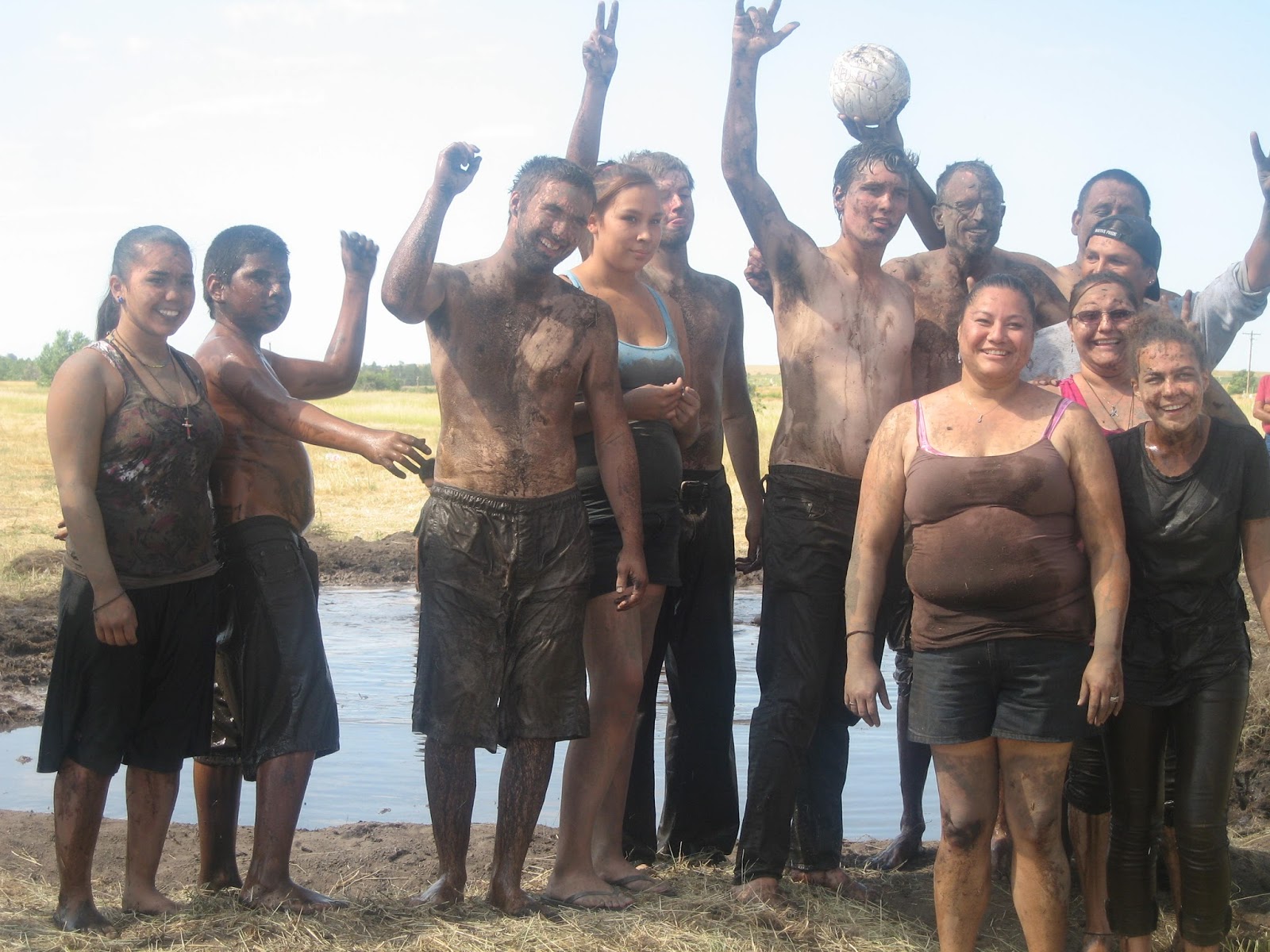
One of the openings was a mud volleyball game at the Eagle’s Nest District Pow Wow.  Our $50 entry fee
made way for a filthy four games of fun and laughs.  We ended up winning the $100 pot, and contributed that to the local youth program.  Something else happened that gave pause for reflection and consideration.  While playing, some of the local youth threw mud at us, at times with rocks mixed in.  One of our players got hit in the eye.  We asked the kids to stop.  They didn’t.  We asked some of the adults to intervene.  They did, but the kids returned and continued sporadically. To the credit of the Workcampers - and perhaps to the credit of the pacifist teachings that come from Quakerism - there was no consideration of reacting with violence or in-kind.

Over the next few days, we had some conversations about this experience.  We struggled to overcome our egos (“Why would they do this to me?  I’m a good person, and I’m here to help”), and as we did, we got to deeper conversations. For example:
·         We often find it understandable and excusable for an oppressed and abused community to exact revenge (a la much of what I hear about Palestinian violence against Israelis as “understandable”).  However, when we represent that power, and find ourselves vulnerable, it feels very different.  The fact is, we have benefited from oppression and exploitation.  Our experience this day was a taste of what many Lakota feel every day – especially when they venture off the Rez.  It was a real eye-opener about power and privilege.
·         In talking with Dwayne about this situation, he affirmed that we acted in the right way.  We did not have the leverage to do more – other than leaving the game, but we were having too much fun.  We could have yelled at the kids, but that would have further agitated the divide.  We were already the outsiders.  But Dwayne also said that if he were there, he would have come down hard on the kids and the adults.  As a member of the community, he could. 

We often talk about Quaker Workcamps as opportunities for experiential learning.  I learned more about power and privilege because of this.  And I am affirmed that change comes from within.  We were the outsiders, but because of how we were in this game, perhaps when we return we will be a bit less so.  

Monday, April 29, 2013

From "I'm Shy" to "Let's Dance" in 60 Seconds

Last week, we hosted two separate groups for a day of Workcamps.  One group was made up of 12 students from China who had just graduated high school there and were part of a cultural exchange program before heading to college (some in the US, but most back in China).  This group arrived early and headed out to work on the beginnings of a project to turn a neglected bit of land into a healthy community space with a tiered rain garden, community garden and basketball court (this will be a project we will be a part of for the next few years).

The other group, from Harford Friends School in MD, consisted of the entire 8th grade class (all six of them), their Head of School, and one of the parents.  They proceeded to go from William Penn House to assist a remarkable woman, Janey Boyd, who has been addressing the problems of hunger in DC since the 1950's. Their work this day was to help unload food that had been gleaned from a local farm and package it for families to pick up at the school where the truck met the group, illustrating the fact that there is good nutritional and fresh food available if we can just get folks to help get it from farm to table.

When it came time to consider what to do for dinner, I thought of simplifying things by having the groups share dinner.  I was a bit unsure how this would play out.  There were differences in both age and culture, as well as language.  But these groups were sharing the house for the night, and Community is one of the testimonies that guides our work at William Penn House, so let's just have faith in it, I thought.
At first, it looked like the groups were going to share food, but sit separately.  I encouraged the Harford students to split in two groups at the tables we have.

"I'm shy" was the immediate response of one of the students, but they took the suggestion anyway.  Within minutes, what was a quiet room with the exception of some subdued Chinese language conversations became a boisterous room as people talked about everything from video games to dance.  The energy and spirit lifted as folks became aware of how much we are not separated by our nations, culture and language, but by how much we are united by our humanity.  I remember in particular, the "shy" student who is a dancer reveling in how she connected with one of the Chinese students who has a passion for dancing as well, and how she really wished she could see him dance.

I know this is just one meal, and who knows what impact it will have.  I do know that transcending one's fear, stepping out of one's comfort zone, and having a wonderful experience can be the building block for doing more of this.  Perhaps one day, the dancers will share that dance.

Wednesday, March 6, 2013

Focus on Material Resources Ignores the Untapped Resource of Compassion

We live in a world that is interconnected.  This is a readily-acknowledged sentiment. From the Christian belief that we are all a part of the body of Christ to the secular understanding that everything from poverty to disease to environment connected, we have many ways to engage in conversation about this largely agreeable fact.  But turning this conversation to unified action is very difficult.  Why?

Because live in a world where attempts to address issues, bring solutions and bring justice are compartmentalized.  Most non-profits focus on specific causes and needs, segregated by income, race, geography, or disease.  The fact that our world is interconnected with each part effecting the other seems to fall by the wayside.  Many of these well-meaning efforts are also deeply entrenched in a bureaucracy that is rigid, resistant to change and is more focused on institutional survival than mission-completion.

I was talking recently with folks about the kind of service and activism we engage in here at William Penn House.  It is always difficult to articulate exactly what we do here in familiar vernacular because we are not focused on one issue or another.  We truly believe that everything is interconnected.  We view our role as nurturing greater consciousness. A few years ago, we embraced the term "radical hospitality" to define our work.  It fits nicely with our belief that there is that of God/goodness in all, and as we build relations based on this deep faith in each other, good things and a more peaceful world emerge.  What this also does is affirm another aspect of a fairly universal belief: all people have  But in the world of social justice and social service with countless compelling issues, especially in a town that has hundreds if not thousands of cause organizations, it can feel isolating.

We also live in a world of finite resources.  The waters that flow around us now are the same waters that have flowed since the dawn of time, albeit now much more toxic and yet needing to nourish more people than ever.  Our capacity to absorb garbage is seriously limited.  The fossil fuels that take thousands of years to create are being depleted within decades.  We also work against ourselves with health issues - making healthcare extremely expensive while supporting unhealthy nutrition and health habits, and not using all the resources (such as self-testing for HIV) to encourage people to do for themselves what they can, instead fostering a dependency on others.  We basically keep going back to this notion that we have endless pockets of material reserves, that we can talk about the needs magically meeting the needs of others while continuing with our own over-consumption.

But there is a resource that is unlimited - our capacity to care for and love each other, and to do so with at least an effort of grace, rather than ego.   In attempting to live this way, I have also learned to appreciate a Jewish way of doing things that is build on concentric circles: we start in our immediate surroundings, tendign to the things closest to us (such as the environmental work in our backyard, being in fellowship at Capitol Hill Methodist Church's morning breakfast with many who are unhoused) and going out from there, never ending but not starting with a vision fixed on a far-away place that ignores those around us.

In doing this, we really see how it all is interconnected.  Tapping into these limitless resources of compassion that is good work, even if it does feel lonely at times in a society where material things continue to be the idols of worship.

Wednesday, January 23, 2013

What Workcamps mean to me


Thoughts on relationships and the Workcamp experience
by Mark Sundermeyer

In its truest form, a work camp is something that goes beyond providing a service. Far too often service is viewed as doing something to help someone, when the reality of the benefit is mutual and harmonious. When we look beyond the simple task of service, when we create meaningful and lasting relationships with those that we work with, those relationships color our view of the world and our place within it. 

  1. Relationships
Building relationships with the people that we are working for and with is the heart of the Workcamp experience, without it, Workcamps are simply physical acts of service. Through several trips to Caretta, West Virginia, I developed relationships with some of the people we were working with, relationships with people that I would never have imagined I would come into contact with, much less become friends with. These relationships transcended any preconceived notions that I may have had about the people of Caretta and caused me to look inward and examine how I fit in with this group of people. Surprisingly, I had very little trouble feeling at one with the community. It became clear to me that there was very little difference, if any between the people of Caretta and myself. This realization is paramount to the Workcamp experience and one that is directly in tune with Quaker philosophy. Building relationships with those that we work with allows us to see that of God in everyone, including ourselves.
  1. Bearing Witness
Another key aspect of the Workcamp is the simple experience of immersing oneself in another person’s life and struggles. This may be the most underrated part of the Workcamp, and does not require a physical outcome, but is surely a powerful component. In my trips to New Orleans in the aftermath of Hurricane Katrina, I began to notice that simply viewing someone’s struggle could be affirming to even the most devastated victim. I am reminded of a sign I saw in the lower 9th ward that read,
“This is what has happened to us,
We have lost loved ones and our homes,
See this devastation and know that this is our struggle.”
People’s struggles go unnoticed in the blur of news media that engulfs us everyday. Simply acknowledging the depths and seriousness of people’s struggles is something that ties directly into our relationships with the people that we work with. If we cannot understand what other people have been through, then the work we do is nothing more than a favor. When we bear witness, we can begin to see parallels to our own lives. It is not a belittling parallel, but rather a unifying experience that solidifies our relationships. To bear witness is not limited to struggles; bearing witness is a holistic practice that includes seeing the joy in people’s lives as well. When we can truly understand each other, our sorrows, our joys, then we can begin to create meaningful relationships. This is the power of the Workcamp.  
Through the experience of creating relationships and bearing witness in service, the Workcamp gains meaning on an internal level. When service is no longer viewed as something that is done to someone else, but as a mutual exchange of experience, both parties leave the Workcamp changed and with a better understanding of their selves and one another. This change may not be predictable but it surely is a strong one. For me, this change was a gradual awareness; I began to see in my life in a different light over the course of many Workcamps as I built relationships with people and places. To the best of my ability, I began to see people as they truly were, not defined by a single struggle, but as a whole person. When Workcamps focus on building meaningful relationships and bearing witness, i.e. working in a place for more than a day, and not just painting or building, then the outcome of the Workcamp will be such that people will naturally be drawn to service, a truer service, one that would be immediately relevant and powerful in their lives.

Wednesday, December 5, 2012

Israel and Palestinian Peace: What are the goals?

Since returning from the delegation trip to Israel and Palestine in early November, I have given 3 subsequent presentations about what I saw and learned, and included these learnings in a series of other presentations last week on global human rights issues.  Each time I presented and was asked questions, I learned even more about the challenges of advancing human rights in a world of institutional activism that often dehumanizes people by painting groups with broad brushes, blurring vital differences.

As I had learned from speakers in the Mideast, the goals of the peace movements are not clear.  One spokesperson (from the Israeli Coalition Against Home Demolitions) stated that his goal is to keep the hopes of the Palestinians alive "until they figure out what they want."  Then there is the  Boycott, Divestment, Sanctions (BDS) movement that has 3 stated goals, one of which is "Respecting, protecting and promoting the Rights of Palestinian refugees to return to their homes and properties as stipulated in UN Resolution 194", which was written in 1948. (The Kairos Palestine Document echoes the same sentiment.)  But there is disagreement among the BDS leaders about what this means.  One co-founder stated unequivocally that this means he has the right to get his grandparents property back and kick all the people who have lived their for as much as 3 generations.  Another leader stated that this is not a realistic goal in the 21st century but should be the spirit in which negotiations are made.  I personally suspect that "right of return" is no more likely than Rapid City, SD being given back to the Lakotas, but I also have not heard much conversation about how this would play out.  For some it seems to be the goal, and for others it's an absolute deal-breaker.

Then, yesterday, there was this posting by a Quaker from Annapolis who is living in the Mideast.  He wrote about the "Principles of Peace", part of the Geneva Accord that is supposed to be the model for peace between Israelis and Palestinians.  The first of these principles is "End of Conflict; End of All Claims."  This is the kicker among peace advocates for this region: there is a global, widespread call for peace and justice, including from Israelis and Palestinians.  But does this vision of peace include "End of All Claims" or "Right of Return"?  If it's the latter, does this include not only Palestinians displaced in 1948, but Jews from Hebron who were relocated to Jerusalem by the Brits in 1929 with a promise of right of return?

A conservative friend of mine said to me recently he is fascinated by how the desire for peace in the Mideast is dividing liberals.  I am increasingly believing it is because we can get caught up in movements that, on the surface, simply want peace but actually have very different views of what that looks like.  "End of All Claims" or absolute "Right of Return" are gulfs apart.  By signing on to the BDS movement, we are being asked to endorse "Right of Return" whether we know it or not. It's unfortunate.  I think we could rapidly find greater harmony in pushing for bringing an end to the settlements, home demolitions and occupations, and for equality for Palestinians in Israel (the other 2 goals of the BDS movement), but we have to be diligent and aware of what is being attached to this. Many good bills in our own congress are shot down because of suspect attachments.  "Right of Return" plays the same role in peace efforts for the Mideast.

Tuesday, November 6, 2012

Faith, Hope and Love: Closing Reflections from Israel/Palestine

At our last delegation meeting last Friday afternoon, we had lunch with Rev. Dr. Mitri Rahib, one of the writers of the Kairos Document.  This document was written by Palestinian Christian leaders in the model of the Kairos South Africa Document bringing together peace makers to address oppression and apartheid.

During the lunch - in a beautiful setting in Bethlehem - Dr. Rahib quoted from Corinthians that "there are these three things that endure: Faith, Hope and Love."  He went on to reflect that faith - more specifically the institutions of religion - are at the core of much of the violence we have seen throughout the world. He comments as well that love becomes increasingly challenged in the face of violence and oppression.  Hope, however, "is not what we do, but what we see."  

As I look back on my time in this beautiful land with all its conflicts and desires - human, cultural, economic, religious and political - it is where there were voices of hope that I remember being most energized.  It is not that these folks could not see the what was going on around them; in many ways I think they could see more clearly what was going on.  But through all this, they saw hope.  It was not that they could hope or wish their realities away (from the kibbutz within missile range of Gaza to the olive farmer in Birqeen); it was their insistence on not giving into anger and despair - committing to welcoming people in while reaching ever-further out.  They shared a wisdom that our politicians are not our messiahs (a lesson to remember on this election day in comparison to what many felt four years ago.)

Now that I am back in DC and sifting through the emotional, intellectual and spiritual rubble of the past two weeks, I want to put my energy into those places that see hope, not problems and solutions that I suspect will lead to more conflict if they lack hope.  There is going to have to be lots of give and take in this epic struggle over there.  For those of us here in the states, it might also be a good opportunity to practice seeing hope here at home, no matter how things play out today.  If we can't practice it here, what can our realistic expectations be over there?

Thursday, November 1, 2012

Visible and Invisible Walls of Oppression

  • 25% higher high school dropout rates
  • Huge standardized test performance discrepancies, often reflecting a cultural bias
  • Discrepancies in unemployment and pay rates
  • Few opportunities to escape oppression but with a gun, either in crime or military service
  • Pervasive militarism
  • Unjust and unequal uses of the legal and penal system to perpetuate cultural and real violence
These are some of the common narratives that have been told here in Israeli/Palestine.  Before I proceed further, let me clearly state that this posting is not to excuse any bad and abusive atrocities by the Israeli Military or settlers against Palestinians. But as I hear these tails of injustice, I can't help but think we have these same narratives in the US, and by not seeing these, we are going to be challenged to get to the root causes of division that lead us all the way through the spectrum of violence.

When I have mentioned this to some people in the delegation, they say "well at least we have laws to prevent this in the states."  This provides absolutely no comfort to me.  It feels like we are saying "sorry our society is so unjust, abusive, violent and prejudiced, but we will give a pass on accountability because we mean well."  To take comfort in laws while ignoring the outcomes misses the real hard work - the same work that we seem to be expecting to be done in Israel, as if we are better practitioners.  Our walls in the states are just as entrenched, just more invisible.  Here's my take on how our walls of segregation and prejudice play out in the states, despite our laws:
  • Laws are one thing.  Enforcement and access to laws is another.  Basically one's ability to have the law work for them has a direct connection to how much money they have to pay a good lawyer.  The economic injustice prevails.
  • We may not have blatant walls and checkpoints, but we have rivers, tunnels, bridges and trains.  These often serve as real and symbolic barriers to segregation and access, and used in a myriad of ways.  In DC, there is the "east of the river" concept.  Train stops, as another example, are sometimes lacking (in the case of Georgetown) to keep some people out, while in other places in DC make getting to a low-paying job an ordeal.  
  • Inner-city violence and rural drug addiction have a direct connection to poor funding for schools, high unemployment and racism/elitism (consider how we classify people in the Appalachias as "hicks").
  • Our prison system is another tool of legalized segregation and injustice, where blacks account for 44% of the incarcerated population.  Those corrupt corporate elite who ruin countless lives in the name of greed walk freely (and in luxury), while those who suffer from their greed are stuck in cycles of violence, abuse, unemployment, addiction and debt all over the country. 
  • The cultural violence is also reflected in higher suicides and murders in many places or among certain groups.  The government/military doesn't have to do it because we do it to ourselves while the rich and powerful thrive.
  • Military indoctrination?  Considering that military service is one of the last remaining ways youth can escape the cycles of poverty in their communities all over the world, we have that.  Furthermore, we don't call people dedicated to breaking the cycles of violence in the name of peace "heroes"; we save that for the troops, and do it persistently in everything from sports announcements to priority boarding on airplanes.  Americorps folks don't get that. 
  • While we don't have home occupations and settlements, we do have predatory loans, right of public domain, and suburban expansionism into rural communities that often displace people.  One Palestinian farmer here, for example, turned down a "name your price" offer for his farm.  He could have been rich.  He chose to stay and fight in a very peaceful and honorable way.  It's inspiring, and I wish more in the states would be so principled, but he also could have been rich.  To me, this is less an example of a victim as a noble person.  
This is not a "tit-for-tat" issue to me.  It's an attempt to normalize the all-too-common narrative that takes place in Israel/Palestine, Washington DC, West Virginia, New Orleans, Pine Ridge, you name it.  Internationally, I see the same in rural Kenya.  The oppressor has a foot on the neck of the oppressed.  In places like the US, it is done so brilliantly that we hardly notice it.  This is not meant to say "so just accept it", but to say "let's unite."  To say "at least we have better laws" does not promote that unity.  Let's not look at the laws; let's look at the outcomes and come together with greater passion and wisdom that we are all in this fight together.   I believe the change will come when we stop competing for who has the greatest victim narrative.  When those of us in places of privilege deem that the suffering of a group across the oceans is worse than that of those around us, it raises questions and concerns about what we are saying about the value of all people.  However, when truly start relating as equals with a commitment to move forward together, that's when I think we will see our way to greater global justice.

Tuesday, October 30, 2012

War, Peace and Flipping Coins


On Monday evening (Oct. 29), our IFPB delegation split up into small groups and spent the night with host families in the ancient walled city of Acco on the Mediterranean.  My travel roommate, Deklan, and I were staying with the family of Yosef a few blocks from the water.  We were joined by Laura and Art who were staying with Yosef’s brother, Ahmed, closer to the water.  The dinner conversation was lively, as we bantered back and forth about historical facts and comparative narratives of injustice and violence – present as well as historical – all around the world. 

After dinner, Deklan, Yosef and I went for a walk.  Deklan asked Yosef how he thinks things will unfold between the Palestinians and Israelis.  “War” was his calm, somewhat sad, answer.  For him it is clear that the only way to avoid war is to return to the 1967 borders but is not going to happen.  He was clear that he does not want war, but he just doesn’t see an alternative.   I reflected my own faith that where there are signs of hope, we can help lessen the violence.  Deklan’s stance was that the Israelis simply need to stop with the lows and policies that keep the Palestinians as second class (or worse) citizens.  It’s as easy as “flipping a coin”, he said. 

“War, Peace or a coin toss”, mused Yosef.  I am increasingly thinking that it is going to be some combination of all of these.  There is already violence – blatant as well as systemic – and to reverse these will take effort and certainly some luck. If, as Yosef said, there will be no peace until there is a return to the 1967 borders, there is no way there without the upheaval of at least 500,000 settlers, many of whom are not likely to go peacefully and will be backed by many Israelis.  At the same time, many Palestinians are not enamored with their own leadership, so even if the Palestinians were to gain autonomy, I would expect a battle for power from within as well.  And then, of course, there is the insidious systemic nature of violence, as evidenced y the US-supported military destruction followed by US-funded rebuilding.  It’s a great economic machine.  It’s a mess.

As I start to reflect on my time here, I don't see groups of people.  I see the faces of individual humans, many of whom are caught up in the daily challenge of human survival.  I am awed by the beauty and the passions in these individual struggles, while shuddering at our capacity to dehumanize each other to the point of annihilation in some cases.  There is Yosef, with his exasperation of  constant arrests and harassment for speaking out but also his friendly hospitality.  There is his wife, and her somewhat defensive and unnecessary statement that Palestinians just want to support life.  There is 23-year old Mahmoud’s spirit of hope for the future while including me in a Palestinian bachelor party with festive music and dancing.  There are the sincere desires and demonstrations of a commitment to find a peaceful way forward from the members of kibbutz communities.  There are Roi and Rwan, a Jew and a Palestinian (his grandparents came to Israel in the 1930's because of anti-semitism in one case and zionism in the other; her grandparents village was wiped out in 1948) working together to bring cross-cultural learning to Jewish and Arab schools as part of their work at the Arab-Jewish Community Center in Tel Aviv.  There are organizations creating new ways forward through theater and community outreach.  And then there are people who hate, fear, resent or wish to harm the neighbor they don’t know.   

I have hope that, if we stay connected and keep acting in ways that support the common humanity of each other through the upheavals, we can come back together as a stronger global community.  Just as I believe will happen in the US as we struggle with all our various prejudices and practices of injustice past and present, my hope is that our descendants can sit around the dinner table, sharing meals from all our faiths and cultures,  celebrate each other rather than try to lord over each other, and look to the past wondering "what the heck were they thinking?"  Yes, it’s ideal, but we can start practicing now so when the opportunity comes, we are ready.  As Whitney Young said “it’s better to prepare for the opportunity that may not come, then to have an opportunity emerge, and not be prepared.”