Showing posts with label culture. Show all posts

Tuesday, February 4, 2014

Macro-Change Starts at the Micro-Level

Over the weekend, I was talking with a good friend about politics, justice and equality issues.  We come at things from very different angles politically and policy-wise, but we know that we want the same things in the world - less conflict, less injustice, more opportunity, more equality.  As we were talking, Mike (not his real name) kept citing data showing that many of the social programs (mostly in education - Head Start, college funding programs) are simply not producing positive outcomes.  We shared sentiments that there is too much bureaucracy and there is too much self-interest from professional organizations, lobbyists and politicians, and once programs are established, the cultural dependency often overlooks outcomes while keeping the funding going.  Mike kept referring to the fact that government-funded programs need to support programs that are proven to bring about change on the macro-level, and the simple fact is that many of our entrenched programs - many of which seemed like great ideas - are not producing the outcomes to justify their continued funding and policy control.

So much of this certainly resonates with my experiences.  I've seen first-hand a deeply-entrenched bureaucracy dictating policy and operating a rigid paradigm in AIDS services.  What I realized, as we were talking and finding that we were not in sync, is that we were talking at different elevations.  Mike stated that new ideas can get funded to ramp up if they are proven to work on a small scale.  While I know this is true, to be able to even get these preliminary outcomes requires a level of funding and administration that small organizations don't have.  Effectively, to implement totally new ideas requires a funding that few innovators have.

“Yesterday I was clever, so I wanted to change the world. Today I am wise, so I am changing myself.” - Rumi


More importantly, though, was recognizing that, while we absolutely need macro-level change - in education, in energy, in environment, in jobs and income - this change does not start at the macro-level.  It starts at the micro-level - with individuals, small groups.  You. Me.  It is at the macro-level that we can measure the success of the effort, but it is the individual action that the change really takes root.  Taking two issues of the day as examples:
  • Energy: As the Keystone Pipeline seems to be nearing approval the voices start to rise up against it, out of concern for the environment as well as the land rights of the Lakota.  But just as I saw after the BP blowout in the Gulf a few years ago, the focus is on the high-level of national and international policy.  To date, I have yet to see a call for less consumption to go along with this, and our consumption is just as complicit in the problem as is greed of the stockholders.  I remember the days when we were encouraged to lower our thermostats, and to "drive 55" not for safety but for fuel efficiency.  These days, the call for sacrifice in combination with better policy seems lacking. 
  • HIV/AIDS: Bank of America and U2 join forces during the Super Bowl evening to give $1 for every free download of U2's latest song (although, if you look at the fine-print, there was a $2 million - a drop in the bucket for BofA and certainly provides great publicity and revenue for both BofA and U2).  The people downloading a free song were feeling good that they were making a difference - by getting something for free.  All in the name of ending AIDS.  Except for one thing.  Not one message to encourage people to know their status, to act or think different. What a lost opportunity.  It is rare that you would have such a wide audience and could really change the message or at least challenge the status quo - raise the conversation, make people think.  Kudos to Coca Cola for doing just that with their ad.  
In both these cases, it may be true that we need more funding and/or better policy that considers the potential environmental impact.  But no matter what the policy - the macro-level work - it is ultimately going to take each one of us to DO differently as individuals on a mass scale - that will bring the change to that macro-level.
-Brad Ogilvie

Thursday, August 8, 2013

Pine Ridge, 2013: Reflections of power, privilege, peace and service

“Welcome Home.” 


This was how Dwayne, one of our hosts in Wanblee, greeted me.  This was my fourth trip to Wanblee and it is becoming a spiritual home of sorts.  It is becoming an important annual ritual that takes me out of my routine, and brings old and new acquaintances together in a deep and spiritual way.

This year, we had a great few weeks helping Earth Tipi work towards a model of sustainability on the Rez, and reconnecting with friends as we helped prepare for the Sundance.   We created a space to practice what we preach, and to work through the physical, emotional and interpersonal challenges in a safe, loving and trusting environment.  Through conversation, action, silence and reflection, we practiced grace, putting the ego aside. We went as way opened. 

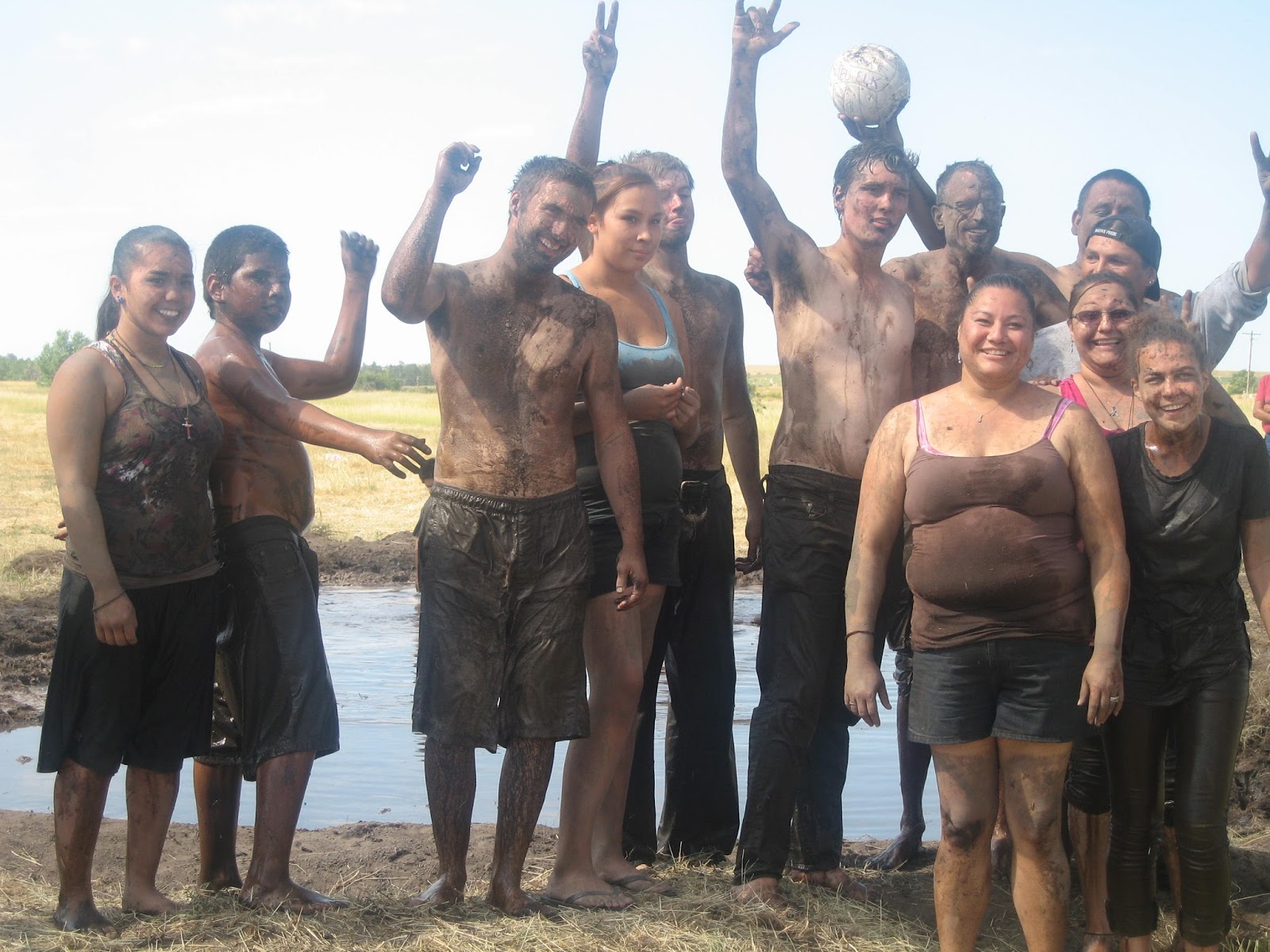
One of the openings was a mud volleyball game at the Eagle’s Nest District Pow Wow.  Our $50 entry fee
made way for a filthy four games of fun and laughs.  We ended up winning the $100 pot, and contributed that to the local youth program.  Something else happened that gave pause for reflection and consideration.  While playing, some of the local youth threw mud at us, at times with rocks mixed in.  One of our players got hit in the eye.  We asked the kids to stop.  They didn’t.  We asked some of the adults to intervene.  They did, but the kids returned and continued sporadically. To the credit of the Workcampers - and perhaps to the credit of the pacifist teachings that come from Quakerism - there was no consideration of reacting with violence or in-kind.

Over the next few days, we had some conversations about this experience.  We struggled to overcome our egos (“Why would they do this to me?  I’m a good person, and I’m here to help”), and as we did, we got to deeper conversations. For example:
·         We often find it understandable and excusable for an oppressed and abused community to exact revenge (a la much of what I hear about Palestinian violence against Israelis as “understandable”).  However, when we represent that power, and find ourselves vulnerable, it feels very different.  The fact is, we have benefited from oppression and exploitation.  Our experience this day was a taste of what many Lakota feel every day – especially when they venture off the Rez.  It was a real eye-opener about power and privilege.
·         In talking with Dwayne about this situation, he affirmed that we acted in the right way.  We did not have the leverage to do more – other than leaving the game, but we were having too much fun.  We could have yelled at the kids, but that would have further agitated the divide.  We were already the outsiders.  But Dwayne also said that if he were there, he would have come down hard on the kids and the adults.  As a member of the community, he could. 

We often talk about Quaker Workcamps as opportunities for experiential learning.  I learned more about power and privilege because of this.  And I am affirmed that change comes from within.  We were the outsiders, but because of how we were in this game, perhaps when we return we will be a bit less so.  

Tuesday, June 25, 2013

Reflections from West Virginia: Energy, Army and Opportunity

Last week, Washington Quaker Workcamps led the annual Sidwell Friends School Workcamp to Caretta, WV to work with Big Creek People in Action, partnering once again with the great folks from Upshur Helping Hands from Buckhannon, WV.
 It was another great week of fun, fellowship, hard work, community-building, deep conversations, love, and learning - all the things that create opportunities for on-going bridge-building across economics, faiths, and geography as we do what we can to promote global community visions and action that belie notions of socio-poltical-economic "bubbles" that really do not exist.

As with all Workcamps, each person has a different experience, high point, or takeaway.  One of the biggest ones for me this year is this:
One evening, Chester Ball made his annual visit to perform, entertain and engage the group in music, games and dance.  This year, he brought with  
him three teens and one pre-teen.  The teens played guitar and sang with Chester - part of his way of preserving a music tradition from this troubled region while nurturing positive activities for youth.  At one point during the evening, I sat with the teens to thank them for coming and to learn more about them.  When asked about post-high school goals, the female among the teens stated she planned to go to cosmetology school.  The males all stated that they planned to either work "in coal" or join the Marines.  I asked whether they wanted to go to the Academy or enlisted; they all said they wanted to go enlisted so they could get to the front lines fully armed and ready to fight.  Coal or Army.  That was it as far as options.  College is prohibitive because of rising costs as well as the fact that they live in a community that does not nurture the pursuit of higher education.    

As I engaged with fellow program participants in sharing this conversation, it led to even more conversations. The wonderful thing about conversations as opposed to arguments and debates is that conversations seem to lead to new insights.  One such insight I had was the irony that, in the circles I tend to float in, there is a unified sense that coal and the military are bad.  The military often is engaged in fights to protect and acquire
Testing a coal tram
fossil fuels (notably, oil), and what we need to be doing is steering people to careers in sustainable and renewable energy.  The ironic part is that the military is starting to step up in a big way in developing alternative energies, with the goal of having 50% of its energy come from sustainable/renewable sources by 2025.  

It's a dilemma.  We want to be a part of creating opportunities as well as supporting people in following their leadings.  At the same time we know that better stewardship of human and natural resources is vital to a healthy world.  For these young men, their leadings right now are to coal and/or the military.  When it comes to renewable energy, we know that coal is not the way, but the military does open that door.  I don't see easy answers, but if I did, then it would not be a dilemma.  I do find that these Workcamp experiences create opportunities to become more open to creating a safe space and talking about the issues rather than choosing sides and fueling partisanship.  Last week affirmed that.  

Monday, April 29, 2013

From "I'm Shy" to "Let's Dance" in 60 Seconds

Last week, we hosted two separate groups for a day of Workcamps.  One group was made up of 12 students from China who had just graduated high school there and were part of a cultural exchange program before heading to college (some in the US, but most back in China).  This group arrived early and headed out to work on the beginnings of a project to turn a neglected bit of land into a healthy community space with a tiered rain garden, community garden and basketball court (this will be a project we will be a part of for the next few years).

The other group, from Harford Friends School in MD, consisted of the entire 8th grade class (all six of them), their Head of School, and one of the parents.  They proceeded to go from William Penn House to assist a remarkable woman, Janey Boyd, who has been addressing the problems of hunger in DC since the 1950's. Their work this day was to help unload food that had been gleaned from a local farm and package it for families to pick up at the school where the truck met the group, illustrating the fact that there is good nutritional and fresh food available if we can just get folks to help get it from farm to table.

When it came time to consider what to do for dinner, I thought of simplifying things by having the groups share dinner.  I was a bit unsure how this would play out.  There were differences in both age and culture, as well as language.  But these groups were sharing the house for the night, and Community is one of the testimonies that guides our work at William Penn House, so let's just have faith in it, I thought.
At first, it looked like the groups were going to share food, but sit separately.  I encouraged the Harford students to split in two groups at the tables we have.

"I'm shy" was the immediate response of one of the students, but they took the suggestion anyway.  Within minutes, what was a quiet room with the exception of some subdued Chinese language conversations became a boisterous room as people talked about everything from video games to dance.  The energy and spirit lifted as folks became aware of how much we are not separated by our nations, culture and language, but by how much we are united by our humanity.  I remember in particular, the "shy" student who is a dancer reveling in how she connected with one of the Chinese students who has a passion for dancing as well, and how she really wished she could see him dance.

I know this is just one meal, and who knows what impact it will have.  I do know that transcending one's fear, stepping out of one's comfort zone, and having a wonderful experience can be the building block for doing more of this.  Perhaps one day, the dancers will share that dance.